

186
under more extreme climate projections, the potential for production of single sex
cohorts. These changes are likely to reduce the viability of turtle populations
(Fuentes et al. 2012). Consequently, knowledge of the primary sex ratio of populations with TSD is key for providing a baseline to inform management strategies and
accurately predict how future climate changes may affect turtle populations.
However, there is a lack of robust data on offspring sex ratio at appropriate temporal
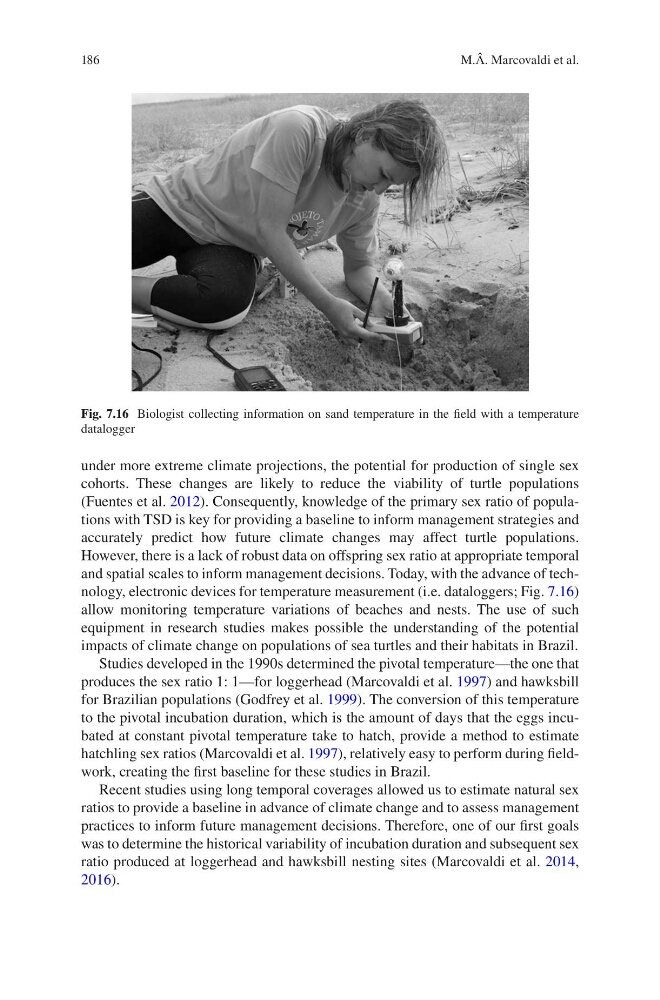
and spatial scales to inform management decisions. Today, with the advance of technology, electronic devices for temperature measurement (i.e. dataloggers; Fig. 7.16)
allow monitoring temperature variations of beaches and nests. The use of such
equipment in research studies makes possible the understanding of the potential
impacts of climate change on populations of sea turtles and their habitats in Brazil.
Studies developed in the 1990s determined the pivotal temperature—the one that
produces the sex ratio 1: 1—for loggerhead (Marcovaldi et al. 1997) and hawksbill
for Brazilian populations (Godfrey et al. 1999). The conversion of this temperature
to the pivotal incubation duration, which is the amount of days that the eggs incubated at constant pivotal temperature take to hatch, provide a method to estimate
hatchling sex ratios (Marcovaldi et al. 1997), relatively easy to perform during fieldwork, creating the first baseline for these studies in Brazil.
Recent studies using long temporal coverages allowed us to estimate natural sex
ratios to provide a baseline in advance of climate change and to assess management
practices to inform future management decisions. Therefore, one of our first goals
was to determine the historical variability of incubation duration and subsequent sex
ratio produced at loggerhead and hawksbill nesting sites (Marcovaldi et al. 2014,
2016).
Fig. 7.16 Biologist collecting information on sand temperature in the field with a temperature
datalogger
M.Â. Marcovaldi et al.
under more extreme climate projections, the potential for production of single sex
cohorts. These changes are likely to reduce the viability of turtle populations
(Fuentes et al. 2012). Consequently, knowledge of the primary sex ratio of populations with TSD is key for providing a baseline to inform management strategies and
accurately predict how future climate changes may affect turtle populations.
However, there is a lack of robust data on offspring sex ratio at appropriate temporal
and spatial scales to inform management decisions. Today, with the advance of technology, electronic devices for temperature measurement (i.e. dataloggers; Fig. 7.16)
allow monitoring temperature variations of beaches and nests. The use of such
equipment in research studies makes possible the understanding of the potential
impacts of climate change on populations of sea turtles and their habitats in Brazil.
Studies developed in the 1990s determined the pivotal temperature—the one that
produces the sex ratio 1: 1—for loggerhead (Marcovaldi et al. 1997) and hawksbill
for Brazilian populations (Godfrey et al. 1999). The conversion of this temperature
to the pivotal incubation duration, which is the amount of days that the eggs incubated at constant pivotal temperature take to hatch, provide a method to estimate
hatchling sex ratios (Marcovaldi et al. 1997), relatively easy to perform during fieldwork, creating the first baseline for these studies in Brazil.
Recent studies using long temporal coverages allowed us to estimate natural sex
ratios to provide a baseline in advance of climate change and to assess management
practices to inform future management decisions. Therefore, one of our first goals
was to determine the historical variability of incubation duration and subsequent sex
ratio produced at loggerhead and hawksbill nesting sites (Marcovaldi et al. 2014,
2016).
Fig. 7.16 Biologist collecting information on sand temperature in the field with a temperature
datalogger
M.Â. Marcovaldi et al.