

7
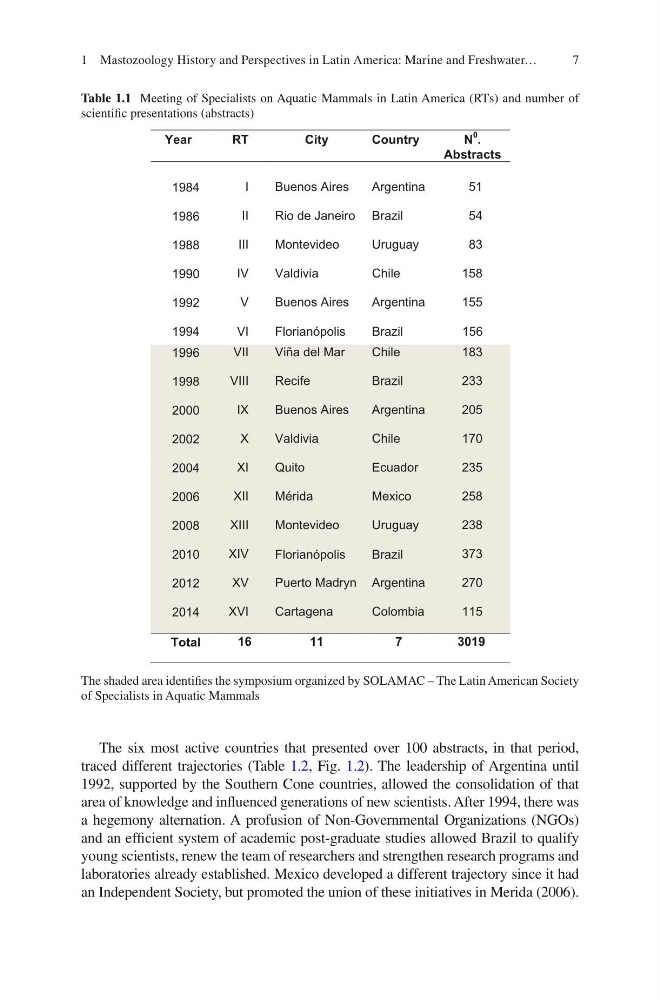
The six most active countries that presented over 100 abstracts, in that period,
traced different trajectories (Table 1.2, Fig. 1.2). The leadership of Argentina until
1992, supported by the Southern Cone countries, allowed the consolidation of that
area of knowledge and influenced generations of new scientists. After 1994, there was
a hegemony alternation. A profusion of Non-Governmental Organizations (NGOs)
and an efficient system of academic post-graduate studies allowed Brazil to qualify
young scientists, renew the team of researchers and strengthen research programs and
laboratories already established. Mexico developed a different trajectory since it had
an Independent Society, but promoted the union of these initiatives in Merida (2006).
Year
R T
City
Country
N
0
.
Abstracts
1984
I
Buenos Aires
Argentina
51
1986
II
Rio de Janeiro Brazil
5 4
1988
III
Montevideo
Uruguay
83
1990
IV
Valdivia
C hile
158
1992
V
Buenos Aires
Argentina
155
1994
VI
Florianópolis
Brazil
1 56
1996
VII
Viña del Mar
Chile
183
1998
VIII
Recife
Brazil
233
2000
IX
Buenos Aires
Argentina
205
2002
X
Valdivia
Chile
170
2004
XI
Quito
Ecuador
235
2006
XII
Mérida
Mexico
258
2008
XIII
Montevideo
Uruguay
238
2010
XIV
Florianópolis
Brazil
373
2012
XV
Puerto Madryn Argentina
270
2014
XVI
Cartagena
Colombia
115
Total
16
11
7
3 019
Table 1.1 Meeting of Specialists on Aquatic Mammals in Latin America (RTs) and number of
scientific presentations (abstracts)
The shaded area identifies the symposium organized by SOLAMAC – The Latin American Society
of Specialists in Aquatic Mammals
1 Mastozoology History and Perspectives in Latin America: Marine and Freshwater…
The six most active countries that presented over 100 abstracts, in that period,
traced different trajectories (Table 1.2, Fig. 1.2). The leadership of Argentina until
1992, supported by the Southern Cone countries, allowed the consolidation of that
area of knowledge and influenced generations of new scientists. After 1994, there was
a hegemony alternation. A profusion of Non-Governmental Organizations (NGOs)
and an efficient system of academic post-graduate studies allowed Brazil to qualify
young scientists, renew the team of researchers and strengthen research programs and
laboratories already established. Mexico developed a different trajectory since it had
an Independent Society, but promoted the union of these initiatives in Merida (2006).
Year
R T
City
Country
N
0
.
Abstracts
1984
I
Buenos Aires
Argentina
51
1986
II
Rio de Janeiro Brazil
5 4
1988
III
Montevideo
Uruguay
83
1990
IV
Valdivia
C hile
158
1992
V
Buenos Aires
Argentina
155
1994
VI
Florianópolis
Brazil
1 56
1996
VII
Viña del Mar
Chile
183
1998
VIII
Recife
Brazil
233
2000
IX
Buenos Aires
Argentina
205
2002
X
Valdivia
Chile
170
2004
XI
Quito
Ecuador
235
2006
XII
Mérida
Mexico
258
2008
XIII
Montevideo
Uruguay
238
2010
XIV
Florianópolis
Brazil
373
2012
XV
Puerto Madryn Argentina
270
2014
XVI
Cartagena
Colombia
115
Total
16
11
7
3 019
Table 1.1 Meeting of Specialists on Aquatic Mammals in Latin America (RTs) and number of
scientific presentations (abstracts)
The shaded area identifies the symposium organized by SOLAMAC – The Latin American Society
of Specialists in Aquatic Mammals
1 Mastozoology History and Perspectives in Latin America: Marine and Freshwater…