

163
6.5 Long-Term Studies
Long-term studies are hard to execute due to scarce resources, logistics, and sometimes additional difficulties to carry out a project continuously over time. However,
we would like to stress out the importance of these studies: they can help us establish baseline knowledge on cetaceans in a particular area, understand habitat use,
seasonal patterns, and others. By having a good baseline it allows us to detect
changes over time, either caused by environmental alterations (gradual or abrupt),
or by human activities. Conservation efforts often require these types of studies to
detect trends in abundance, distribution, as well as changes in behavior. Other kinds
of impact from cumulative and aggregate threats on a population or a species are
also possible by conducting long-term studies, but complementary techniques may
be needed, such as heavy metal analyses, histological studies from stranded animals, etc. In this section, we will go through a successful case study that we are
currently developing in collaboration with other researchers and institutions.
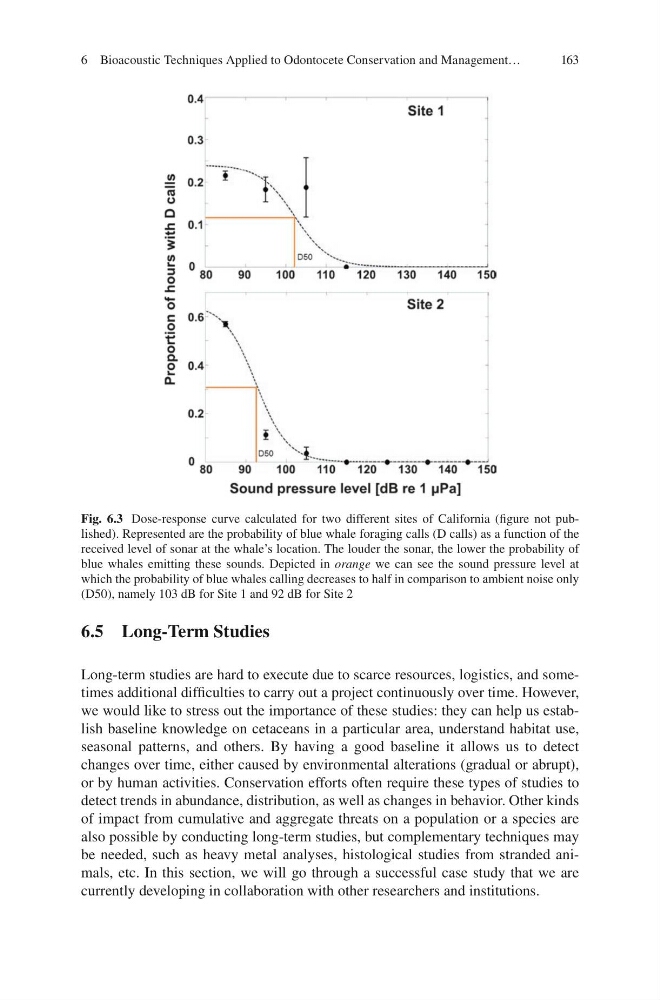
Fig. 6.3 Dose-response curve calculated for two different sites of California (figure not published). Represented are the probability of blue whale foraging calls (D calls) as a function of the
received level of sonar at the whale’s location. The louder the sonar, the lower the probability of
blue whales emitting these sounds. Depicted in orange we can see the sound pressure level at
which the probability of blue whales calling decreases to half in comparison to ambient noise only
(D50), namely 103 dB for Site 1 and 92 dB for Site 2
6 Bioacoustic Techniques Applied to Odontocete Conservation and Management…
6.5 Long-Term Studies
Long-term studies are hard to execute due to scarce resources, logistics, and sometimes additional difficulties to carry out a project continuously over time. However,
we would like to stress out the importance of these studies: they can help us establish baseline knowledge on cetaceans in a particular area, understand habitat use,
seasonal patterns, and others. By having a good baseline it allows us to detect
changes over time, either caused by environmental alterations (gradual or abrupt),
or by human activities. Conservation efforts often require these types of studies to
detect trends in abundance, distribution, as well as changes in behavior. Other kinds
of impact from cumulative and aggregate threats on a population or a species are
also possible by conducting long-term studies, but complementary techniques may
be needed, such as heavy metal analyses, histological studies from stranded animals, etc. In this section, we will go through a successful case study that we are
currently developing in collaboration with other researchers and institutions.
Fig. 6.3 Dose-response curve calculated for two different sites of California (figure not published). Represented are the probability of blue whale foraging calls (D calls) as a function of the
received level of sonar at the whale’s location. The louder the sonar, the lower the probability of
blue whales emitting these sounds. Depicted in orange we can see the sound pressure level at
which the probability of blue whales calling decreases to half in comparison to ambient noise only
(D50), namely 103 dB for Site 1 and 92 dB for Site 2
6 Bioacoustic Techniques Applied to Odontocete Conservation and Management…