

139
(Whitehead 2002; Mellinger and Barlow 2003) as they tend to increase the probability of detecting individuals (Barlow and Taylor 1998, 2005; McDonald and
Moore 2002; Whitehead 2003; Rankin et al. 2008c).
The long and deep dives performed by sperm whales can last approximately 1 h
(Leatherwood et al. 1982; Barlow and Taylor 2005; Watwood et al. 2006). Thus,
individuals spend short periods at the surface, reducing the probability of being
visually detected (Whitehead 2003; Watwood et al. 2006; Ward et al. 2012).
However, this species produces a variety of types of clicks (usual and slow clicks,
creaks and coda), which are used in different contexts such as echolocation and
communication (Zimmer et al. 2005).
According to Barlow and Taylor (2005), sperm whales are most likely to be
acoustically detected among others cetacean’s species. During their foraging dives,
produce regular, audible and short duration clicks (‘usual’ clicks and creaks) with
frequencies ranging from several hundred hertz to over 30 kHz (Watkins 1980;
Gillespie 1997; Weilgart and Whitehead 1988; Madsen et al. 2002; Barlow and
Taylor 2005). Several studies have been increasingly applied passive acoustic monitoring, some of which combined with visual surveys, trying to improve the methods
of localization and density estimation of marine mammals, using sperm whales as a
model (Gillespie 1997; Barlow and Taylor 1998, 2005; Gannier et al. 2002; Hastie
et al. 2003; Leaper et al. 2003; Lewis et al. 2007; Swift et al. 2009; Whitehead 2009;
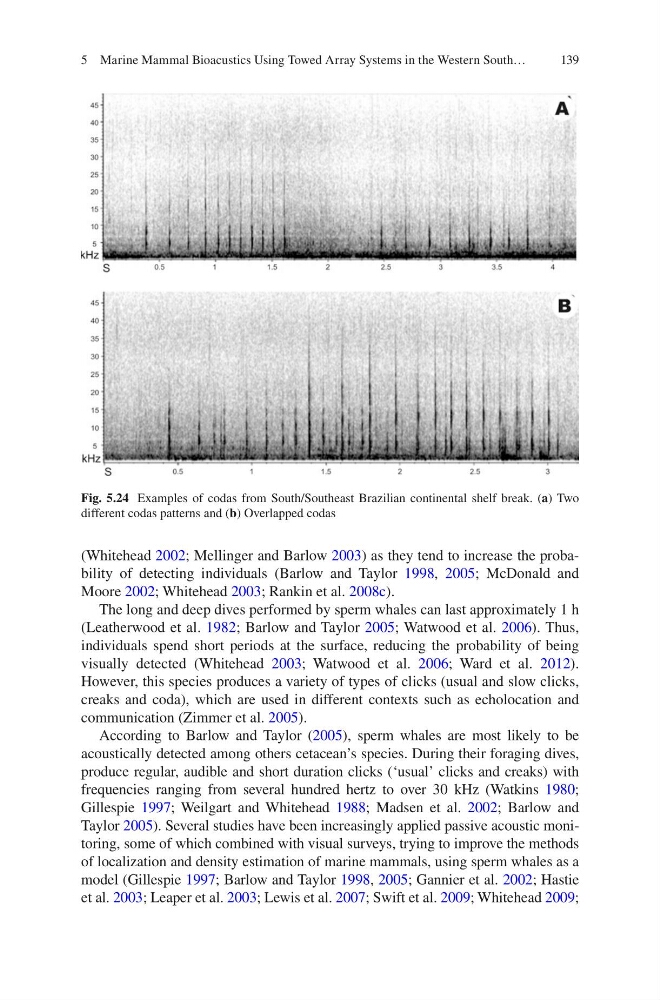
Fig. 5.24 Examples of codas from South/Southeast Brazilian continental shelf break. (a) Two
different codas patterns and (b) Overlapped codas
5 Marine Mammal Bioacustics Using Towed Array Systems in the Western South…
(Whitehead 2002; Mellinger and Barlow 2003) as they tend to increase the probability of detecting individuals (Barlow and Taylor 1998, 2005; McDonald and
Moore 2002; Whitehead 2003; Rankin et al. 2008c).
The long and deep dives performed by sperm whales can last approximately 1 h
(Leatherwood et al. 1982; Barlow and Taylor 2005; Watwood et al. 2006). Thus,
individuals spend short periods at the surface, reducing the probability of being
visually detected (Whitehead 2003; Watwood et al. 2006; Ward et al. 2012).
However, this species produces a variety of types of clicks (usual and slow clicks,
creaks and coda), which are used in different contexts such as echolocation and
communication (Zimmer et al. 2005).
According to Barlow and Taylor (2005), sperm whales are most likely to be
acoustically detected among others cetacean’s species. During their foraging dives,
produce regular, audible and short duration clicks (‘usual’ clicks and creaks) with
frequencies ranging from several hundred hertz to over 30 kHz (Watkins 1980;
Gillespie 1997; Weilgart and Whitehead 1988; Madsen et al. 2002; Barlow and
Taylor 2005). Several studies have been increasingly applied passive acoustic monitoring, some of which combined with visual surveys, trying to improve the methods
of localization and density estimation of marine mammals, using sperm whales as a
model (Gillespie 1997; Barlow and Taylor 1998, 2005; Gannier et al. 2002; Hastie
et al. 2003; Leaper et al. 2003; Lewis et al. 2007; Swift et al. 2009; Whitehead 2009;
Fig. 5.24 Examples of codas from South/Southeast Brazilian continental shelf break. (a) Two
different codas patterns and (b) Overlapped codas
5 Marine Mammal Bioacustics Using Towed Array Systems in the Western South…