

137
length between adults; females reach reproductive maturity about nine meters long
while males at approximately 16 m long. Although they are considered cosmopolitan, the distribution of females and young individuals are restricted to tropical and
temperate deep waters and differs from adult male, which extends their distribution
to polar waters (Whitehead 2009). Few records of sperm whales stranding occur
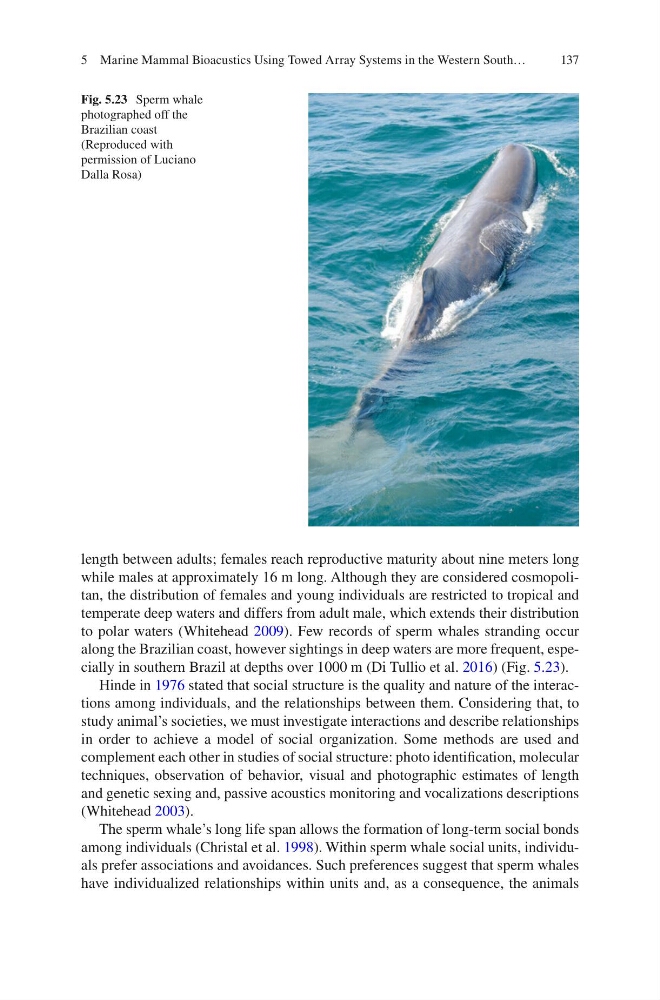
along the Brazilian coast, however sightings in deep waters are more frequent, especially in southern Brazil at depths over 1000 m (Di Tullio et al. 2016) (Fig. 5.23).
Hinde in 1976 stated that social structure is the quality and nature of the interactions among individuals, and the relationships between them. Considering that, to
study animal’s societies, we must investigate interactions and describe relationships
in order to achieve a model of social organization. Some methods are used and
complement each other in studies of social structure: photo identification, molecular
techniques, observation of behavior, visual and photographic estimates of length
and genetic sexing and, passive acoustics monitoring and vocalizations descriptions
(Whitehead 2003).
The sperm whale’s long life span allows the formation of long-term social bonds
among individuals (Christal et al. 1998). Within sperm whale social units, individuals prefer associations and avoidances. Such preferences suggest that sperm whales
have individualized relationships within units and, as a consequence, the animals
Fig. 5.23 Sperm whale
photographed off the
Brazilian coast
(Reproduced with
permission of Luciano
Dalla Rosa)
5 Marine Mammal Bioacustics Using Towed Array Systems in the Western South…
length between adults; females reach reproductive maturity about nine meters long
while males at approximately 16 m long. Although they are considered cosmopolitan, the distribution of females and young individuals are restricted to tropical and
temperate deep waters and differs from adult male, which extends their distribution
to polar waters (Whitehead 2009). Few records of sperm whales stranding occur
along the Brazilian coast, however sightings in deep waters are more frequent, especially in southern Brazil at depths over 1000 m (Di Tullio et al. 2016) (Fig. 5.23).
Hinde in 1976 stated that social structure is the quality and nature of the interactions among individuals, and the relationships between them. Considering that, to
study animal’s societies, we must investigate interactions and describe relationships
in order to achieve a model of social organization. Some methods are used and
complement each other in studies of social structure: photo identification, molecular
techniques, observation of behavior, visual and photographic estimates of length
and genetic sexing and, passive acoustics monitoring and vocalizations descriptions
(Whitehead 2003).
The sperm whale’s long life span allows the formation of long-term social bonds
among individuals (Christal et al. 1998). Within sperm whale social units, individuals prefer associations and avoidances. Such preferences suggest that sperm whales
have individualized relationships within units and, as a consequence, the animals
Fig. 5.23 Sperm whale
photographed off the
Brazilian coast
(Reproduced with
permission of Luciano
Dalla Rosa)
5 Marine Mammal Bioacustics Using Towed Array Systems in the Western South…