

127
investigate other factors handling those geographical differences (Moron et al.
2015) and even extend the comparison to pulsed signals. Therefore, more studies
and partnerships between researchers studying other populations are important to be
better explore and recognize the results found so far.
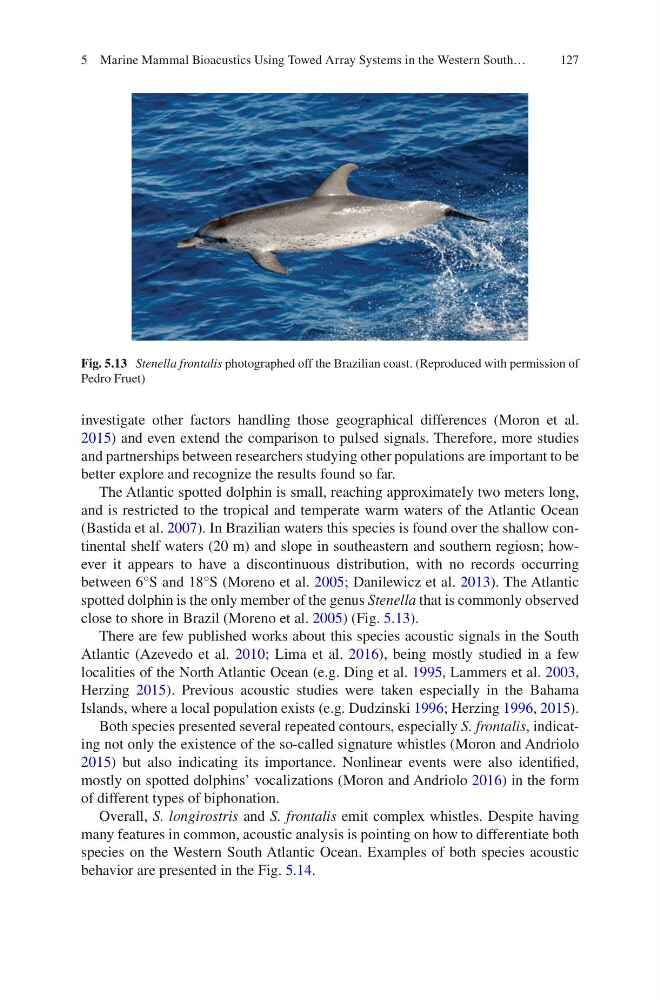
The Atlantic spotted dolphin is small, reaching approximately two meters long,
and is restricted to the tropical and temperate warm waters of the Atlantic Ocean
(Bastida et al. 2007). In Brazilian waters this species is found over the shallow continental shelf waters (20 m) and slope in southeastern and southern regiosn; however it appears to have a discontinuous distribution, with no records occurring
between 6°S and 18°S (Moreno et al. 2005; Danilewicz et al. 2013). The Atlantic
spotted dolphin is the only member of the genus Stenella that is commonly observed
close to shore in Brazil (Moreno et al. 2005) (Fig. 5.13).
There are few published works about this species acoustic signals in the South
Atlantic (Azevedo et al. 2010; Lima et al. 2016), being mostly studied in a few
localities of the North Atlantic Ocean (e.g. Ding et al. 1995, Lammers et al. 2003,
Herzing 2015). Previous acoustic studies were taken especially in the Bahama
Islands, where a local population exists (e.g. Dudzinski 1996; Herzing 1996, 2015).
Both species presented several repeated contours, especially S. frontalis, indicating not only the existence of the so-called signature whistles (Moron and Andriolo
2015) but also indicating its importance. Nonlinear events were also identified,
mostly on spotted dolphins’ vocalizations (Moron and Andriolo 2016) in the form
of different types of biphonation.
Overall, S. longirostris and S. frontalis emit complex whistles. Despite having
many features in common, acoustic analysis is pointing on how to differentiate both
species on the Western South Atlantic Ocean. Examples of both species acoustic
behavior are presented in the Fig. 5.14.
Fig. 5.13 Stenella frontalis photographed off the Brazilian coast. (Reproduced with permission of
Pedro Fruet)
5 Marine Mammal Bioacustics Using Towed Array Systems in the Western South…
investigate other factors handling those geographical differences (Moron et al.
2015) and even extend the comparison to pulsed signals. Therefore, more studies
and partnerships between researchers studying other populations are important to be
better explore and recognize the results found so far.
The Atlantic spotted dolphin is small, reaching approximately two meters long,
and is restricted to the tropical and temperate warm waters of the Atlantic Ocean
(Bastida et al. 2007). In Brazilian waters this species is found over the shallow continental shelf waters (20 m) and slope in southeastern and southern regiosn; however it appears to have a discontinuous distribution, with no records occurring
between 6°S and 18°S (Moreno et al. 2005; Danilewicz et al. 2013). The Atlantic
spotted dolphin is the only member of the genus Stenella that is commonly observed
close to shore in Brazil (Moreno et al. 2005) (Fig. 5.13).
There are few published works about this species acoustic signals in the South
Atlantic (Azevedo et al. 2010; Lima et al. 2016), being mostly studied in a few
localities of the North Atlantic Ocean (e.g. Ding et al. 1995, Lammers et al. 2003,
Herzing 2015). Previous acoustic studies were taken especially in the Bahama
Islands, where a local population exists (e.g. Dudzinski 1996; Herzing 1996, 2015).
Both species presented several repeated contours, especially S. frontalis, indicating not only the existence of the so-called signature whistles (Moron and Andriolo
2015) but also indicating its importance. Nonlinear events were also identified,
mostly on spotted dolphins’ vocalizations (Moron and Andriolo 2016) in the form
of different types of biphonation.
Overall, S. longirostris and S. frontalis emit complex whistles. Despite having
many features in common, acoustic analysis is pointing on how to differentiate both
species on the Western South Atlantic Ocean. Examples of both species acoustic
behavior are presented in the Fig. 5.14.
Fig. 5.13 Stenella frontalis photographed off the Brazilian coast. (Reproduced with permission of
Pedro Fruet)
5 Marine Mammal Bioacustics Using Towed Array Systems in the Western South…