

102
Box 4.3: Humpback Whale at Abrolhos, Brazil
A remaining population of Humpback whales was rediscovered around the
Abrolhos Archipelago in 1988, after the intensive hunting. This population
was estimated in 1.379–1.887animals in 1995 (Kinas and Bethlem 1998), and
the most recent estimate was of 16,410 (CV = 0.228, 95% CI = 10,563–
25,495) animals in 2008 (Bartolotto et al. 2016).
The Abrolhos Archipelago is located 70 km off Caravelas city, southern
Bahia State, Brazil. It is encompassed by the most important reef formation of
the Southwestern Atlantic Ocean. The archipelago is within the first marine
park created in Brazil (IBAMA/FUNATURA 1991).
The Abrolhos Archipelago land-based station project begun in 1997 with a
pilot study that allowed the detailed description of the species ethogram.
From 1998 to 2004, systematic scans and focal follows were conducted daily
along the seasons. This middle-term study indexed temporal patterns of
behaviors, group structure, seasonal and fluctuation of abundance, respiratory
behavior, and calf behavior (Morete et al. 2003b, 2007b, 2008; Petta et al.
2004; Bisi 2006). The “tail-up” was first described, suggesting a culturally
transmitted behaviour (Morete et al. 2003a). The finding that, around the
Abrolhos Archipelago almost 50% of the groups contained calves, demonstrated the importance of the area for nursery (Morete et al. 2003b), and a
study focused on the responses of the mother-calf pair to vessels was conducted, resulting in a recommendation to amend the existing Brazilian
Legislation so that vessels maintained a 300 m caution zone, reducing the
speed and avoid sudden changes around a mother with a calf (Morete et al.
2007a). Also, the 8-year data-set was used in a study about migration timing
and environmental and climate change effects on the migration dynamics
(Abras 2015). After a gap period, land-based systematic sampling was
resumed in 2015, aiming to continue the legacy of knowledge achieved from
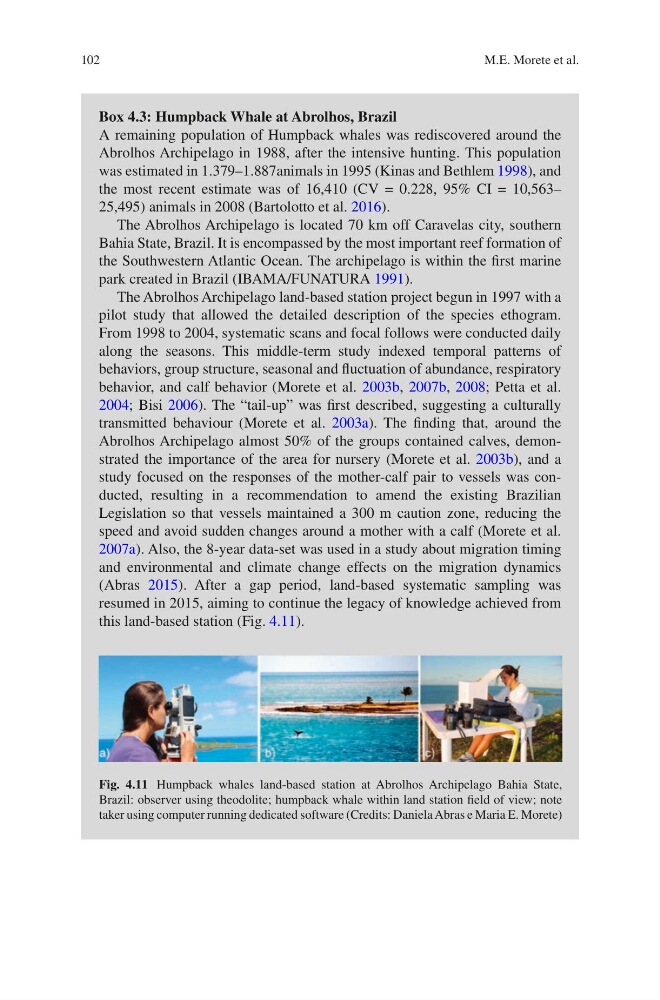
this land-based station (Fig. 4.11).
Fig. 4.11 Humpback whales land-based station at Abrolhos Archipelago Bahia State,
Brazil: observer using theodolite; humpback whale within land station field of view; note
taker using computer running dedicated software (Credits: Daniela Abras e Maria E. Morete)
M.E. Morete et al.
Box 4.3: Humpback Whale at Abrolhos, Brazil
A remaining population of Humpback whales was rediscovered around the
Abrolhos Archipelago in 1988, after the intensive hunting. This population
was estimated in 1.379–1.887animals in 1995 (Kinas and Bethlem 1998), and
the most recent estimate was of 16,410 (CV = 0.228, 95% CI = 10,563–
25,495) animals in 2008 (Bartolotto et al. 2016).
The Abrolhos Archipelago is located 70 km off Caravelas city, southern
Bahia State, Brazil. It is encompassed by the most important reef formation of
the Southwestern Atlantic Ocean. The archipelago is within the first marine
park created in Brazil (IBAMA/FUNATURA 1991).
The Abrolhos Archipelago land-based station project begun in 1997 with a
pilot study that allowed the detailed description of the species ethogram.
From 1998 to 2004, systematic scans and focal follows were conducted daily
along the seasons. This middle-term study indexed temporal patterns of
behaviors, group structure, seasonal and fluctuation of abundance, respiratory
behavior, and calf behavior (Morete et al. 2003b, 2007b, 2008; Petta et al.
2004; Bisi 2006). The “tail-up” was first described, suggesting a culturally
transmitted behaviour (Morete et al. 2003a). The finding that, around the
Abrolhos Archipelago almost 50% of the groups contained calves, demonstrated the importance of the area for nursery (Morete et al. 2003b), and a
study focused on the responses of the mother-calf pair to vessels was conducted, resulting in a recommendation to amend the existing Brazilian
Legislation so that vessels maintained a 300 m caution zone, reducing the
speed and avoid sudden changes around a mother with a calf (Morete et al.
2007a). Also, the 8-year data-set was used in a study about migration timing
and environmental and climate change effects on the migration dynamics
(Abras 2015). After a gap period, land-based systematic sampling was
resumed in 2015, aiming to continue the legacy of knowledge achieved from
this land-based station (Fig. 4.11).
Fig. 4.11 Humpback whales land-based station at Abrolhos Archipelago Bahia State,
Brazil: observer using theodolite; humpback whale within land station field of view; note
taker using computer running dedicated software (Credits: Daniela Abras e Maria E. Morete)
M.E. Morete et al.