

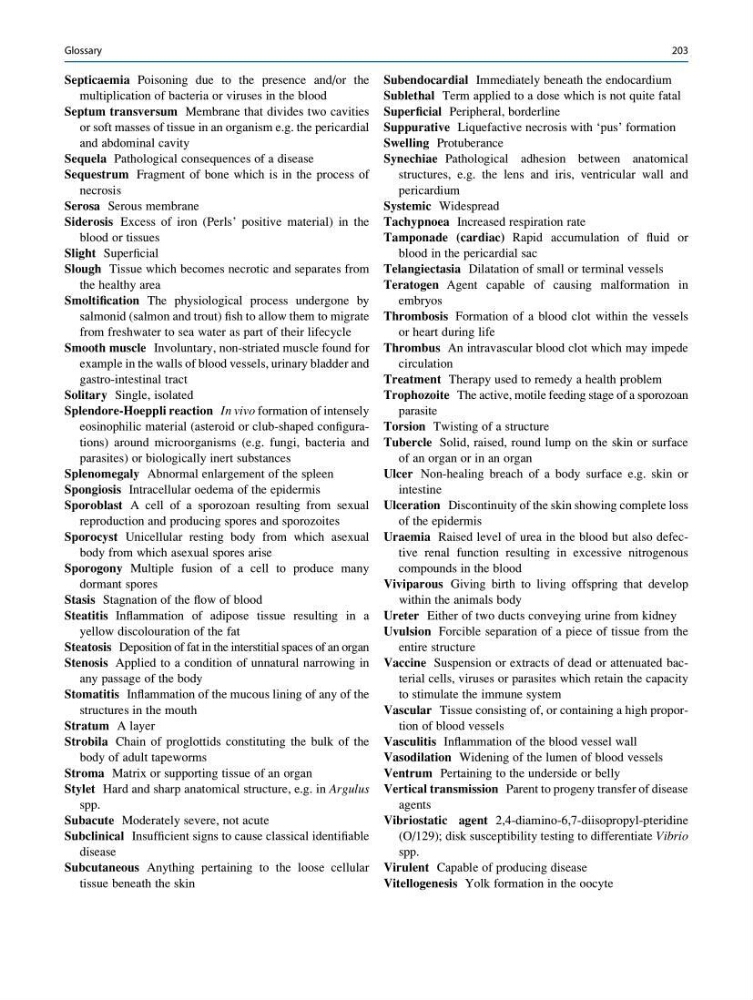
Septicaemia Poisoning due to the presence and/or the
multiplication of bacteria or viruses in the blood
Septum transversum Membrane that divides two cavities
or soft masses of tissue in an organism e.g. the pericardial
and abdominal cavity
Sequela Pathological consequences of a disease
Sequestrum Fragment of bone which is in the process of
necrosis
Serosa Serous membrane
Siderosis Excess of iron (Perls’ positive material) in the
blood or tissues
Slight Superficial
Slough Tissue which becomes necrotic and separates from
the healthy area
Smoltification The physiological process undergone by
salmonid (salmon and trout) fish to allow them to migrate
from freshwater to sea water as part of their lifecycle
Smooth muscle Involuntary, non-striated muscle found for
example in the walls of blood vessels, urinary bladder and
gastro-intestinal tract
Solitary Single, isolated
Splendore-Hoeppli reaction In vivo formation of intensely
eosinophilic material (asteroid or club-shaped configurations) around microorganisms (e.g. fungi, bacteria and
parasites) or biologically inert substances
Splenomegaly Abnormal enlargement of the spleen
Spongiosis Intracellular oedema of the epidermis
Sporoblast A cell of a sporozoan resulting from sexual
reproduction and producing spores and sporozoites
Sporocyst Unicellular resting body from which asexual
body from which asexual spores arise
Sporogony Multiple fusion of a cell to produce many
dormant spores
Stasis Stagnation of the flow of blood
Steatitis Inflammation of adipose tissue resulting in a
yellow discolouration of the fat
Steatosis Deposition of fat in the interstitial spaces of an organ
Stenosis Applied to a condition of unnatural narrowing in
any passage of the body
Stomatitis Inflammation of the mucous lining of any of the
structures in the mouth
Stratum A layer
Strobila Chain of proglottids constituting the bulk of the
body of adult tapeworms
Stroma Matrix or supporting tissue of an organ
Stylet Hard and sharp anatomical structure, e.g. in Argulus
spp.
Subacute Moderately severe, not acute
Subclinical Insufficient signs to cause classical identifiable
disease
Subcutaneous Anything pertaining to the loose cellular
tissue beneath the skin
Subendocardial Immediately beneath the endocardium
Sublethal Term applied to a dose which is not quite fatal
Superficial Peripheral, borderline
Suppurative Liquefactive necrosis with ‘pus’ formation
Swelling Protuberance
Synechiae Pathological adhesion between anatomical
structures, e.g. the lens and iris, ventricular wall and
pericardium
Systemic Widespread
Tachypnoea Increased respiration rate
Tamponade (cardiac) Rapid accumulation of fluid or
blood in the pericardial sac
Telangiectasia Dilatation of small or terminal vessels
Teratogen Agent capable of causing malformation in
embryos
Thrombosis Formation of a blood clot within the vessels
or heart during life
Thrombus An intravascular blood clot which may impede
circulation
Treatment Therapy used to remedy a health problem
Trophozoite The active, motile feeding stage of a sporozoan
parasite
Torsion Twisting of a structure
Tubercle Solid, raised, round lump on the skin or surface
of an organ or in an organ
Ulcer Non-healing breach of a body surface e.g. skin or
intestine
Ulceration Discontinuity of the skin showing complete loss
of the epidermis
Uraemia Raised level of urea in the blood but also defective renal function resulting in excessive nitrogenous
compounds in the blood
Viviparous Giving birth to living offspring that develop
within the animals body
Ureter Either of two ducts conveying urine from kidney
Uvulsion Forcible separation of a piece of tissue from the
entire structure
Vaccine Suspension or extracts of dead or attenuated bacterial cells, viruses or parasites which retain the capacity
to stimulate the immune system
Vascular Tissue consisting of, or containing a high proportion of blood vessels
Vasculitis Inflammation of the blood vessel wall
Vasodilation Widening of the lumen of blood vessels
Ventrum Pertaining to the underside or belly
Vertical transmission Parent to progeny transfer of disease
agents
Vibriostatic agent 2,4-diamino-6,7-diisopropyl-pteridine
(O/129); disk susceptibility testing to differentiate Vibrio
spp.
Virulent Capable of producing disease
Vitellogenesis Yolk formation in the oocyte
Glossary
203
multiplication of bacteria or viruses in the blood
Septum transversum Membrane that divides two cavities
or soft masses of tissue in an organism e.g. the pericardial
and abdominal cavity
Sequela Pathological consequences of a disease
Sequestrum Fragment of bone which is in the process of
necrosis
Serosa Serous membrane
Siderosis Excess of iron (Perls’ positive material) in the
blood or tissues
Slight Superficial
Slough Tissue which becomes necrotic and separates from
the healthy area
Smoltification The physiological process undergone by
salmonid (salmon and trout) fish to allow them to migrate
from freshwater to sea water as part of their lifecycle
Smooth muscle Involuntary, non-striated muscle found for
example in the walls of blood vessels, urinary bladder and
gastro-intestinal tract
Solitary Single, isolated
Splendore-Hoeppli reaction In vivo formation of intensely
eosinophilic material (asteroid or club-shaped configurations) around microorganisms (e.g. fungi, bacteria and
parasites) or biologically inert substances
Splenomegaly Abnormal enlargement of the spleen
Spongiosis Intracellular oedema of the epidermis
Sporoblast A cell of a sporozoan resulting from sexual
reproduction and producing spores and sporozoites
Sporocyst Unicellular resting body from which asexual
body from which asexual spores arise
Sporogony Multiple fusion of a cell to produce many
dormant spores
Stasis Stagnation of the flow of blood
Steatitis Inflammation of adipose tissue resulting in a
yellow discolouration of the fat
Steatosis Deposition of fat in the interstitial spaces of an organ
Stenosis Applied to a condition of unnatural narrowing in
any passage of the body
Stomatitis Inflammation of the mucous lining of any of the
structures in the mouth
Stratum A layer
Strobila Chain of proglottids constituting the bulk of the
body of adult tapeworms
Stroma Matrix or supporting tissue of an organ
Stylet Hard and sharp anatomical structure, e.g. in Argulus
spp.
Subacute Moderately severe, not acute
Subclinical Insufficient signs to cause classical identifiable
disease
Subcutaneous Anything pertaining to the loose cellular
tissue beneath the skin
Subendocardial Immediately beneath the endocardium
Sublethal Term applied to a dose which is not quite fatal
Superficial Peripheral, borderline
Suppurative Liquefactive necrosis with ‘pus’ formation
Swelling Protuberance
Synechiae Pathological adhesion between anatomical
structures, e.g. the lens and iris, ventricular wall and
pericardium
Systemic Widespread
Tachypnoea Increased respiration rate
Tamponade (cardiac) Rapid accumulation of fluid or
blood in the pericardial sac
Telangiectasia Dilatation of small or terminal vessels
Teratogen Agent capable of causing malformation in
embryos
Thrombosis Formation of a blood clot within the vessels
or heart during life
Thrombus An intravascular blood clot which may impede
circulation
Treatment Therapy used to remedy a health problem
Trophozoite The active, motile feeding stage of a sporozoan
parasite
Torsion Twisting of a structure
Tubercle Solid, raised, round lump on the skin or surface
of an organ or in an organ
Ulcer Non-healing breach of a body surface e.g. skin or
intestine
Ulceration Discontinuity of the skin showing complete loss
of the epidermis
Uraemia Raised level of urea in the blood but also defective renal function resulting in excessive nitrogenous
compounds in the blood
Viviparous Giving birth to living offspring that develop
within the animals body
Ureter Either of two ducts conveying urine from kidney
Uvulsion Forcible separation of a piece of tissue from the
entire structure
Vaccine Suspension or extracts of dead or attenuated bacterial cells, viruses or parasites which retain the capacity
to stimulate the immune system
Vascular Tissue consisting of, or containing a high proportion of blood vessels
Vasculitis Inflammation of the blood vessel wall
Vasodilation Widening of the lumen of blood vessels
Ventrum Pertaining to the underside or belly
Vertical transmission Parent to progeny transfer of disease
agents
Vibriostatic agent 2,4-diamino-6,7-diisopropyl-pteridine
(O/129); disk susceptibility testing to differentiate Vibrio
spp.
Virulent Capable of producing disease
Vitellogenesis Yolk formation in the oocyte
Glossary
203