

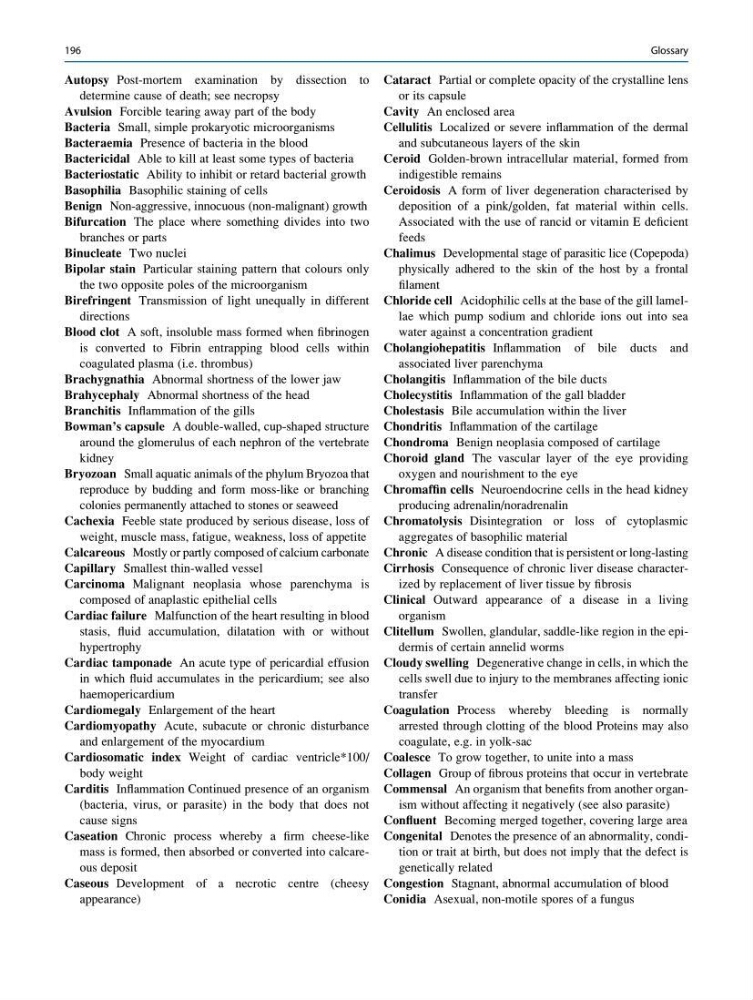
Autopsy Post-mortem examination by dissection to
determine cause of death; see necropsy
Avulsion Forcible tearing away part of the body
Bacteria Small, simple prokaryotic microorganisms
Bacteraemia Presence of bacteria in the blood
Bactericidal Able to kill at least some types of bacteria
Bacteriostatic Ability to inhibit or retard bacterial growth
Basophilia Basophilic staining of cells
Benign Non-aggressive, innocuous (non-malignant) growth
Bifurcation The place where something divides into two
branches or parts
Binucleate Two nuclei
Bipolar stain Particular staining pattern that colours only
the two opposite poles of the microorganism
Birefringent Transmission of light unequally in different
directions
Blood clot A soft, insoluble mass formed when fibrinogen
is converted to Fibrin entrapping blood cells within
coagulated plasma (i.e. thrombus)
Brachygnathia Abnormal shortness of the lower jaw
Brahycephaly Abnormal shortness of the head
Branchitis Inflammation of the gills
Bowman’s capsule A double-walled, cup-shaped structure
around the glomerulus of each nephron of the vertebrate
kidney
Bryozoan Small aquatic animals of the phylum Bryozoa that
reproduce by budding and form moss-like or branching
colonies permanently attached to stones or seaweed
Cachexia Feeble state produced by serious disease, loss of
weight, muscle mass, fatigue, weakness, loss of appetite
Calcareous Mostly or partly composed of calcium carbonate
Capillary Smallest thin-walled vessel
Carcinoma Malignant neoplasia whose parenchyma is
composed of anaplastic epithelial cells
Cardiac failure Malfunction of the heart resulting in blood
stasis, fluid accumulation, dilatation with or without
hypertrophy
Cardiac tamponade An acute type of pericardial effusion
in which fluid accumulates in the pericardium; see also
haemopericardium
Cardiomegaly Enlargement of the heart
Cardiomyopathy Acute, subacute or chronic disturbance
and enlargement of the myocardium
Cardiosomatic index Weight of cardiac ventricle*100/
body weight
Carditis Inflammation Continued presence of an organism
(bacteria, virus, or parasite) in the body that does not
cause signs
Caseation Chronic process whereby a firm cheese-like
mass is formed, then absorbed or converted into calcareous deposit
Caseous Development of a necrotic centre (cheesy
appearance)
Cataract Partial or complete opacity of the crystalline lens
or its capsule
Cavity An enclosed area
Cellulitis Localized or severe inflammation of the dermal
and subcutaneous layers of the skin
Ceroid Golden-brown intracellular material, formed from
indigestible remains
Ceroidosis A form of liver degeneration characterised by
deposition of a pink/golden, fat material within cells.
Associated with the use of rancid or vitamin E deficient
feeds
Chalimus Developmental stage of parasitic lice (Copepoda)
physically adhered to the skin of the host by a frontal
filament
Chloride cell Acidophilic cells at the base of the gill lamellae which pump sodium and chloride ions out into sea
water against a concentration gradient
Cholangiohepatitis Inflammation of bile ducts and
associated liver parenchyma
Cholangitis Inflammation of the bile ducts
Cholecystitis Inflammation of the gall bladder
Cholestasis Bile accumulation within the liver
Chondritis Inflammation of the cartilage
Chondroma Benign neoplasia composed of cartilage
Choroid gland The vascular layer of the eye providing
oxygen and nourishment to the eye
Chromaffin cells Neuroendocrine cells in the head kidney
producing adrenalin/noradrenalin
Chromatolysis Disintegration or loss of cytoplasmic
aggregates of basophilic material
Chronic A disease condition that is persistent or long-lasting
Cirrhosis Consequence of chronic liver disease characterized by replacement of liver tissue by fibrosis
Clinical Outward appearance of a disease in a living
organism
Clitellum Swollen, glandular, saddle-like region in the epidermis of certain annelid worms
Cloudy swelling Degenerative change in cells, in which the
cells swell due to injury to the membranes affecting ionic
transfer
Coagulation Process whereby bleeding is normally
arrested through clotting of the blood Proteins may also
coagulate, e.g. in yolk-sac
Coalesce To grow together, to unite into a mass
Collagen Group of fibrous proteins that occur in vertebrate
Commensal An organism that benefits from another organism without affecting it negatively (see also parasite)
Confluent Becoming merged together, covering large area
Congenital Denotes the presence of an abnormality, condition or trait at birth, but does not imply that the defect is
genetically related
Congestion Stagnant, abnormal accumulation of blood
Conidia Asexual, non-motile spores of a fungus
196
Glossary
determine cause of death; see necropsy
Avulsion Forcible tearing away part of the body
Bacteria Small, simple prokaryotic microorganisms
Bacteraemia Presence of bacteria in the blood
Bactericidal Able to kill at least some types of bacteria
Bacteriostatic Ability to inhibit or retard bacterial growth
Basophilia Basophilic staining of cells
Benign Non-aggressive, innocuous (non-malignant) growth
Bifurcation The place where something divides into two
branches or parts
Binucleate Two nuclei
Bipolar stain Particular staining pattern that colours only
the two opposite poles of the microorganism
Birefringent Transmission of light unequally in different
directions
Blood clot A soft, insoluble mass formed when fibrinogen
is converted to Fibrin entrapping blood cells within
coagulated plasma (i.e. thrombus)
Brachygnathia Abnormal shortness of the lower jaw
Brahycephaly Abnormal shortness of the head
Branchitis Inflammation of the gills
Bowman’s capsule A double-walled, cup-shaped structure
around the glomerulus of each nephron of the vertebrate
kidney
Bryozoan Small aquatic animals of the phylum Bryozoa that
reproduce by budding and form moss-like or branching
colonies permanently attached to stones or seaweed
Cachexia Feeble state produced by serious disease, loss of
weight, muscle mass, fatigue, weakness, loss of appetite
Calcareous Mostly or partly composed of calcium carbonate
Capillary Smallest thin-walled vessel
Carcinoma Malignant neoplasia whose parenchyma is
composed of anaplastic epithelial cells
Cardiac failure Malfunction of the heart resulting in blood
stasis, fluid accumulation, dilatation with or without
hypertrophy
Cardiac tamponade An acute type of pericardial effusion
in which fluid accumulates in the pericardium; see also
haemopericardium
Cardiomegaly Enlargement of the heart
Cardiomyopathy Acute, subacute or chronic disturbance
and enlargement of the myocardium
Cardiosomatic index Weight of cardiac ventricle*100/
body weight
Carditis Inflammation Continued presence of an organism
(bacteria, virus, or parasite) in the body that does not
cause signs
Caseation Chronic process whereby a firm cheese-like
mass is formed, then absorbed or converted into calcareous deposit
Caseous Development of a necrotic centre (cheesy
appearance)
Cataract Partial or complete opacity of the crystalline lens
or its capsule
Cavity An enclosed area
Cellulitis Localized or severe inflammation of the dermal
and subcutaneous layers of the skin
Ceroid Golden-brown intracellular material, formed from
indigestible remains
Ceroidosis A form of liver degeneration characterised by
deposition of a pink/golden, fat material within cells.
Associated with the use of rancid or vitamin E deficient
feeds
Chalimus Developmental stage of parasitic lice (Copepoda)
physically adhered to the skin of the host by a frontal
filament
Chloride cell Acidophilic cells at the base of the gill lamellae which pump sodium and chloride ions out into sea
water against a concentration gradient
Cholangiohepatitis Inflammation of bile ducts and
associated liver parenchyma
Cholangitis Inflammation of the bile ducts
Cholecystitis Inflammation of the gall bladder
Cholestasis Bile accumulation within the liver
Chondritis Inflammation of the cartilage
Chondroma Benign neoplasia composed of cartilage
Choroid gland The vascular layer of the eye providing
oxygen and nourishment to the eye
Chromaffin cells Neuroendocrine cells in the head kidney
producing adrenalin/noradrenalin
Chromatolysis Disintegration or loss of cytoplasmic
aggregates of basophilic material
Chronic A disease condition that is persistent or long-lasting
Cirrhosis Consequence of chronic liver disease characterized by replacement of liver tissue by fibrosis
Clinical Outward appearance of a disease in a living
organism
Clitellum Swollen, glandular, saddle-like region in the epidermis of certain annelid worms
Cloudy swelling Degenerative change in cells, in which the
cells swell due to injury to the membranes affecting ionic
transfer
Coagulation Process whereby bleeding is normally
arrested through clotting of the blood Proteins may also
coagulate, e.g. in yolk-sac
Coalesce To grow together, to unite into a mass
Collagen Group of fibrous proteins that occur in vertebrate
Commensal An organism that benefits from another organism without affecting it negatively (see also parasite)
Confluent Becoming merged together, covering large area
Congenital Denotes the presence of an abnormality, condition or trait at birth, but does not imply that the defect is
genetically related
Congestion Stagnant, abnormal accumulation of blood
Conidia Asexual, non-motile spores of a fungus
196
Glossary