

9: CARCHARHINIDAE (REQUIEM SHARKS)
•
c
E
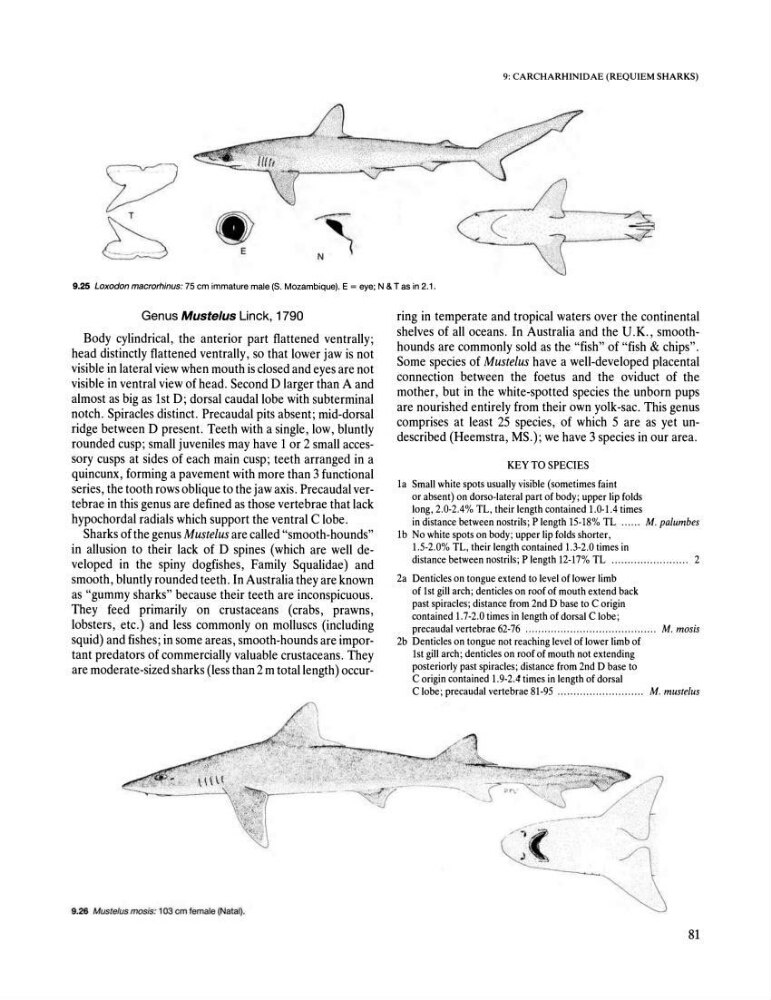
9.25 Loxodon macrorhinus: 75 em immature male (S. Mozambique). E = eye; N & T as in 2.1.
Genus Mustelus Linck, 1790
Body cylindrical, the anterior part flattened ventrally;
head distinctly flattened ventrally, so that lower jaw is not
visible in lateral view when mouth is closed and eyes are not
visible in ventral view of head. Second D larger than A and
almost as big as 1st D; dorsal caudal lobe with subterminal
notch. Spiracles distinct. Precaudal pits absent; mid-dorsal
ridge between D present. Teeth with a single, low, bluntly
rounded cusp; small juveniles may have 1 or 2 small accessory cusps at sides of each main cusp; teeth arranged in a
quincunx, forming a pavement with more than 3 functional
series, the tooth rows oblique to the jaw axis. Precaudal vertebrae in this genus are defined as those vertebrae that lack
hypochordal radials which support the ventral C lobe.
Sharks of the genus Mustelus are called "smooth-hounds"
in allusion to their lack of D spines (which are well developed in the spiny dogfishes, Family Squalidae) and
smooth, bluntly rounded teeth . In Australia they are known
as "gummy sharks" because their teeth are inconspicuous.
They feed primarily on crustaceans (crabs, prawns,
lobsters, etc.) and less commonly on molluscs (including
squid) and fishes; in some areas, smooth-hounds are important predators of commercially valuable crustaceans. They
are moderate-sized sharks (less than 2 m total length) occur9.26 Muste/us mosis: 103 em female (Natal).
ring in temperate and tropical waters over the continental
shelves of all oceans. In Australia and the U.K., smoothhounds are commonly sold as the "fish" of "fish & chips".
Some species of Mustelus have a well-developed placental
connection between the foetus and the oviduct of the
mother, but in the white-spotted species the unborn pups
are nourished entirely from their own yolk-sac. This genus
comprises at least 25 species, of which 5 are as yet undescribed (Heemstra, MS.); we have 3 species in our area.
KEY TO SPECIES
la Small white spots usually visible (sometimes faint
or absent) on dorso-Iateral part of body; upper lip folds
long, 2.0-2.4% TL, their length contained 1.0-1.4 times
in distance between nostrils; P length 15-18% TL ...... M. palumbes
Ib No white spots on body; upper lip folds shorter,
1.5-2.0% TL, their length contained 1.3-2.0 times in
distance between nostrils; P length 12-17% TL ............. .... ....... 2
2a Denticles on tongue extend to level of lower limb
of 1st gill arch; denticles on roof of mouth extend back
past spiracles; distance from 2nd D base to C origin
contained 1.7-2.0 times in length of dorsal C lobe;
precaudal vertebrae 62-76 ............ .. ........ ............. .. .... M. mosis
2b Denticles on tongue not reaching level of lower limb of
1st gill arch ; denticles on roof of mouth not extending
posteriorly past spiracles; distance from 2nd D base to
C origin contained 1. 9-2.4 times in length of dorsal
C lobe; precaudal vertebrae 81-95 .... ....................... M. mustelus
81
•
c
E
9.25 Loxodon macrorhinus: 75 em immature male (S. Mozambique). E = eye; N & T as in 2.1.
Genus Mustelus Linck, 1790
Body cylindrical, the anterior part flattened ventrally;
head distinctly flattened ventrally, so that lower jaw is not
visible in lateral view when mouth is closed and eyes are not
visible in ventral view of head. Second D larger than A and
almost as big as 1st D; dorsal caudal lobe with subterminal
notch. Spiracles distinct. Precaudal pits absent; mid-dorsal
ridge between D present. Teeth with a single, low, bluntly
rounded cusp; small juveniles may have 1 or 2 small accessory cusps at sides of each main cusp; teeth arranged in a
quincunx, forming a pavement with more than 3 functional
series, the tooth rows oblique to the jaw axis. Precaudal vertebrae in this genus are defined as those vertebrae that lack
hypochordal radials which support the ventral C lobe.
Sharks of the genus Mustelus are called "smooth-hounds"
in allusion to their lack of D spines (which are well developed in the spiny dogfishes, Family Squalidae) and
smooth, bluntly rounded teeth . In Australia they are known
as "gummy sharks" because their teeth are inconspicuous.
They feed primarily on crustaceans (crabs, prawns,
lobsters, etc.) and less commonly on molluscs (including
squid) and fishes; in some areas, smooth-hounds are important predators of commercially valuable crustaceans. They
are moderate-sized sharks (less than 2 m total length) occur9.26 Muste/us mosis: 103 em female (Natal).
ring in temperate and tropical waters over the continental
shelves of all oceans. In Australia and the U.K., smoothhounds are commonly sold as the "fish" of "fish & chips".
Some species of Mustelus have a well-developed placental
connection between the foetus and the oviduct of the
mother, but in the white-spotted species the unborn pups
are nourished entirely from their own yolk-sac. This genus
comprises at least 25 species, of which 5 are as yet undescribed (Heemstra, MS.); we have 3 species in our area.
KEY TO SPECIES
la Small white spots usually visible (sometimes faint
or absent) on dorso-Iateral part of body; upper lip folds
long, 2.0-2.4% TL, their length contained 1.0-1.4 times
in distance between nostrils; P length 15-18% TL ...... M. palumbes
Ib No white spots on body; upper lip folds shorter,
1.5-2.0% TL, their length contained 1.3-2.0 times in
distance between nostrils; P length 12-17% TL ............. .... ....... 2
2a Denticles on tongue extend to level of lower limb
of 1st gill arch; denticles on roof of mouth extend back
past spiracles; distance from 2nd D base to C origin
contained 1.7-2.0 times in length of dorsal C lobe;
precaudal vertebrae 62-76 ............ .. ........ ............. .. .... M. mosis
2b Denticles on tongue not reaching level of lower limb of
1st gill arch ; denticles on roof of mouth not extending
posteriorly past spiracles; distance from 2nd D base to
C origin contained 1. 9-2.4 times in length of dorsal
C lobe; precaudal vertebrae 81-95 .... ....................... M. mustelus
81