

9: CARCHARHINIDAE (REQUIEM SHARKS)
'.'.- .-:
.... . -
~; . . "
N
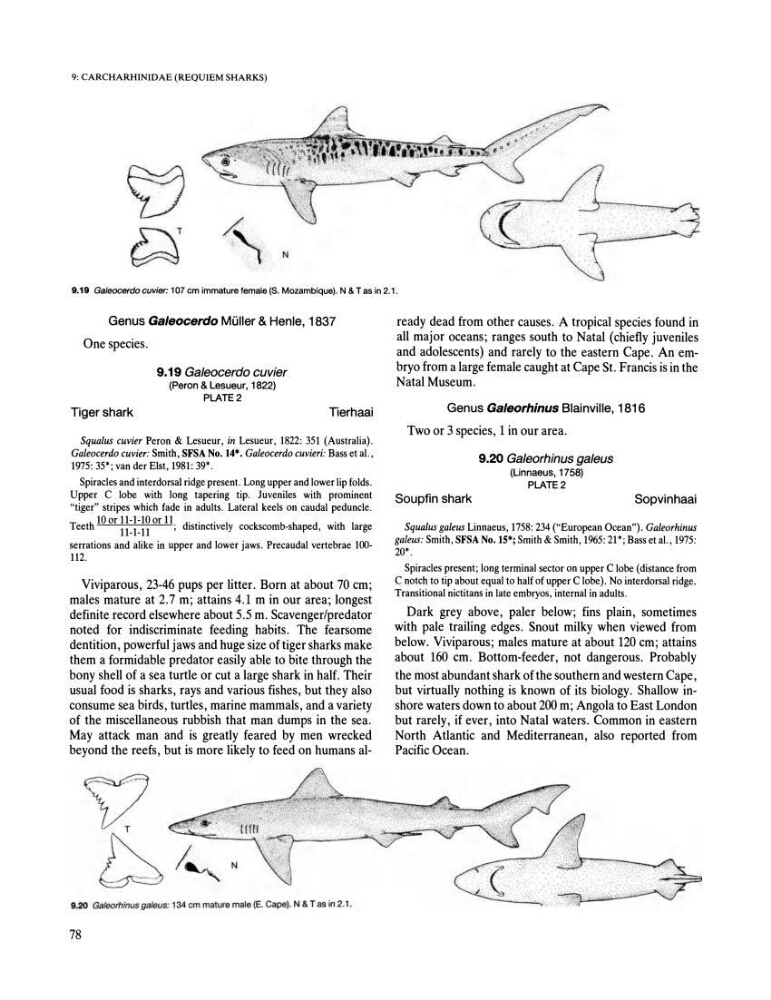
9.19 Galeoeerdo euvier: 107 em immature female (S. Mozambique). N & T as in 2.1.
Genus Galeocerdo Muller & Henle, 1837
One species.
9.19 Galeocerdo cuvier
(Peron & Lesueur, 1822)
PLATE 2
Tiger shark
Tierhaai
Squalus cuvier Peron & Lesueur, in Lesueur, 1822: 351 (Australia).
Galeocerdo cuvier: Smith, SFSA No. 14*. Galeocerdo cuvieri: Bass et aI.,
1975: 35'; van der Elst, 1981: 39'.
Spiracles and interdorsal ridge present. Long upper and lower lip folds.
Upper C lobe with long tapering tip. Juveniles with prominent
"tiger" stripes which fade in adults. Lateral keels on caudal peduncle.
10 or 11-1-10 or 11 .. .
Teeth
11-1-11
; dlstmctIvely cockscomb-shaped, with large
serrations and alike in upper and lower jaws. Precaudal vertebrae 100112.
Viviparous, 23-46 pups per litter. Born at about 70 cm;
males mature at 2.7 m; attains 4.1 m in our area; longest
definite record elsewhere about 5.5 m. Scavenger/predator
noted for indiscriminate feeding habits. The fearsome
dentition, powerful jaws and huge size of tiger sharks make
them a formidable predator easily able to bite through the
bony shell of a sea turtle or cut a large shark in half. Their
usual food is sharks, rays and various fishes, but they also
consume sea birds, turtles, marine mammals, and a variety
of the miscellaneous rubbish that man dumps in the sea.
May attack man and is greatly feared by men wrecked
beyond the reefs, but is more likely to feed on humans al9.20 Galeorhinus galeus: 134 em mature male (E. Cape). N & T as in 2 .1.
78
ready dead from other causes. A tropical species found in
all major oceans; ranges south to Natal (chiefly juveniles
and adolescents) and rarely to the eastern Cape. An embryo from a large female caught at Cape St. Francis is in the
Natal Museum.
Genus Galeorhinus Blainville, 1816
Two or 3 species, 1 in our area.
Soupfin shark
9.20 Galeorhinus galeus
(linnaeus, 1758)
PLATE 2
Sopvinhaai
Squalus galeus Linnaeus, 1758: 234 ("European Ocean"). Galeorhinus
galeus: Smith, SFSA No. 15*; Smith & Smith, 1965: 21'; Bass et aI., 1975:
20*.
Spiracles present; long terminal sector on upper C lobe (distance from
C notch to tip about equal to half of upper C lobe). No interdorsal ridge.
Transitional nictitans in late embryos, internal in adults.
Dark grey above, paler below; fins plain, sometimes
with pale trailing edges. Snout milky when viewed from
below. Viviparous; males mature at about 120 cm; attains
about 160 cm. Bottom-feeder, not dangerous. Probably
the most abundant shark of the southern and western Cape,
but virtually nothing is known of its biology. Shallow inshore waters down to about 200 m; Angola to East London
but rarely, if ever, into Natal waters. Common in eastern
North Atlantic and Mediterranean, also reported from
Pacific Ocean.
'.'.- .-:
.... . -
~; . . "
N
9.19 Galeoeerdo euvier: 107 em immature female (S. Mozambique). N & T as in 2.1.
Genus Galeocerdo Muller & Henle, 1837
One species.
9.19 Galeocerdo cuvier
(Peron & Lesueur, 1822)
PLATE 2
Tiger shark
Tierhaai
Squalus cuvier Peron & Lesueur, in Lesueur, 1822: 351 (Australia).
Galeocerdo cuvier: Smith, SFSA No. 14*. Galeocerdo cuvieri: Bass et aI.,
1975: 35'; van der Elst, 1981: 39'.
Spiracles and interdorsal ridge present. Long upper and lower lip folds.
Upper C lobe with long tapering tip. Juveniles with prominent
"tiger" stripes which fade in adults. Lateral keels on caudal peduncle.
10 or 11-1-10 or 11 .. .
Teeth
11-1-11
; dlstmctIvely cockscomb-shaped, with large
serrations and alike in upper and lower jaws. Precaudal vertebrae 100112.
Viviparous, 23-46 pups per litter. Born at about 70 cm;
males mature at 2.7 m; attains 4.1 m in our area; longest
definite record elsewhere about 5.5 m. Scavenger/predator
noted for indiscriminate feeding habits. The fearsome
dentition, powerful jaws and huge size of tiger sharks make
them a formidable predator easily able to bite through the
bony shell of a sea turtle or cut a large shark in half. Their
usual food is sharks, rays and various fishes, but they also
consume sea birds, turtles, marine mammals, and a variety
of the miscellaneous rubbish that man dumps in the sea.
May attack man and is greatly feared by men wrecked
beyond the reefs, but is more likely to feed on humans al9.20 Galeorhinus galeus: 134 em mature male (E. Cape). N & T as in 2 .1.
78
ready dead from other causes. A tropical species found in
all major oceans; ranges south to Natal (chiefly juveniles
and adolescents) and rarely to the eastern Cape. An embryo from a large female caught at Cape St. Francis is in the
Natal Museum.
Genus Galeorhinus Blainville, 1816
Two or 3 species, 1 in our area.
Soupfin shark
9.20 Galeorhinus galeus
(linnaeus, 1758)
PLATE 2
Sopvinhaai
Squalus galeus Linnaeus, 1758: 234 ("European Ocean"). Galeorhinus
galeus: Smith, SFSA No. 15*; Smith & Smith, 1965: 21'; Bass et aI., 1975:
20*.
Spiracles present; long terminal sector on upper C lobe (distance from
C notch to tip about equal to half of upper C lobe). No interdorsal ridge.
Transitional nictitans in late embryos, internal in adults.
Dark grey above, paler below; fins plain, sometimes
with pale trailing edges. Snout milky when viewed from
below. Viviparous; males mature at about 120 cm; attains
about 160 cm. Bottom-feeder, not dangerous. Probably
the most abundant shark of the southern and western Cape,
but virtually nothing is known of its biology. Shallow inshore waters down to about 200 m; Angola to East London
but rarely, if ever, into Natal waters. Common in eastern
North Atlantic and Mediterranean, also reported from
Pacific Ocean.