

268: TETRAODONTIDAE (BLAASOPS)
dusky with yellow tinge; A of breeding female yellow, A in
males white. Attains 30 cm. Tropical Indo-West Pacific
from South Africa to China; our most common species from
the Cape to Natal in tidepools, estuaries and in the sea to
depths of 400 m. ("A pest to anglers, tears most baits
rapidly, and even cuts lines, apparently quite casually.
Highly poisonous, not touched by fishes or sea birds. Eaten
by cats with rapidly fatal consequences, is sometimes
employed to end nocturnal disturbances. Hands should be
washed after handling this fish." - J.L.B. Smith, SFSA.)
Genus Arothron Mulier, 1841
Body heavy, broad; C peduncle depth about equal to its
length; C rounded; no lower LL or skin ridge on peduncle.
Nasal organ a bifurcate tentacle. An Indo-Pacific genus
with about 10 species, 7 species in our area.
KEY TO SPECIES
la Margins of C black; no marks on body except
dark blotch at P base ........................................ A. immaculatus
Ib Margins of C not black, body with various markings .................. 2
2a Anus in black area ................. ... ... ... .................................. 3
2b Anus not in black area .................................... ... ... ... .......... 6
3a Rounded black area surrounds gill opening and
P base; subparallel fine lines along belly even in
adults .............................................................. A. inconditus
3b P base not surrounded by black area ...................................... 4
4a Body with dark spots ................................................... ...... 5
4b Body with fine lines on back and a dark reticulated
pattern below P ..................................................... A. mappa
5a Upper part of body spotted, ventral partin
adults uniform, in juveniles with wide bands ............... A. steliallls
5b Whole body with irregularly spaced dark
blotches ..................................................... A. nigropunctallls
6a Dark body covered with small white spots, no
stripes or bars ..................................................... A. meleagris
6b White spots on head, back and sides, 1 or 2
yellow rings and several yellow spots round
P; 2-5 bars across sides, always a short dark
bar below eye and another below P .......................... A. hispidus
268.2 Arothron hispidus
Linnaeus, 1758
PLATE 142
Whitespotted blaasop
Witspikkel-blaasop
Tetraodon hispidus Linnaeus, 1758: 333 (India). Arothron hispidus:
Smith, SFSA No. 1207*; Sanches, 1963: 182*; Shen, Lim & Ting, 1975:
166*.
D 10; A 10; P 17-19.
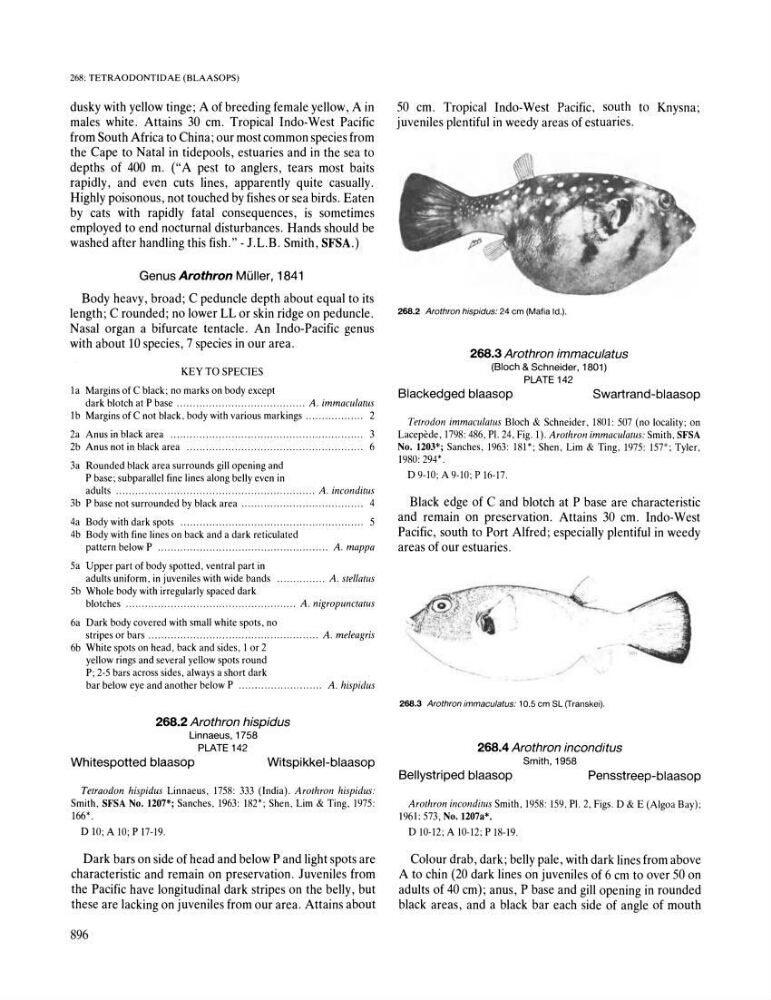
Dark bars on side of head and below P and light spots are
characteristic and remain on preservation. Juveniles from
the Pacific have longitudinal dark stripes on the belly, but
these are lacking on juveniles from our area. Attains about
896
50 cm. Tropical Indo-West Pacific, south to Knysna;
juveniles plentiful in weedy areas of estuaries.
268.2 Arothron hispidus: 24 cm (Mafia Id.).
268.3 Arothron immaculatus
(Bloch & Schneider, 1801)
PLATE 142
Blackedged blaasop
Swartrand-blaasop
Tetrodon immaculatus Bloch & Schneider, 1801: 507 (no locality; on
Lacepede, 1798: 486, PI. 24, Fig. 1). Arothron immaculatus: Smith, SFSA
No. 1203*; Sanches, 1963: 181 *; Shen, Lim & Ting, 1975: 157*; Tyler,
1980: 294*.
D 9-10; A 9-10; P 16-17.
Black edge of C and blotch at P base are characteristic
and remain on preservation. Attains 30 cm. Indo-West
Pacific, south to Port Alfred; especially plentiful in weedy
areas of our estuaries.
./
268.3 Arothron immaculatus: 10.5 cm SL (Transkei).
268.4 Arothron inconditus
Smith,1958
Bellystriped blaasop
Pensstreep-blaasop
Arothron inconditus Smith, 1958: 159, PI. 2, Figs. D & E (Algoa Bay);
1961: 573, No. 1207a*.
D 10·12; A 10-12; P 18-19.
Colour drab, dark; belly pale, with dark lines from above
A to chin (20 dark lines on juveniles of 6 cm to over 50 on
adults of 40 cm); anus, P base and gill opening in rounded
black areas, and a black bar each side of angle of mouth