

267: TRIODONTIDAE (THREETOOTH PUFFER)
Family No. 267: TRIODONTIDAE
by M.M. Smith
Threetooth puffer
Drietand-blaasop
Body compressed ventrally, with a huge distensible belly
flap between lower jaw and anus; body, head and belly flap
covered with small, spiny scales. Teeth fused; upper jaw
with median suture, lower jaw without suture, hence the
name "threetooth" or Triodon. No fin spines; pelvic fins
absent; specimens from the western Pacific have a rudimentary spinous dorsal fin set in a groove well in front of the
soft-rayed fin.
A single species.
267.1 Triodon macropterus
Lesson, 1830
PLATE 142
Threetooth puffer
Drietand-blaasop
Triodon macropterus Lesson, 1829: PI. 4; 1830: 103 (to accompany 1829
illustration; Mauritius); Tyler, 1967: 89'; Smith, 1975: 84. Triodon
bursarius: Smith, 1953: 522, No. 1189a*.
D 10-12; A 9-10; P 14-16; C 12 principal, with 6-9 procurrent rays above
and below. Vertebrae 9 + 11.
Body yellowish brown; belly flap white, with yellow area
around the black blotch, which is about midway between
lower end of P base and anus. Attains about 54 cm; tropical
Indo-Pacific down to 300 m; 1 specimen obtained by depth
charge from about 55 m off Inhambane, Mozambique.
Rare.
Family No. 268: TETRAODONTIDAE
by M.M. Smith & P.C. Heemstra
Blaasops
Blaasoppe
Blaasops (or puffers) are so called because they can
inflate their body by swallowing water (or air) to form an
almost spherical, generally spiny ball to deter predators.
The posterior position of the dorsal and anal fins, absence
of pelvic fins and ribs, and tough, elastic skin with or without scattered small spinules are all features that permit the
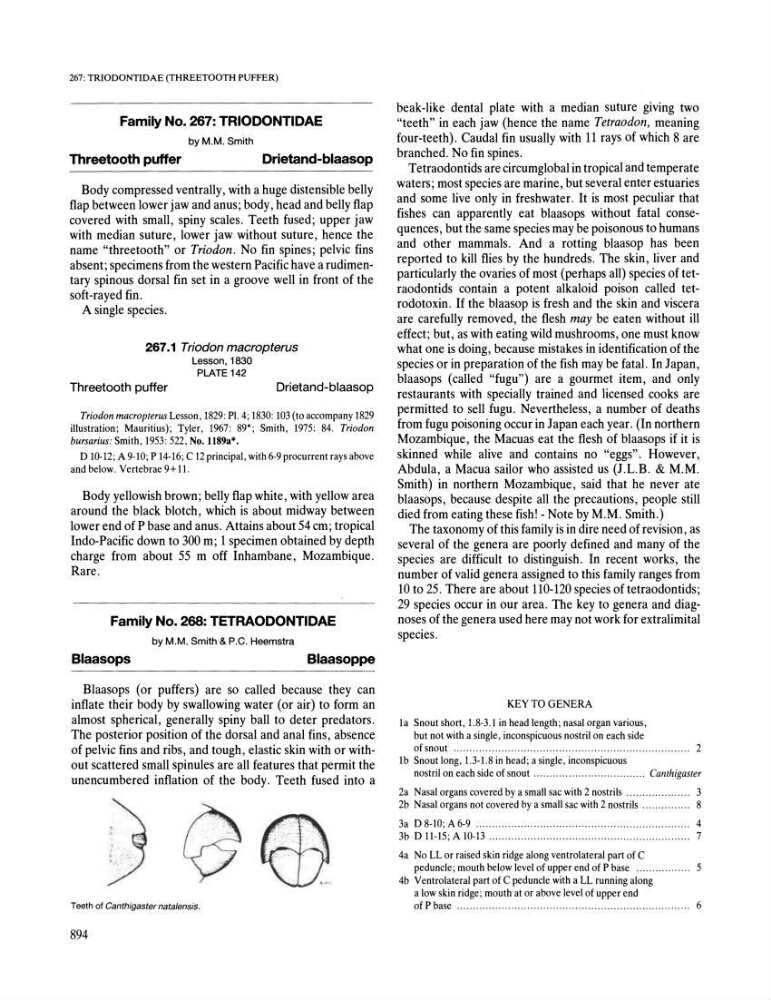
unencumbered inflation of the body. Teeth fused into a
® , . " " .
.' .. -~ - -
, '
, :
_
r
.
.
'-.... ~
Teeth of Canthigaster natalensis.
894
beak-like dental plate with a median suture giving two
"teeth" in each jaw (hence the name Tetraodon, meaning
four-teeth). Caudal fin usually with 11 rays of which 8 are
branched. No fin spines.
Tetraodontids are circum global in tropical and temperate
waters; most species are marine, but several enter estuaries
and some live only in freshwater. It is most peculiar that
fishes can apparently eat blaasops without fatal consequences, but the same species may be poisonous to humans
and other mammals. And a rotting blaasop has been
reported to kill flies by the hundreds. The skin, liver and
particularly the ovaries of most (perhaps all) species of tetraodontids contain a potent alkaloid poison called tetrodotoxin. If the blaasop is fresh and the skin and viscera
are carefully removed, the flesh may be eaten without ill
effect; but, as with eating wild mushrooms, one must know
what one is doing, because mistakes in identification of the
species or in preparation of the fish may be fatal. In Japan,
blaasops (called "fugu") are a gourmet item, and only
restaurants with specially trained and licensed cooks are
permitted to sell fugu. Nevertheless, a number of deaths
from fugu poisoning occur in Japan each year. (In northern
Mozambique, the Macuas eat the flesh of blaasops if it is
skinned while alive and contains no "eggs". However,
Abdula, a Macua sailor who assisted us (J.L.B. & M.M.
Smith) in northern Mozambique, said that he never ate
blaasops, because despite all the precautions, people still
died from eating these fish! - Note by M.M. Smith.)
The taxonomy of this family is in dire need of revision, as
several of the genera are poorly defined and many of the
species are difficult to distinguish. In recent works, the
number of valid genera assigned to this family ranges from
10 to 25. There are about 110-120 species of tetraodontids;
29 species occur in our area. The key to genera and diagnoses of the genera used here may not work for extralimital
species.
KEY TO GENERA
la Snout short, 1.8-3.1 in head length; nasal organ various,
but not with a single, inconspicuous nostril on each side
of snout .......................................................................... 2
Ib Snout long, 1.3-1.8 in head; a single, inconspicuous
nostril on each side of snout ................................... Canthigaster
2a Nasal organs covered by a small sac with 2 nostrils .................... 3
2b Nasal organs not covered by a small sac with 2 nostrils ............... 8
3a D8-1O;A6-9 ................................................................... 4
3b D 11-15; A 10-13 ....................................................... .. ...... 7
4a No LL or raised skin ridge along ventrolateral part of C
peduncle; mouth below level of upper end of P base ................. 5
4b Ventrolateral part of C peduncle with a LL running along
a low skin ridge; mouth at or above level of upper end
of P base ......................................................................... 6