

263: BALlSTlDAE (TRIGGERFlSHES)
well developed; cheek fully scaled, no enlarged scales on cheek or behind
gill slit; body scales without spines but with normal erect flat-topped
tubercles; front of 1st 0 spine with spinules or spiny ridges; 3rd 0 spine
short, inclined forwards; C truncate.
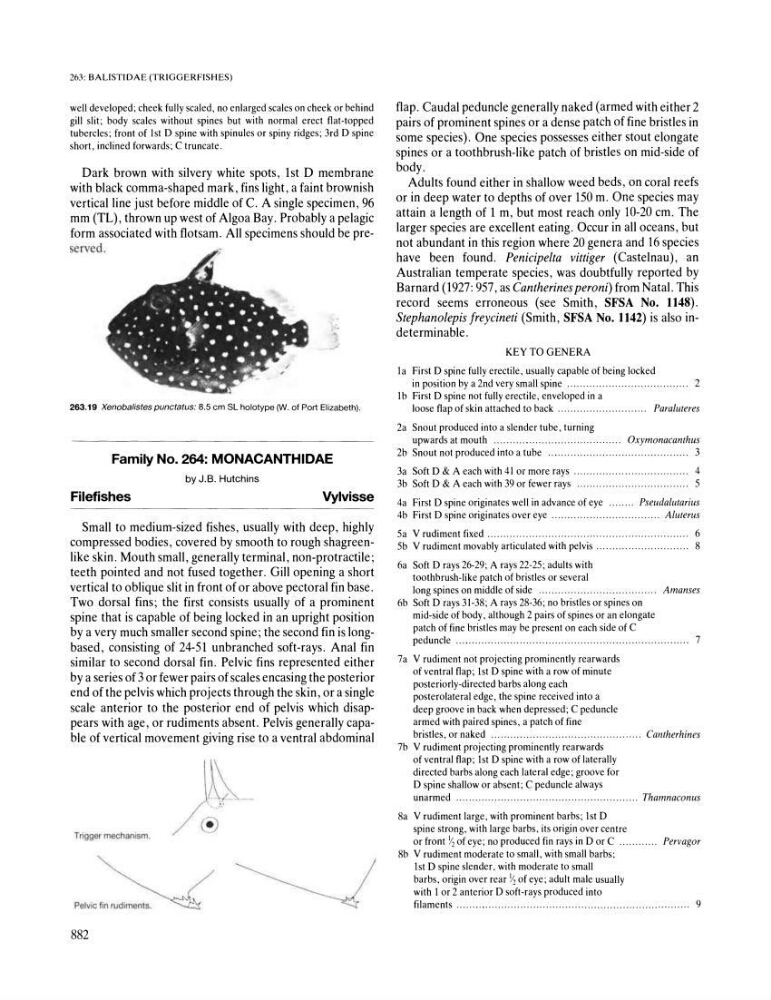
Dark brown with silvery white spots, 1st D membrane
with black comma-shaped mark, fins light, a faint brownish
vertical line just before middle of C. A single specimen, 96
mm (TL), thrown up west of Algoa Bay. Probably a pelagic
form associated with flotsam. All specimens should be preerved.
. "
.' .. " ......
' \. .. , . .. .. . .
•
10' "
•
•
. . .. ~ ...
, . · . . . . i···. ·
•
•
• r
'
_
.
• •
• •
,
•
•
.. . - .
. ... . j .'
.. . . ~.~...;~
•
• • .. .
263.19 Xenobalistes punctatus: 8.5 cm SL holotype (W. of Port Elizabeth).
Family No. 264: MONACANTHIDAE
by J.B. Hutchins
Filefishes
Vylvisse
Small to medium-sized fishes, usually with deep, highly
compressed bodies, covered by smooth to rough shagreenlike skin. Mouth small, generally terminal, non-protractile;
teeth pointed and not fused together. Gill opening a short
vertical to oblique slit in front of or above pectoral fin base.
Two dorsal fins; the first consists usually of a prominent
spine that is capable of being locked in an upright position
by a very much smaller second spine; the second fin is longbased, consisting of 24-51 unbranched soft-rays. Anal fin
similar to second dorsal fin. Pelvic fins represented either
by a series of 3 or fewer pairs of scales encasing the posterior
end of the pelvis which projects through the skin, or a single
scale anterior to the posterior end of pelvis which disappears with age, or rudiments absent. Pelvis generally capable of vertical movement giving rise to a ventral abdominal
Trigger mechanism .
Pelvic f in rudimen ts.
882
flap. Caudal peduncle generally naked (armed with either 2
pairs of prominent spines or a dense patch of fine bristles in
some species). One species possesses either stout elongate
spines or a toothbrush-like patch of bristles on mid-side of
body.
Adults found either in shallow weed beds, on coral reefs
or in deep water to depths of over 150 m. One species may
attain a length of 1 m, but most reach only 10-20 cm. The
larger species are excellent eating. Occur in all oceans, but
not abundant in this region where 20 genera and 16 species
have been found. Penicipelta vittiger (Castelnau), an
Australian temperate species, was doubtfully reported by
Barnard (1927: 957, as Cantherines peroni) from Natal. This
record seems erroneous (see Smith, SFSA No. 1148).
Stephanolepis freycineti (Smith, SFSA No. 1142) is also indeterminable.
KEY TO GENERA
1a First 0 spine fully erectile, usually capable of being locked
in position by a 2nd very small spine ...................................... 2
1 b First 0 spine not fully erectile, enveloped in a
loose flap of skin attached to back ............................ ParaiUleres
2a Snout produced into a slender tube, turning
upwards at mouth ........................................ Oxymonacanthus
2b Snout not produced into a tube ............................................ 3
3a Soft 0 & A each with 41 or more rays .................................... 4
3b Soft 0 & A each with 39 orfewer rays ................................... 5
4a First 0 spine originates well in advance of eye ........ Pseudailltarius
4b First 0 spine originates over eye .................................. Aillterus
5a V rudiment fixed............................................................... 6
5b V rudiment movably articulated with pelvis.................. .. ... ...... 8
6a Soft 0 rays 26-29; A rays 22-25; adults with
toothbrush-like patch of bristles or several
long spines on middle of side ..................................... Amanses
6b Soft 0 rays 31-38; A rays 28-36; no bristles or spines on
mid-side of body, although 2 pairs of spines or an elongate
patch of fine bristles may be present on each side of C
peduncle ......................................................................... 7
7a V rudiment not projecting prominently rearwards
of ventral flap; 1st 0 spine with a row of minute
posteriorly-directed barbs along each
posterolateral edge, the spine received into a
deep groove in back when depressed; C peduncle
armed with paired spines, a patch of fine
bristles, or naked .............................................. Cantherhines
7b V rudiment projecting prominently rearwards
of ventral flap; 1st 0 spine with a row of laterally
directed barbs along each lateral edge; groove for
o spine shallow or absent; C peduncle always
unarmed ......................................................... Thamnaconus
8a V rudiment large. with prominent barbs; 1st 0
spine strong, with large barbs, its origin over centre
or front Yz of eye; no produced fin rays in 0 or C ............ Pervagor
8b V rudiment moderate to small, with small barbs;
1st 0 spine slender, with moderate to small
barbs, origin over rear Yz of eye; adult male usually
with 1 or 2 anterior 0 soft-rays produced into
filaments ............................................................... .......... 9