

terior }J of lower eye in specimens> 5 cm SL. Each eye usually with 1-3
tentacles (rarely missing) in both sexes. Males> 12-15 cm SL with eyedside P elongated, wider interorbital, and spines on snout and edge of eye.
Eyed side with numerous dark spots, blotches and rings
on body and median fins; 1 distinct dark blotch on middle of
straight section of LL; P of eyed side usually with narrow
dark crossbars. Attains 30 cm (records to 45 cm are questionable). Confirmed records from Port Alfred northward;
larvae and juveniles possibly occur south to Cape St. Blaize.
Indo-West Pacific from South Africa to Hawaii; doubtful
record from eastern Mediterranean. In 1 - 110 m on sand or
mud bottoms.
Genus Chascanopsetta Alcock, 1894
Three to 5 species; 1 in our area.
259.6 Chascanopsetta lugubris
Alcock, 1894
Pelican flounder
Pelikaan-botvis
Chascanopsetta lugubris Alcock, 1894: 129, PI. 6, Fig. 4 (Bay of Bengal); Norman, 1934: 250*; Smith, SFSA No. 306*. Chascanopsetta gilchristi von Bonde, 1922: 7 (Natal). Chascanopsetta maculata von Bonde,
1922: 8, PI. 2, Fig. 1 (Natal). Chascanopsetta galatheae Nielsen, 1961: 220,
PI. 14, Figs. a-c (Natal).
D 122-128; A 84-89; P 14-17 on eyed side, 12-16 on blind side; LL
167-204 (in southeast Africa). Depth 2.7-4.2, head 4.0-5.8 in SL. Lower
jaw 1.0-1.3 in head. Larvae reach very large size; metamorphosis occurs at
ca. 10-12 cm SL; some juveniles remain pelagic for a period after metamorphosis. Specimens from southern Africa and possibly southern
Madagascar generally have higher D and A ray and LL scale counts (D
111-124, A 76-88, LL 152-195 reported from other areas).
Eyed side brown, sometimes with numerous small dark
spots; median fins dusky; peritoneum black, showing
through abdominal wall. Attains 38 cm. Natal to Delagoa
Bay; Indo-Pacific and Atlantic oceans, in 120 - 977 m on
sand, mud and clay bottoms.
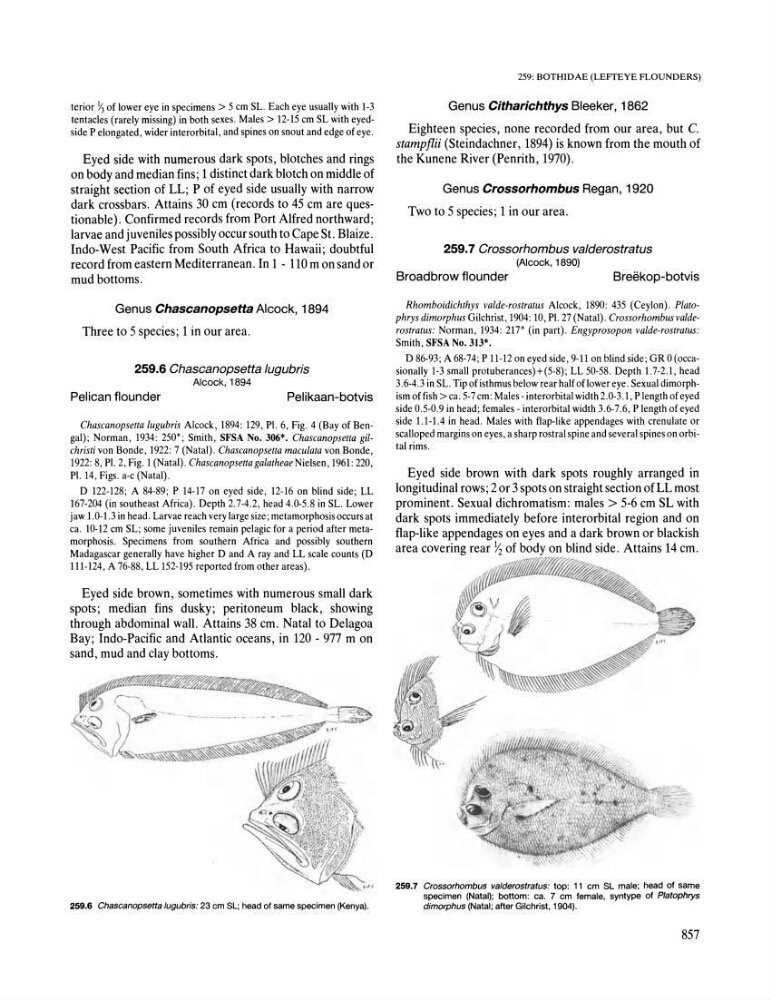
259.6 Chascanopsetta lugubris: 23 em SL; head of same specimen (Kenya).
259: BOTHIDAE (LEFTEYE FLOUNDERS)
Genus Citharichthys Bleeker, 1862
Eighteen species, none recorded from our area, but C.
stampflii (Steindachner, 1894) is known from the mouth of
the Kunene River (Penrith, 1970).
Genus Crossorhombus Regan, 1920
Two to 5 species; 1 in our area.
259.7 Crossorhombus valderostratus
(Alcock, 1890)
Broadbrow flounder
Breekop-botvis
Rhomboidichthys valde-rostratus Alcock, 1890: 435 (Ceylon). Platophrys dimorphus Gilchrist, 1904: 10, PI. 27 (Natal). Crossorhombus valderostratus: Norman, 1934: 217* (in part). Engyprosopon valde-rostratus:
Smith, SFSA No. 313*.
D 86-93; A 68-74; P 11-12 on eyed side, 9-11 on blind side; GR 0 (occasionally 1-3 small protuberances)+(5-8); LL 50-58. Depth 1.7-2.1, head
3.6-4.3 in SL. Tip of isthmus below rear half of lower eye. Sexual dimorphism offish> ca. 5-7 cm: Males - interorbital width 2.0-3.1, P length of eyed
side 0.5-0.9 in head; females - interorbital width 3.6-7.6, P length of eyed
side 1.1-1.4 in head. Males with flap-like appendages with crenulate or
scalloped margins on eyes, a sharp rostral spine and several spines on orbital rims.
Eyed side brown with dark spots roughly arranged in
longitudinal rows; 2 or 3 spots on straight section of LL most
prominent. Sexual dichromatism: males> 5-6 cm SL with
dark spots immediately before interorbital region and on
flap-like appendages on eyes and a dark brown or blackish
area covering rear Yz of
on blind side. Attains 14 cm.
259.7 Crossorhombus valr;lerostratus: top: 11 em SL male; head of same
specimen (Natal); bottom: ca. 7 em female, syntype of Platophrys
r;limorphus (Natal; after Gilchrist, 1904).
857