

9.1 Carcharhinus albimarginatus
(Ruppeil, 1837)
Silvertip shark
Silwertiphaai
Carcharias albimarginalus Riippell, 1837: 64, PI. 18, Fig. 1 (Red Sea).
Carcharhinus albimarginalus: Bass et aI., 1973: 17*; Smith, 1980: 173;
Garrick, 1982: 116*.
Distinctive white tips and margins on otherwise dark fins. Interdorsal
.
13-1 or 2-13
rIdge present. Teeth 12-1 or 2-12' Pre caudal vertebrae 115-121.
Usually 5 or 6, sometimes up to 11 pups per litter, born at
70-80 cm; mature at 175 cm (males) and 2.0 m (females);
attains 2.7 m. Eats fish; could be dangerous. Common in
tropical parts of southwest Indian Ocean, ranges south to
Cape Vidal. Usually found near offshore banks but also
comes into shallow inshore waters and has been taken over
deep water near offshore banks and islands. Occurs widely
in tropical Indian Ocean and the western and eastern Pacific,
but noticeably absent from Australia, central Pacific and
Atlantic Ocean.
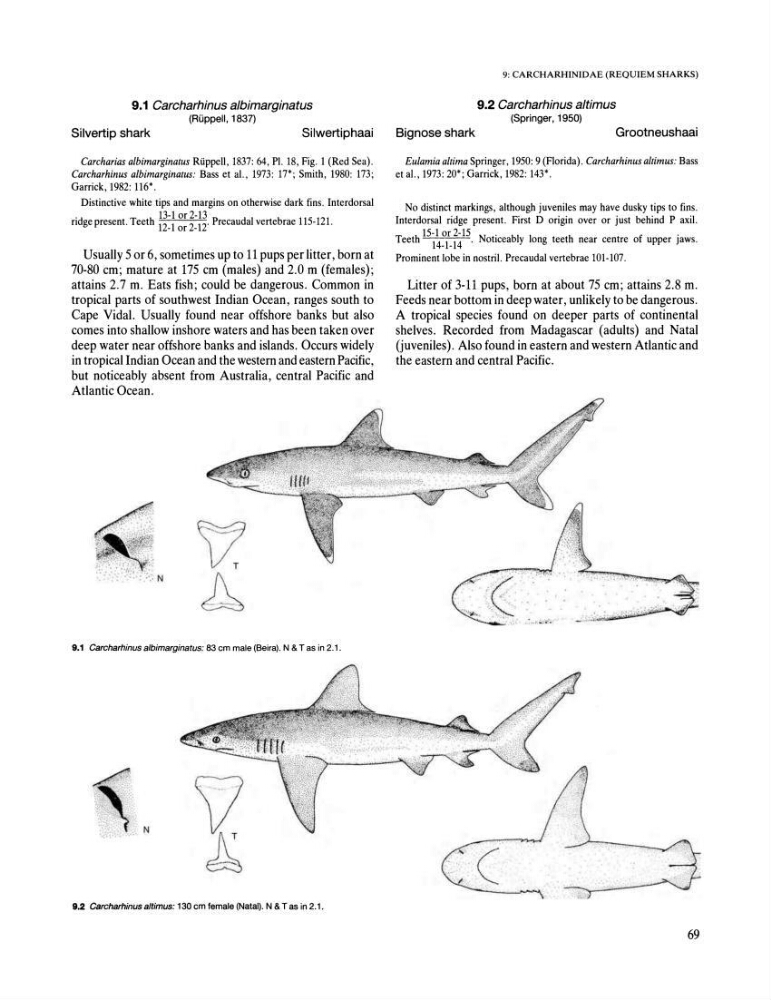
9.1 Carcharhinus albimarginatus: 83 em male (Beira). N & T as in 2.1.
N
9.2 Carcharhinus a/timus: 130 em female (Natal). N & T as in 2.1.
Bignose shark
9: CARCHARHINIDAE (REQUIEM SHARKS)
9.2 Carcharhinus altimus
(Springer, 1950)
Grootneushaai
Eulamia allima Springer, 1950: 9 (Florida). Carcharhinus allimus: Bass
et aI., 1973: 20*; Garrick, 1982: 143*.
No distinct markings, although juveniles may have dusky tips to fins.
Interdorsal ridge present. First D origin over or just behind P axil.
15-1 or 2-15
.
.
Teeth 14-1-14 . Noticeably long teeth near centre of upper Jaws.
Prominent lobe in nostril. Precaudal vertebrae 101-107.
Litter of 3-11 pups, born at about 75 cm; attains 2.8 m.
Feeds near bottom in deep water, unlikely to be dangerous.
A tropical species found on deeper parts of continental
shelves. Recorded from Madagascar (adults) and Natal
(juveniles). Also found in eastern and western Atlantic and
the eastern and central Pacific.
. ..... :- ..... . . .. . . ,.,;:.:. -.... .
(
69
(Ruppeil, 1837)
Silvertip shark
Silwertiphaai
Carcharias albimarginalus Riippell, 1837: 64, PI. 18, Fig. 1 (Red Sea).
Carcharhinus albimarginalus: Bass et aI., 1973: 17*; Smith, 1980: 173;
Garrick, 1982: 116*.
Distinctive white tips and margins on otherwise dark fins. Interdorsal
.
13-1 or 2-13
rIdge present. Teeth 12-1 or 2-12' Pre caudal vertebrae 115-121.
Usually 5 or 6, sometimes up to 11 pups per litter, born at
70-80 cm; mature at 175 cm (males) and 2.0 m (females);
attains 2.7 m. Eats fish; could be dangerous. Common in
tropical parts of southwest Indian Ocean, ranges south to
Cape Vidal. Usually found near offshore banks but also
comes into shallow inshore waters and has been taken over
deep water near offshore banks and islands. Occurs widely
in tropical Indian Ocean and the western and eastern Pacific,
but noticeably absent from Australia, central Pacific and
Atlantic Ocean.
9.1 Carcharhinus albimarginatus: 83 em male (Beira). N & T as in 2.1.
N
9.2 Carcharhinus a/timus: 130 em female (Natal). N & T as in 2.1.
Bignose shark
9: CARCHARHINIDAE (REQUIEM SHARKS)
9.2 Carcharhinus altimus
(Springer, 1950)
Grootneushaai
Eulamia allima Springer, 1950: 9 (Florida). Carcharhinus allimus: Bass
et aI., 1973: 20*; Garrick, 1982: 143*.
No distinct markings, although juveniles may have dusky tips to fins.
Interdorsal ridge present. First D origin over or just behind P axil.
15-1 or 2-15
.
.
Teeth 14-1-14 . Noticeably long teeth near centre of upper Jaws.
Prominent lobe in nostril. Precaudal vertebrae 101-107.
Litter of 3-11 pups, born at about 75 cm; attains 2.8 m.
Feeds near bottom in deep water, unlikely to be dangerous.
A tropical species found on deeper parts of continental
shelves. Recorded from Madagascar (adults) and Natal
(juveniles). Also found in eastern and western Atlantic and
the eastern and central Pacific.
. ..... :- ..... . . .. . . ,.,;:.:. -.... .
(
69