

Escolar
247.3 Lepidocybium flavobrunneum
(Smith, 1843)
Skolier
eybium flavo-brunneum Smith, 1843: PI. 20 (Cape of Good Hope).
Lepidocybium flavobrunneum: Smith, SFSA No. 862*; Parin & Bekker,
1973: 458.
D VIII-XIII6-18 + 4-6 finlets; A 13-15 + 4-5 finlets; P 15-17; VI,S.
Depth about 4.5. Scales small, each surrounded by a network of tubules
bearing pores. Body uniformly dark brown, becoming almost black with
age.
Attains almost 2 m. Flesh very oily, with purgative
properties. Previously thought to be rare, but recently
found to be sporadically distributed in tropical and subtropical waters of all oceans.
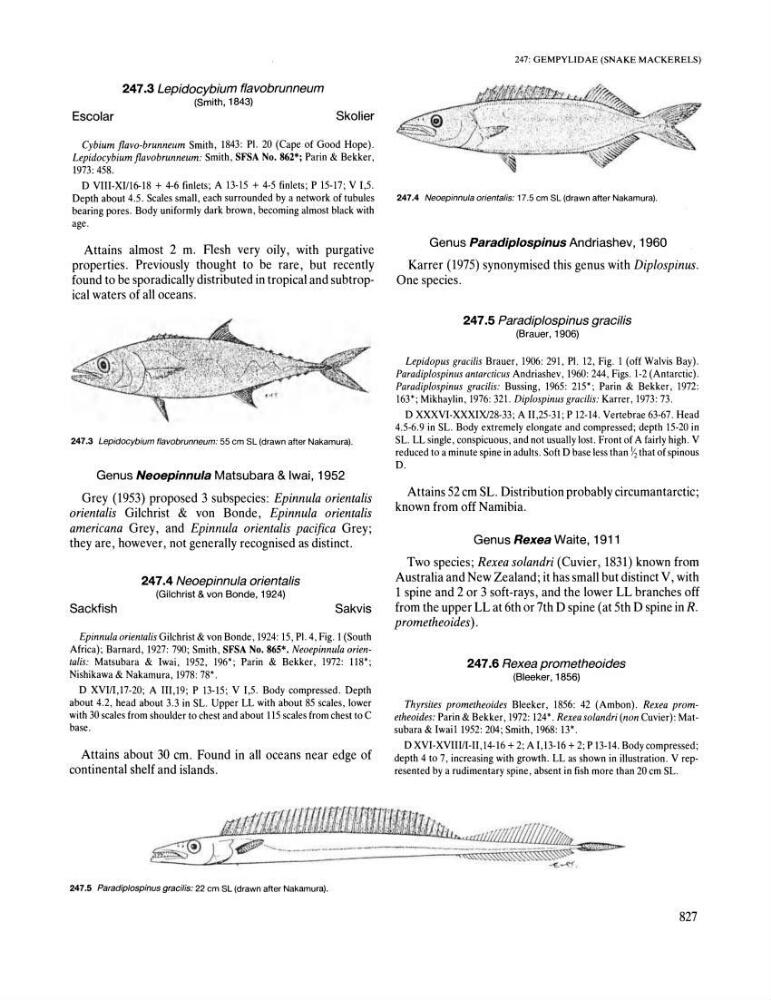
247.3 Lepidocybium flavobrunneum: 55 cm SL (drawn after Nakamura).
Genus Neoepinnu/a Matsubara & Iwai, 1952
Grey (1953) proposed 3 subspecies: Epinnula orientalis
orientalis Gilchrist & von Bonde, Epinnula orientalis
americana Grey, and Epinnula orientalis pacifica Grey;
they are, however, not generally recognised as distinct.
Sackfish
247.4 Neoepinnula orienta/is
(Gilchrist & von Bonde, 1924)
Sakvis
Epinnula orientalis Gilchrist & von Bonde, 1924: 15, PI. 4, Fig. 1 (South
Africa); Barnard, 1927: 790; Smith, SFSA No. 865*. Neoepinnula orientalis: Matsubara & Iwai, 1952, 196*; Parin & Bekker, 1972: 118*;
Nishikawa & Nakamura, 1978: 78*.
D XVIII ,17-20; A III,19; P 13-15; V I,5. Body compressed. Depth
about 4.2, head about 3.3 in SL. Upper LL with about 85 scales, lower
with 30 scales from shoulder to chest and about 115 scales from chest to C
base.
Attains about 30 cm. Found in all oceans near edge of
continental shelf and islands.
247.5 Paradip/ospinus graci/is: 22 cm SL (drawn after Nakamura).
247: GEMPYLIDAE (SNAKE MACKERELS)
247.4 Neoepinnu/a orienta/is: 17.5 em SL (drawn after Nakamura).
Genus Paradip/ospinus Andriashev, 1960
Karrer (1975) synonymised this genus with Diplospinus.
One species.
247.5 Paradiplospinus graCilis
(Brauer, 1906)
Lepidopus gracilis Brauer, 1906: 291, PI. 12, Fig. 1 (off Walvis Bay).
Paradiplospinus antarcticus Andriashev, 1960: 244, Figs. 1-2 (Antarctic).
Paradiplospinus gracilis: Bussing, 1965: 215*; Parin & Bekker, 1972:
163*; Mikhaylin, 1976: 321. Diplospinus gracilis: Karrer, 1973: 73.
D XXXVI-XXXlx/28-33; A II,25-31; P 12-14. Vertebrae 63-67. Head
4.5-6.9 in SL. Body extremely elongate and compressed; depth 15-20 in
SL. LL single, conspicuous, and not usually lost. Front of A fairly high. V
reduced to a minute spine in adults. Soft D base less than IS that of spinous
D.
Attains 52 cm SL. Distribution probably circumantarctic;
known from off Namibia.
Genus Rexea Waite, 1911
Two species; Rexea solandri (Cuvier, 1831) known from
Australia and New Zealand; it has small but distinct V, with
1 spine and 2 or 3 soft-rays, and the lower LL branches off
from the upper LL at 6th or 7th D spine (at 5th D spine in R.
prometheoides) .
247.6 Rexea prometheoides
(Bleeker, 1856)
Thyrsites prometheoides Bleeker, 1856: 42 (Ambon). Rexea prometheoides: Parin & Bekker, 1972: 124 *. Rexea solandri (non Cuvier): Matsubara & Iwai11952: 204; Smith, 1968: 13*.
D XVI-XVIII/I-II,14-16 + 2; A I,13-16 + 2; P 13-14. Body compressed;
depth 4 to 7, increasing with growth. LL as shown in illustration. V represented by a rudimentary spine, absent in fish more than 20 em SL.
827