

Colour in life variable, depending on mood of fish and
colour of substrate; cream or pearly spots or ocelli evenly
spaced over sides, largest spots bigger than pupil.
Frightened, injured and dead fish marbled light and dark
brown, obscuring large spots; marbling often takes the form
of 6 irregular, dark diagonal zones alternating with paler;
belly usually dappled with small light and dark brown spots.
Dark blotch, slightly smaller than eye, sometimes present at
LL origin. Attains 45 cm. Lives in schools around weedy
areas of sandy flats and rock and coral reefs. Abundant
from Delagoa Bay northwards, stragglers as far south as
Knysna. Restricted to western Indian Ocean: South Africa
to Kenya, Seychelles, Comores, Madagascar, Reunion,
Mauritius and Rodriguez.
245.2 Siganus sutor: 16 em
Family No. 246: SCOMBROLABRACIDAE
by I. Nakamura
Black mackerel
Swartmakriel
Body moderately elongate and compressed. Upper jaws
slightly protractile; 2 or 3 large fangs at front of upper jaw;
strong lateral teeth of upper jaw more numerous and smaller than those of lower jaw; small teeth on vomer and
palatines. Two nostrils on each side of snout. Four or 5 welldeveloped, denticulate gill-rakers on lower limb; about 1(')
clusters of minute spines on upper limb, and a large denticulate raker at corner of first arch. Base of first dorsal fin twice
longer than base of second dorsal fin. No keels on caudal
peduncle. Lateral line single, running close to dorsal contour. Scales irregular in size and shape, very deciduous.
Vertebrae 13+17 = 30; 5th-12th vertebrae of adult with
large lateral swellings into which fit evaginations of the gasbladder (Bond & Uyeno, 1981).
A single species; placed in the Gempylidae by some
authors (e.g. Grey, 1960; Gosline, 1968).
246.1 Scombrolabrax heterolepis
Roule, 1922
Black mackerel
Swartmakriel
. Scombr?labrax heterolepis Roule, 1922: 1, Figs. 1-4 (Madeira); Higgms, Mon & Uyeno, 1970: 51*; Potthoff, Richards & Ueyanagi, 1980:
331 *.
247: GEMPYLIDAE (SNAKE MACKERELS)
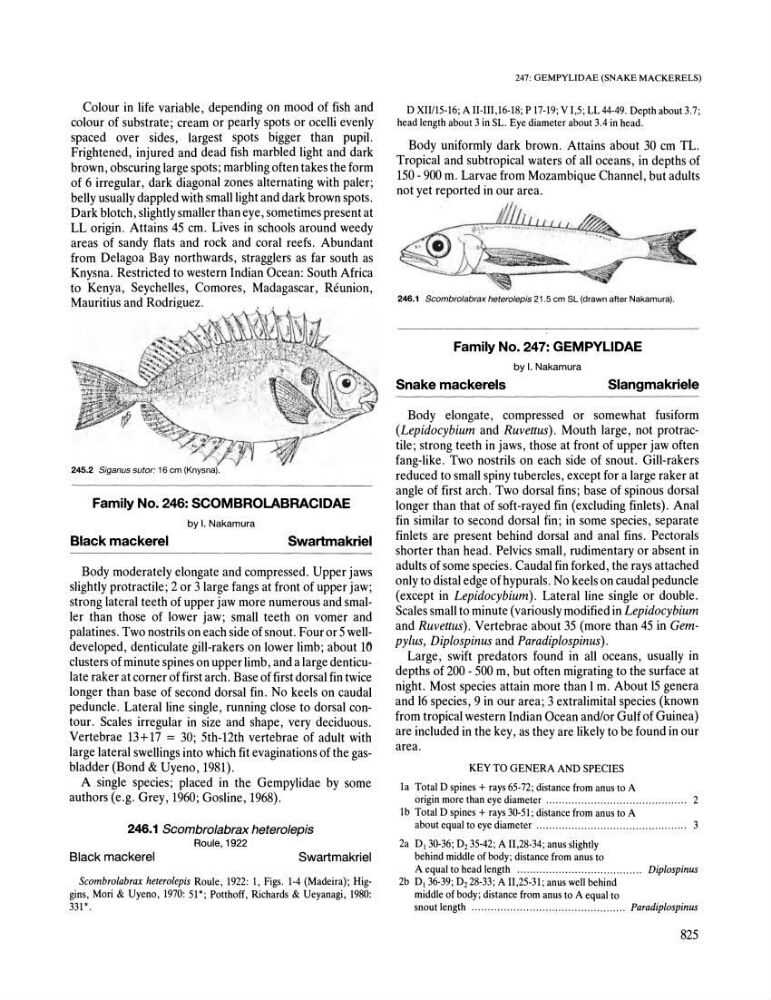
D XII/15-16; A II-III,16-18; P 17-19; V 1,5; LL 44-49. Depth about 3.7;
head length about 3 in SL. Eye diameter about 3.4 in head.
Body uniformly dark brown. Attains about 30 cm TL.
Tropical and subtropical waters of all oceans, in depths of
150 - 900 m. Larvae from Mozambique Channel, but adults
not yet reported in our area.
246.1 Seombrolabrax heterolepis 21.5 em SL (drawn after Nakamura).
Family No. 247: GEMPYLIDAE
by I. Nakamura
Snake mackerels
Siangmakriele
Body elongate, compressed or somewhat fusiform
(Lepidocybium and Ruvettus). Mouth large, not protractile; strong teeth in jaws, those at front of upper jaw often
fang-like. Two nostrils on each side of snout. Gill-rakers
reduced to small spiny tubercles, except for a large raker at
angle of first arch. Two dorsal fins; base of spinous dorsal
longer than that of soft -rayed fin (excluding finlets). Anal
f~n similar to second dorsal fin; in some species, separate
fmlets are present behind dorsal and anal fins. Pectorals
shorter than head. Pelvics small, rudimentary or absent in
adults of some species. Caudal fin forked, the rays attached
only to distal edge of hypurals. No keels on caudal peduncle
(except in Lepidocybium). Lateral line single or double.
Scales small to minute (variously modified in Lepidocybium
and Ruvettus). Vertebrae about 35 (more than 45 in Gempylus, Diplospinus and Paradiplospinus).
Large, swift predators found in all oceans, usually in
depths of 200 - 500 m, but often migrating to the surface at
night. Most species attain more than I m. About IS genera
and 16 species, 9 in our area; 3 extralimital species (known
from tropical western Indian Ocean and/or Gulf of Guinea)
are included in the key, as they are likely to be found in our
area.
KEY TO GENERA AND SPECIES
1a Total D spines + rays 65-72; distance from anus to A
origin more than eye diameter ............................................ 2
1b Total D spines + rays 30-51; distance from anus to A
about equal to eye diameter ............................................... 3
2a D, 30-36; D2 35-42; A II,28-34; anus slightly
behind middle of body; distance from anus to
A equal to head length ....................................... Diplospinus
2b D,36-39; D2 28-33; A II,25-31; anus well behind
middle of body; distance from anus to A equal to
snout length ................................................ Paradiplospinus
825