

D VI+I,13-14; A 1,13-14; P 18-20; LS 45-55 ; TRB 14-18; GR (1-3}+9.
Scales cycloid; midline of nape naked, sides scaled to above operculum;
fifth D spine longest.
Attains 7.5 cm. Red Sea to Inhaca.
Genus Yongeichfhys Whitley, 1932
Scales large , ctenoid; head naked, with longitudinal
papillae pattern; gill opening equals P base; V united. D
VI+I,8-9; A 1,9; P 18-19; LS 26-30. Vertebrae 26. Tropical
species found on muddy bottoms in mangroves or continental shelf muds. Most easily confused with the extralimital
Acentrogobius, which has head scales, andAmoya, which is
more slender bodied and has a slightly different head papillae pattern. About 3 species, 1 in our area.
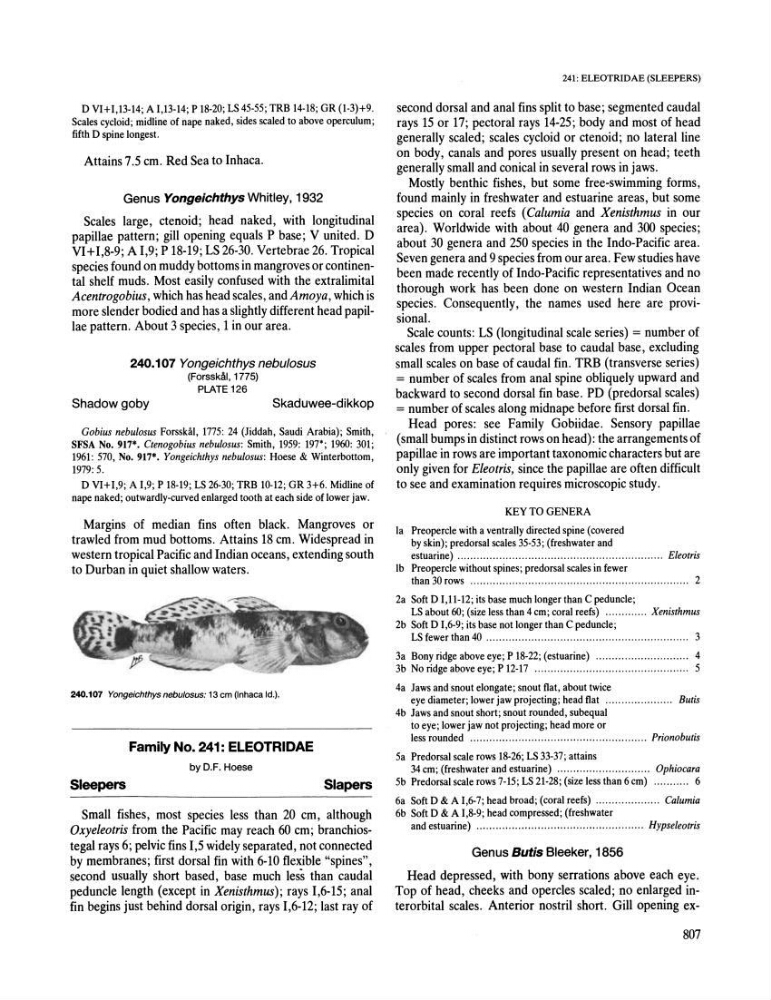
240.107 Yongeichthys nebulosus
(Forsskal. 1775)
PLATE 126
Shadowgoby
Skaduwee-dikkop
Gobius nebulosus Forsskfll , 1775: 24 (Jiddah , Saudi Arabia); Smith,
SFSA No. 917*. Ctenogobius nebulosus: Smith, 1959: 197*; 1960: 301;
1961: 570, No. 917*. Yongeichthys nebulosus: Hoese & Winterbottom,
1979: 5.
D VI+I ,9; A 1,9; P 18-19; LS 26-30; TRB 10-12; GR 3+6. Midline of
nape naked ; outwardly-curved enlarged tooth at each side of lower jaw.
Margins of median fins often black . Mangroves or
trawled from mud bottoms. Attains 18 cm. Widespread in
western tropical Pacific and Indian oceans, extending south
to Durban in quiet shallow waters.
240.107 Yongeichthys nebulosus: 13 cm (Inhaca Id.).
Sleepers
Family No. 241: ELEOTRIDAE
by D.F. Hoese
Siapers
Small fishes, most species less than 20 cm, although
Oxyeieotris from the Pacific may reach 60 cm; branchiostegal rays 6; pelvic fins 1,5 widely separated, not connected
by membranes; first dorsal fin with 6-10 flexible "spines",
second usually short based, base much less than caudal
peduncle length (except in Xenisthmus); rays 1,6-15; anal
fin begins just behind dorsal origin, rays 1,6-12; last ray of
241 : ELEOTRIDAE (SLEEPERS)
second dorsal and anal fins split to base ; segmented caudal
rays 15 or 17; pectoral rays 14-25; body and most of head
generally scaled; scales cycloid or ctenoid; no lateral line
on body, canals and pores usually present on head; teeth
generally small and conical in several rows in jaws.
Mostly benthic fishes, but some free-swimming forms,
found mainly in freshwater and estuarine areas, but some
species on coral reefs (Calumia and Xenisthmus in our
area) . Worldwide with about 40 genera and 300 species;
about 30 genera and 250 species in the Indo-Pacific area.
Seven genera and 9 species from our area. Few studies have
been made recently of Indo-Pacific representatives and no
thorough work has been done on western Indian Ocean
species. Consequently, the names used here are provisional.
Scale counts: LS (longitudinal scale series) = number of
scales from upper pectoral base to caudal base, excluding
small scales on base of caudal fin. TRB (transverse series)
= number of scales from anal spine obliquely upward and
backward to second dorsal fin base. PD (predorsal scales)
= number of scales along midnape before first dorsal fin.
Head pores: see Family Gobiidae. Sensory papillae
(small bumps in distinct rows on head) : the arrangements of
papillae in rows are important taxonomic characters but are
only given for Eleotris, since the papillae are often difficult
to see and examination requires microscopic study.
KEY TO GENERA
la Preopercle with a ventrally directed spine (covered
by skin) ; predorsal scales 35-53; (freshwater and
estuarine) .. ................... ..... ...... .. ..... .... ... ... .... ... ... .... . Eleotris
Ib Preopercle without spines; predorsal scales in fewer
than 30 rows ...... ... .... .... .. ... ...... ... ....... .. ..... ........... .... ... ..... 2
2a Soft D 1,11-12; its base much longer than C peduncle;
LS about 60; (size less than 4 cm; coral reefs) ..... .... .. .. Xenisthmus
2b Soft D 1,6-9; its base not longer than C peduncle ;
LS fewer than 40 .. ...... .. ...... ... ..... ..... ... .. ... ........ .. ... ............. 3
3a Bony ridge above eye; P 18-22; (estuarine) ....... ... ... .... .. .... .... .. 4
3b No ridge above eye; P 12-17 ... ... .... ... ... .. ... ..... .... ..... ... .... ... ... 5
4a Jaws and snout elongate; snout flat , about twice
eye diameter; lower jaw projecting; head flat ..... ... ... .... ..... . Butis
4b Jaws and snout short; snout rounded, subequal
to eye; lower jaw not projecting; head more or
less rounded .......... ... .. ..... ... ... ... ..... .. ......... ..... ..... Prionobutis
5a Predorsal scale rows 18-26; LS 33-37; attains
34 cm; (freshwater and estuarine) ....... .... .... ....... ..... .. Ophiocara
5b Predorsal scale rows 7-15 ; LS 21-28; (size less than 6 cm) ... ....... . 6
6a Soft D & A 1,6-7; head broad; (coral reefs) .... ..... .. ...... ... Calumia
6b Soft D & A 1,8-9; head compressed; (freshwater
and estuarine) ... ...... ... ... .. ....... .. ... .... ... ... ... .... .. .... Hypseleotris
Genus Sufis Bleeker, 1856
Head depressed, with bony serrations above each eye.
Top of head, cheeks and opercles scaled; no enlarged interorbital scales. Anterior nostril short. Gill opening ex807