

240: GOBJIDAE (GOBlES)
upper jaw; no flaps on shoulder girdle; tongue largely fused
to floor of mouth, tip free; lower jaw curved slightly upward
in front. V a disc. Gill opening to under mid-operculum.
Scales ctenoid. D VI + l,lD-11; A 1,11-12; P20-22; LS 24-27.
Easily confused with Oxyurichthys, which has 1 row of teeth
in upper jaw, and typically higher scale and D counts. Few
species, tropical, found in muddy estuaries and coastal
bays; 2 species in our area.
KEY TO SPECIES
la No preopercular pores; maxilla reaching to or
beyond rear edge of eye in adults; dark brown
bar from eye forward and downward to middle
of upper jaw; body often with small oblique bars;
D VI+I,ll .......................................................... O. keiensis
Ib Preopercular pores present; maxilla not' reaching
past eye in adult; dark brown bar from below eye
to behind end of jaws; no oblique bars on body;
D VI + 1,10 ..................................................... O. acutipennis
240.65 Oligolepis acutipennis
(Valenciennes, 1837)
Sharptail goby
Skerpstert-dikkop
Gobius acutipennis Valenciennes, in Cuv. & Val., 1837: 80 (Malabar,
India); Smith, SFSA No. 923. Ctenogobius acutipennis: Smith, 1959: 196
(in part); 1960 (in part); 1961: 570, No. 923.
D VI+ 1,10; A 1,11; P 20-21; LS 25-27; TRB 6-7; GR 1+6. D spines 3-5
prolonged and filamentous in male. Predorsal, P base and prepelvic
naked; midline of belly scaled.
Body brownish with numerous dark blotches along back;
a series of faint blotches, equal to eye, on midside, the last
at C base. Fins clear to dusky, often spotted. Attains 13 cm.
Indo-West Pacific south to Great Fish River.
240.65 Oligolepis aeutipennis: 4.5 em SL (Natal).
Kei goby
240.66 Oligolepis keiensis
(Smith, 1938)
PLATE 124
Kei-dikkop
Gobius keiensis Smith, 1938: 319, Fig. 1 (Kei River mouth); Smith,
SFSA No. 928*. Ctenogobius acutipennis: Smith, 1959: 196* (in part).
Ctenogobius keiensis: Smith, 1960: 301; 1961: 570, No. 928. Gobionellus
keiensis: Hoese & Winterbottom, 1979: 4.
D VI + I,ll; A I,12; P 20-22; LS 26-28; TRB 8-9; GR 3+4.C longer than
head in adult. D spines 2-5 prolonged in male. Predorsal, P base, prepelvic
and midline of belly naked.
796
Body grey or brown with dark brown oblique streaks on
side; a black spot equal to pupil on upper peduncle at base
of C; V blackish in adult. Attains 7 cm. Seychelles,
Madagascar and Inhaca to Fish River mouth.
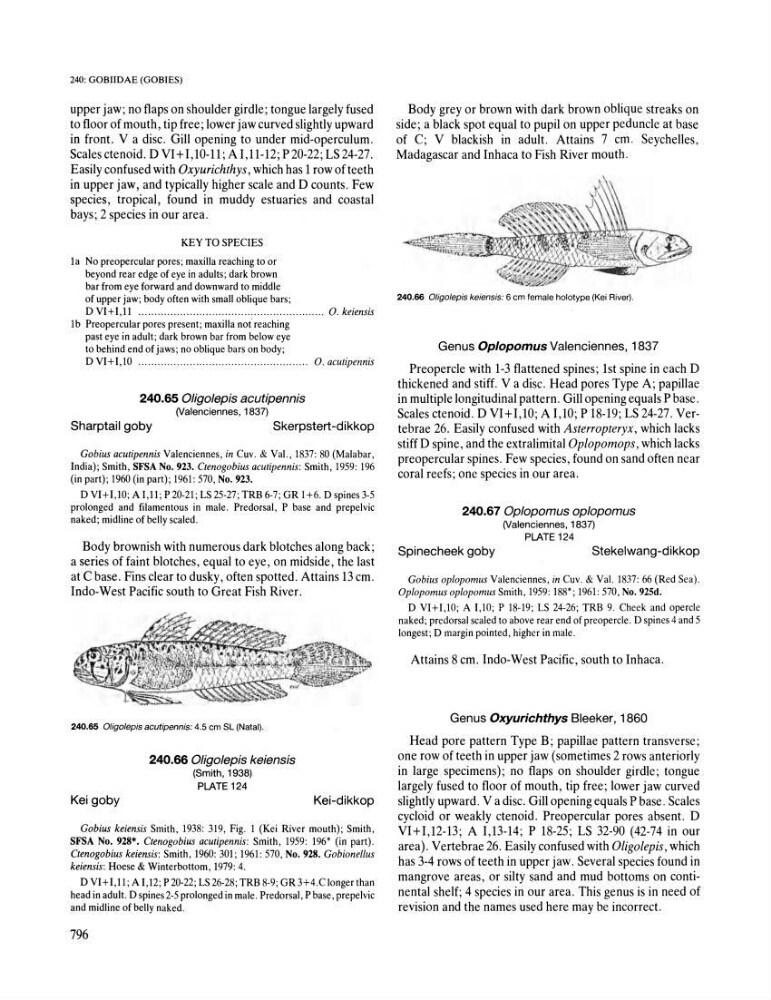
240.66 O/igolepis keiensis: 6 em female holotype (Kei River).
Genus Op/opomus Valenciennes, 1837
Preopercle with 1-3 flattened spines; 1st spine in each D
thickened and stiff. Va disc. Head pores Type A; papillae
in multiple longitudinal pattern. Gill opening equals P base.
Scales ctenoid. D VI+ l,lD; A l,lD; P 18-19; LS 24-27. Vertebrae 26. Easily confused with Asterropteryx, which lacks
stiffD spine, and the extralimital Oplopomops, which lacks
preopercular spines. Few species, found on sand often near
coral reefs; one species in our area.
240.67 Oplopomus oplopomus
(Valenciennes, 1837)
PLATE 124
Spinecheek goby
Stekelwang-dikkop
Gobius oplopomus Valenciennes, in Cuv. & Val. 1837: 66 (Red Sea).
Oplopomus oplopomus Smith, 1959: 188*; 1961: 570, No. 925d.
D VI+I,IO; A I,10; P 18-19; LS 24-26; TRB 9. Cheek and opercle
naked; predorsal scaled to above rear end of preopercle. D spines 4 and 5
longest; D margin pointed, higher in male.
Attains 8 cm. Indo-West Pacific, south to Inhaca.
Genus Oxyurichthys Bleeker, 1860
Head pore pattern Type B; papillae pattern transverse;
one row of teeth in upper jaw (sometimes 2 rows anteriorly
in large specimens); no flaps on shoulder girdle; tongue
largely fused to floor of mouth, tip free; lower jaw curved
slightly upward. Va disc. Gill opening equals P base. Scales
cycloid or weakly ctenoid. Preopercular pores absent. D
VI+I,12-13; A 1,13-14; P 18-25; LS 32-90 (42-74 in our
area). Vertebrae 26. Easily confused with Oligolepis, which
has 3-4 rows of teeth in upper jaw. Several species found in
mangrove areas, or silty sand and mud bottoms on continental shelf; 4 species in our area. This genus is in need of
revision and the names used here may be incorrect.