

240: GOBIIDAE (GOBlES)
stripe ventrally; V with elongate blue spots. Close to A. fasciata (Herre, 1953) which has narrower bands and separate
V. Indo-West Pacific, south to Sodwana Bay.
Genus Amb/ygobius Bleeker, 1874
Gill opening just below P base; V a disc; 10-15 short
vertical papillae rows under eye; head pores Type A;
filamentous projections on upper part of first gill arch.
D VI+I,13-17; A 1,12-16; P 18-22; LS 46-69, cycloid or
ctenoid. Vertebrae 26. Found on coral reefs. About 15
species; 2 in our area.
KEY TO SPECIES
la First D margin rounded, 5th spine longest;
no dark spot above P base ........................................ A. sphynx
Ib First D with middle spines distinctly prolonged;
enlarged brown spot above P base ..................... A. albimaculatus
240.4 Amblygabius albimaculatus
(Ruppel!, 1830)
PLATE 112
Butterfly gaby
Vlinder-dikkop
Gobius albimaculatus Riippell, 1830: 135 (Red Sea). Gobius albomaculatus: Smith, SFSA No. 933*. Amblygobius albimaculatus: Smith, 1959:
204*; 1960: 308; 1961: 570, No. 933*. Gobius vonbondei Smith, 1936: 259
Fig. or PI. (Natal).
D VI+I,13-15; A 1,12-14; P 19-21; LS 47-51; TRB 17-20; PD 21-25, to
above middle of eye; operculum scaled dorsally; body scales ctenoid.
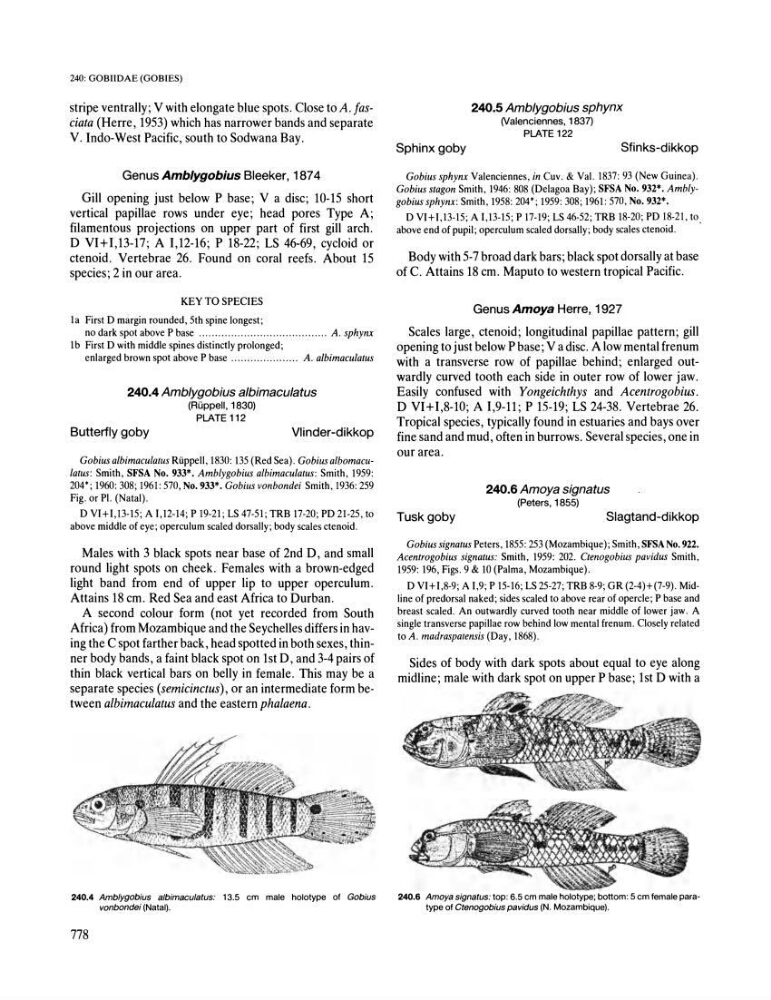
Males with 3 black spots near base of 2nd D, and small
round light spots on cheek. Females with a brown-edged
light band from end of upper lip to upper operculum.
Attains 18 cm. Red Sea and east Africa to Durban.
A second colour form (not yet recorded from South
Africa) from Mozambique and the Seychelles differs in having the C spot farther back, head spotted in both sexes, thinner body bands, a faint black spot on 1st D, and 3-4 pairs of
thin black vertical bars on belly in female. This may be a
separate species (semicinctus), or an intermediate form between albimaculatus and the eastern phalaena.
240.4 Amblygobius albimaculatus: 13.5 em male holotype of Gobius
vonbondei (Natal).
778
240.5 Amb/ygabius sphynx
(Valenciennes, 1837)
PLATE 122
Sphinx goby
Sfinks-dikkop
Gobius sphynx Valenciennes, in Cuv. & Val. 1837: 93 (New Guinea).
Gobius stagon Smith, 1946: 808 (Delagoa Bay); SFSA No. 932*. Amblygobius sphynx: Smith, 1958: 204*; 1959: 308; 1961: 570, No. 932*.
D VI+I,13-15; A 1,13-15; P 17-19; LS 46-52; TRB 18-20; PD 18-21, to
above end of pupil; operculum scaled dorsally; body scales ctenoid.
Body with 5-7 broad dark bars; black spot dorsally at base
of C. Attains 18 cm. Maputo to western tropical Pacific.
Genus Amoya Herre, 1927
Scales large, ctenoid; longitudinal papillae pattern; gill
opening to just below P base; V a disc. A low mental frenum
with a transverse row of papillae behind; enlarged outwardly curved tooth each side in outer row of lower jaw.
Easily confused with Yongeichthys and Acentrogobius.
D VI+I,8-1O; A 1,9-11; P 15-19; LS 24-38. Vertebrae 26.
Tropical species, typically found in estuaries and bays over
fine sand and mud, often in burrows. Several species, one in
our area.
Tusk goby
240.6 Amaya signatus
(Peters, 1855)
Siagtand-dikkop
Gobius signatus Peters, 1855: 253 (Mozambique); Smith, SFSA No. 922.
Acentrogobius signatus: Smith, 1959: 202. Ctenogobius pavidus Smith,
1959: 196, Figs. 9 & 10 (Palma, Mozambique).
D VI+ 1,8-9; A 1,9; P 15-16; LS 25-27; TRB 8-9; GR (2-4)+(7-9). Midline of pre dorsal naked; sides scaled to above rear of opercle; P base and
breast scaled. An outwardly curved tooth near middle of lower jaw. A
single transverse papillae row behind low mental frenum. Closely related
to A. madraspatensis (Day, 1868).
Sides of body with dark spots about equal to eye along
midline; male with dark spot on upper P base; 1st D with a
240.6 Amoya signatus: top: 6.5 em male holotype; bottom: 5 em female paratype of Ctenogobius pavidus (N. Mozambique).