

Family No.6: ECHINORHINIDAE
by A.J. Bass & L.J.V. Compagno
Bramble sharks
Braamhaaie
Dorsal fins without spines; first dorsal origin behind origin of pelvics. No anal fin. Spiracle minute. Teeth similar in
both jaws, with 1 cusp in juveniles but 3-7 cusps in adults.
Lateral line an open furrow along sides of body, its walls
supported by incomplete skeletal rings whose free ends project as spines along edges of furrow, bridged at irregular intervals by narrow cross-connections of skin. Caudal tip
pointed, without subterminal notch. One genus,
Echinorhinus Blainville, 1816 with 2 species. Only
Echinorhinus brucus has been reported from our area; E.
cookei Pietsch mann , 1928, widespread in the Pacific
Ocean, may also occur here.
KEY TO SPECIES
la Dermal denticles small (not more than 4 mm in
basal diameter) , numerous and uniformly distributed,
with deeply indented, angular bases and prominently
ridged spines; skin of adults almost smooth under
snout and around mouth ....... ........... ......................... E. cookei
~
T
N
.'
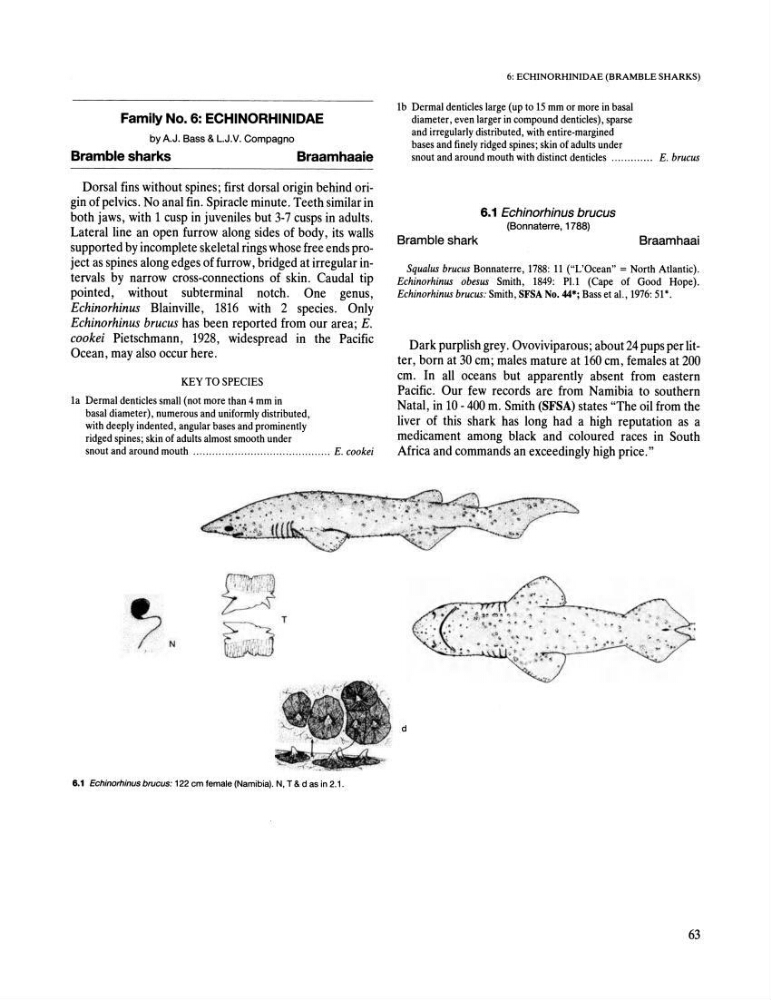
6.1 Echinorhinus brucus: 122 em female (Namibia). N. T & d as in 2.1.
6: ECHINORHINIDAE (BRAMBLE SHARKS)
Ib Dermal denticles large (up to 15 mm or more in basal
diameter, even larger in compound denticles), sparse
and irregularly distributed, with entire-margined
bases and finely ridged spines; skin of adults under
snout and around mouth with distinct denticles ............. E. brucus
Bramble shark
6.1 Echinorhinus brucus
(Bonnaterre, 1788)
Braamhaai
Squalus brucus Bonnaterre, 1788: 11 ("L'Ocean" = North Atlantic).
Echinorhinus obesus Smith, 1849: Pl.1 (Cape of Good Hope).
Echinorhinus brucus: Smith, SFSA No. 44*; Bass et al., 1976: 51".
Dark purplish grey. Ovoviviparous; about 24 pups per litter' born at 30 cm; males mature at 160 cm, females at 200
cm. In all oceans but apparently absent from eastern
Pacific. Our few records are from Namibia to southern
Natal, in 10 - 400 m. Smith (SFSA) states "The oil from the
liver of this shark has long had a high reputation as a
medicament among black and coloured races in South
Africa and commands an exceedingly high price."
~ ,
~
.. ... e ~
r. '::' ..
, •
d
63
by A.J. Bass & L.J.V. Compagno
Bramble sharks
Braamhaaie
Dorsal fins without spines; first dorsal origin behind origin of pelvics. No anal fin. Spiracle minute. Teeth similar in
both jaws, with 1 cusp in juveniles but 3-7 cusps in adults.
Lateral line an open furrow along sides of body, its walls
supported by incomplete skeletal rings whose free ends project as spines along edges of furrow, bridged at irregular intervals by narrow cross-connections of skin. Caudal tip
pointed, without subterminal notch. One genus,
Echinorhinus Blainville, 1816 with 2 species. Only
Echinorhinus brucus has been reported from our area; E.
cookei Pietsch mann , 1928, widespread in the Pacific
Ocean, may also occur here.
KEY TO SPECIES
la Dermal denticles small (not more than 4 mm in
basal diameter) , numerous and uniformly distributed,
with deeply indented, angular bases and prominently
ridged spines; skin of adults almost smooth under
snout and around mouth ....... ........... ......................... E. cookei
~
T
N
.'
6.1 Echinorhinus brucus: 122 em female (Namibia). N. T & d as in 2.1.
6: ECHINORHINIDAE (BRAMBLE SHARKS)
Ib Dermal denticles large (up to 15 mm or more in basal
diameter, even larger in compound denticles), sparse
and irregularly distributed, with entire-margined
bases and finely ridged spines; skin of adults under
snout and around mouth with distinct denticles ............. E. brucus
Bramble shark
6.1 Echinorhinus brucus
(Bonnaterre, 1788)
Braamhaai
Squalus brucus Bonnaterre, 1788: 11 ("L'Ocean" = North Atlantic).
Echinorhinus obesus Smith, 1849: Pl.1 (Cape of Good Hope).
Echinorhinus brucus: Smith, SFSA No. 44*; Bass et al., 1976: 51".
Dark purplish grey. Ovoviviparous; about 24 pups per litter' born at 30 cm; males mature at 160 cm, females at 200
cm. In all oceans but apparently absent from eastern
Pacific. Our few records are from Namibia to southern
Natal, in 10 - 400 m. Smith (SFSA) states "The oil from the
liver of this shark has long had a high reputation as a
medicament among black and coloured races in South
Africa and commands an exceedingly high price."
~ ,
~
.. ... e ~
r. '::' ..
, •
d
63