

237: CLINIDAE (KLIPFISHES)
dark longitudinal stripes. Attains 17.5 cm. In tide pools and
subtidally from Saldanha Bay to East London; not common.
Genus Cancelloxus Smith, 1961
Similar to Xenopoclinus, this genus has the typical elongate
body, naked head and minute embedded scales on body.
Vomer edentate; anterior nostril a tube with a flap-like cirrus sometimes terminally notched; P with central rays
longest and lower rays thickened.
KEY TO SPECIES
la Soft 0 rays 10-14; soft A rays 38-43 ............................ C. burrelli
Ib Soft 0 rays 3-4; soft A rays 27-32 ............................ C. elongatus
237.5 Cancelloxus burrelli
Smith,1961
Slender platanna-klipfish
Siank platanna-klipvis
Cancelloxus burrelli Smith, 1961: 355, Figs. 1 & 4 (Lambert's Bay);
Penrith, 1969: 103*.
o XXXIII-XXXIX,1O-14; A 11,38-43; P 13-15; V 1,3; GR (0-2)+(5-9);
vertebrae: females (20-21)+(44-45), males 19+(43-46); LL slopes gradually from shoulder to midline behind P; front LL of 69-71 single pores
opening more or less medially along line; rear LL has the usual clinid disjointed horizontal tubes with a pore each end; V resembles a webbed foot
with membranes joining the 3 well-developed rays able to be widely separated at the tips.
Semitranslucent, silvery, with 12 light brown saddles; LL
marked by white stripe; odd brownish mottled lines on pinkish head, iris golden with dark blotch in front; two white
bars across P base, remaining fins hyaline except for shading of saddles up D. Attains 12 cm. Lives in coarse shingle at
lowest part of intertidal zone on west coast from Orange
River Mouth southwards, but down to 20 m in the warmer
water of the south coast round to Algoa Bay.
237.6 Cancelloxus elongatus
Heemstra & Wright, 1986
Whiteblotched klipfish
Witgevlekde klipvis
Cancelloxus elongatus Heemstra & Wright, 1986:00 (off Storms River,
Tsitsikama coast).
o XXXVIII-XLIII,3-4; A 11,27-32; P 11-12; V 1,3; C 11-12; total GR
1-2+5 = 5-7; vertebrae (15-16)+(33-34).
Attains about 5 cm. Found on sandy areas near rocks in
10 - 25 m; from Storms River mouth to Algoa Bay.
Genus Cirrhibarbis Valenciennes, 1836
Always recognised by the barbels around the mouth.
Vomer dentate. Monotypic.
237.7 Cirrhibarbis capensis
Valenciennes, 1836
PLATE 117
Barbelled klipfish
Baard-klipvis
Cirrhibarbis capensis Valenciennes, in Cuv. & Val., 1836: 406, PI. 337
(Cape of Good Hope); Smith, 1946: 538; SFSA No. 977*; Smith & Smith,
1966: 108*. Clinus (Cirrhibarbis) capensis: Penrith, 1969: 26*.
o XXXVII-XLIV,5-9; A 11,26-34; P 12-14; V 1,2-3; GR (2-3)+(5-7);
vertebrae (18-21)+(32-37); LL with about 30 vertical pairs of pores in
front; flat supraorbital tentacle with fringe affine cirri at tip; 3-5 cirri at tip
of each dorsal spine; 11 barbels round mouth.
Colour variable, generally milky, cirri and edges of fins
generally vermillion; ocellus on shoulder remains long after
fish is uniform buff in preservative. Attains 35 cm. In rock
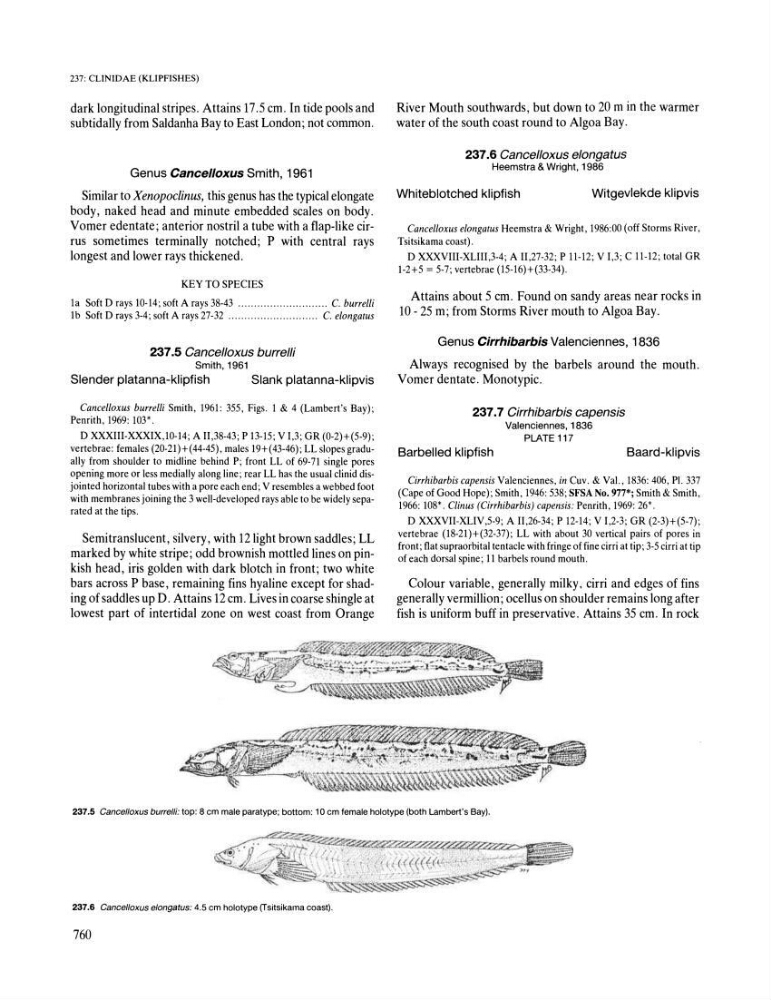
237.5 Caneelloxus burrelli: top: 8 em male paratype; bottom: 10 em female holotype (both Lambert's Bay).
237.6 Caneelloxus elongatus: 4.5 em holotype (Tsitsikama coast).
760