

236: TRIPTERYGIIDAE (THREEFIN BLENNIES)
Attains 45 mm. From Coffee Bay, Transkei to Red Sea
and western Indian Ocean.
Genus Norfolkia Fowler, 1953
Some 10 species, 1 in our area.
236.9 Norfolkia springeri
Clark,1979
Rough-head triplefin
Rowwekop-drievin
Norfolkia springeri Clark, 1979: 9S, Figs 4f, Sd & 9 (Gulf of Aqaba, Red
Sea).
D IV+XIII-XIV+9-11; A 11,18-19; P 16; LL (IS-17)+(22-24); lateral
scales 32; transverse scales 3/8. Nape, cheeks, P base and belly with
ctenoid scales. Orbital and nasal tentacles crenulate.
Mottled russets and browns. Attains 45 mm. Natal to Red
Sea, Sri Lanka, Taiwan, Philippines and southern Japan.
236.9 Norfolkia springeri: 5 cm male (Natal).
Klipfishes
Family No. 237: CLiNIDAE
by M.M. Smith
Klipvissies
Body elongate, compressed posteriorly, with dorsal fin
from head to caudal peduncle, of many sharp spines and few
to no soft-rays; the first 3 dorsal spines sometimes form an
elevated crest and may even be separate from rest of fin.
Anal fin long, with 2 spines anteriorly. Pelvic fins inserted
anterior to pectorals; V 1,2-3, the 3rd ray well developed,
minute or absent. Segmented caudal fin rays 13, unless
otherwise stated. South African species with all fin rays unbranched. Scales usually present, but small, cycloid, embedded and generally inconspicuous; lateral line generally
bent behind tip of pectoral fin, the hind portion usually
consisting of a straight midlateralline of disjointed horizontal tubes with a pore each end. Branchiostegal membranes
united, forming a free fold across the isthmus, the rays 6-7; a
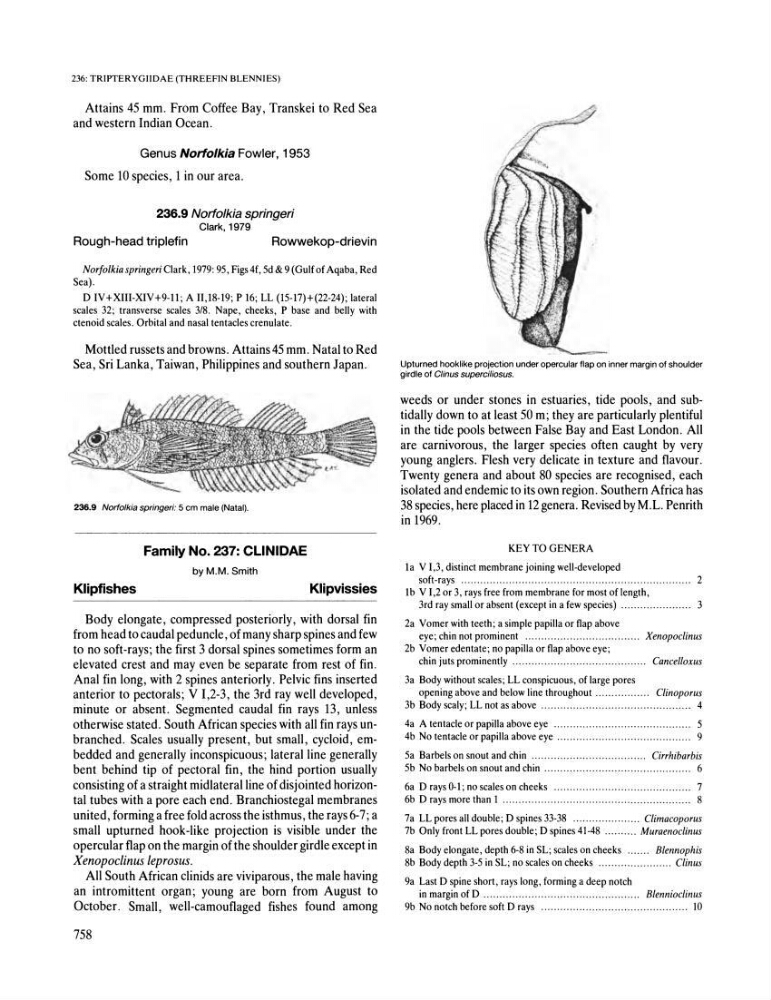
small upturned hook-like projection is visible under the
opercular flap on the margin of the shoulder girdle except in
Xenopoclinus leprosus.
All South African c1inids are viviparous, the male having
an intromittent organ; young are born from August to
October. Small, well-camouflaged fishes found among
758
Upturned hooklike projection under opercular flap on inner margin of shoulder
girdle of Clinus superciliosus.
weeds or under stones in estuaries, tide pools, and subtidally down to at least 50 m; they are particularly plentiful
in the tide pools between False Bay and East London. All
are carnivorous, the larger species often caught by very
young anglers. Flesh very delicate in texture and flavour.
Twenty genera and about 80 species are recognised, each
isolated and endemic to its own region. Southern Africa has
38 species, here placed in 12 genera. Revised by M.L. Penrith
in 1969.
KEY TO GENERA
la V 1,3, distinct membrane joining well-developed
soft-rays ........................................................................ 2
Ib V 1,2 or 3, rays free from membrane for most of length,
3rd ray small or absent (except in a few species) ...................... 3
2a Vomer with teeth; a simple papilla or flap above
eye; chin not prominent .................................... Xenopoclinus
2b Vomer edentate; no papilla or flap above eye;
chin juts prominently .......................................... Cancelloxus
3a Body without scales; LL conspicuous, of large pores
opening above and below line throughout ................. Clinoporus
3b Body scaly; LL not as above ........ ........................ ............... 4
4a A tentacle or papilla above eye .................................... .. ..... S
4b No tentacle or papilla above eye ............ .. ............................ 9
Sa Barbels on snout and chin ........ .. .. .. .. ...... .. .. .... ...... Cirrhibarbis
Sb No barbels on snout and chin ...... .. ........ .. ............................ 6
6a Drays 0-1; no scales on cheeks .......................... .. ............... 7
6b D rays more than 1 ........................................................... 8
7a LL pores all double; D spines 33-38 ..................... Climacoporus
7b Only front LL pores double; D spines 41-48 .......... Muraenoclinus
8a Body elongate, depth 6-8 in SL; scales on cheeks ....... Blennophis
8b Body depth 3-S in SL; no scales on cheeks ....................... Clinus
9a Last D spine short, rays long, forming a deep notch
in margin of D ................................................. Blennioclinus
9b No notch before soft Drays .............. .. .............................. 10