

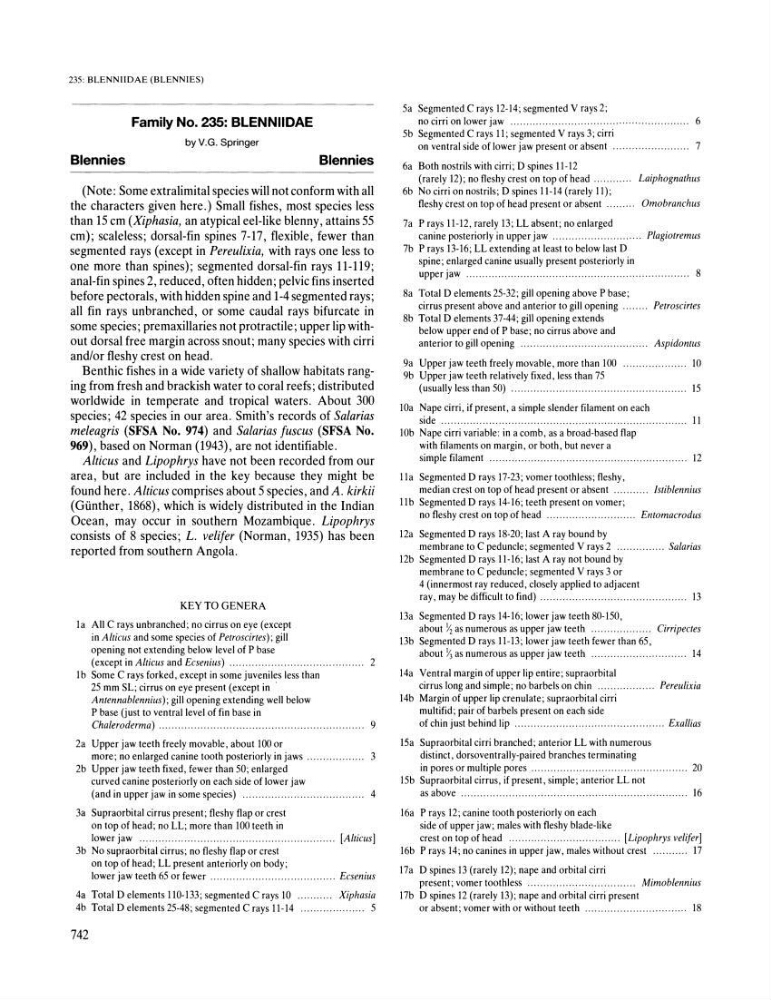
235: BLENNIIDAE (BLENNIES)
Family No. 235: BLENNIIDAE
by V.G. Springer
Blennies
Blennies
(Note: Some extralimital species will not conform with all
the characters given here.) Small fishes, most species less
than 15 cm (Xiphasia, an atypical eel-like blenny, attains 55
cm); scaleless; dorsal-fin spines 7-17, flexible, fewer than
segmented rays (except in Pereulixia, with rays one less to
one more than spines); segmented dorsal-fin rays 11-119;
anal-fin spines 2, reduced, often hidden; pelvic fins inserted
before pectorals, with hidden spine and 1-4 segmented rays;
all fin rays unbranched, or some caudal rays bifurcate in
some species; premaxillaries not protractile; upper lip without dorsal free margin across snout; many species with cirri
and/or fleshy crest on head.
Benthic fishes in a wide variety of shallow habitats ranging from fresh and brackish water to coral reefs; distributed
worldwide in temperate and tropical waters. About 300
species; 42 species in our area. Smith's records of Salarias
meleagris (SFSA No. 974) and Salarias fuscus (SFSA No.
969), based on Norman (1943), are not identifiable.
Alficus and Lipophrys have not been recorded from our
area, but are included in the key because they might be
found here. Alficus comprises about 5 species, and A. kirkii
(Gunther, 1868), which is widely distributed in the Indian
Ocean, may occur in southern Mozambique. Lipophrys
consists of 8 species; L. velifer (Norman, 1935) has been
reported from southern Angola.
KEY TO GENERA
la All C rays unbranched; no cirrus on eye (except
in Alticus and some species of Petroscirtes); gill
opening not extending below level of P base
(except in Alticus and Ecsenius) .......................................... 2
1 b Some C rays forked, except in some juveniles less than
25 mm SL; cirrus on eye present (except in .
Antennablennius); gill opening extending well below
P base (just to ventral level of fin base in
Chaleroderma) ................................................................ 9
2a Upper jaw teeth freely movable, about 100 or
more; no enlarged canine tooth posteriorly in jaws .................. 3
2b Upper jaw teeth fixed, fewer than 50; enlarged
curved canine posteriorly on each side of lower jaw
(and in upper jaw in some species) ...................................... 4
3a Supraorbital cirrus present; fleshy flap or crest
on top of head; no LL; more than 100 teeth in
lower jaw ............................................................. [Alticus]
3b No supraorbital cirrus; no fleshy flap or crest
on top of head; LL present anteriorly on body;
lower jaw teeth 65 orfewer ....................................... Ecsenius
4a Total D elements 110-133; segmented Crays 10 ........... Xiphasia
4b Total D elements 25-4S; segmented Crays 11-14 .................... 5
742
5a Segmented Crays 12-14; segmented V rays 2;
no cirri on lower jaw ........................................................ 6
5b Segmented Crays 11; segmented V rays 3; cirri
on ventral side of lower jaw present or absent ........................ 7
6a Both nostrils with cirri; D spines 11-12
(rarely 12); no fleshy crest on top of head ............ Laiphognathus
6b No cirri on nostrils; D spines 11-14 (rarely 11);
fleshy crest on top of head present or absent ......... Omobranchus
7a Prays 11-12, rarely 13; LL absent; no enlarged
canine posteriorly in upper jaw ............................ Plagiotremus
7b Prays 13-16; LL extending at least to below last D
spine; enlarged canine usually present posteriorly in
upper jaw ...................................................................... S
Sa Total D elements 25-32; gill opening above P base;
cirrus present above and anterior to gill opening ........ Petroscirtes
Sb Total D elements 37-44; gill opening extends
below upper end of P base; no cirrus above and
anterior to gill opening ........................................ Aspidontus
9a Upper jaw teeth freely movable, more than 100 .................... 10
9b Upper jaw teeth relatively fixed, less than 75
(usually less than 50) ....................................................... 15
lOa Nape cirri, if present, a simple slender filament on each
side ............................................................................. 11
lOb Nape cirri variable: in a comb, as a broad-based flap
with filaments on margin, or both, but never a
simple filament .............................................................. 12
lla Segmented Drays 17-23; vomer toothless; fleshy,
median crest on top of head present or absent ........... lstiblennius
lIb Segmented Drays 14-16; teeth present on vomer;
no fleshy crest on top of head ............................ Entomacrodus
12a Segmented Drays IS-20; last A ray bound by
membrane to C peduncle; segmented V rays 2 ............... Salarias
12b Segmented Drays 11-16; last A ray not bound by
membrane to C peduncle; segmented V rays 3 or
4 (innermost ray reduced, closely applied to adjacent
ray, may be difficult to find) .............................................. 13
13a Segmented Drays 14-16; lower jaw teeth SO-150,
about Yz as numerous as upper jaw teeth ................... Cirripectes
13b Segmented Drays 11-13; lower jaw teeth fewer than 65,
about ~ as numerous as upper jaw teeth .............................. 14
14a Ventral margin of upper lip entire; supraorbital
cirrus long and simple; no barbels on chin .................. Pereulixia
14b Margin of upper lip crenulate; supraorbital cirri
multifid; pair of barbels present on each side
of chin just behind lip ............................................... Exallias
15a Supraorbital cirri branched; anterior LL with numerous
distinct, dorsoventrally-paired branches terminating
in pores or mUltiple pores ................................................. 20
15b Supraorbital cirrus, if present, simple; anterior LL not
as above ....................................................................... 16
16a Prays 12; canine tooth posteriorly on each
side of upper jaw; males with fleshy blade-like
crest on top of head ................................... [Lipophrys velifer]
16b Prays 14; no canines in upper jaw, males without crest ........... 17
17a D spines 13 (rarely 12); nape and orbital cirri
present; vomer toothless .................................. Mimoblennius
17b D spines 12 (rarely 13); nape and orbital cirri present
or absent; vomer with or without teeth ................................ 18
Family No. 235: BLENNIIDAE
by V.G. Springer
Blennies
Blennies
(Note: Some extralimital species will not conform with all
the characters given here.) Small fishes, most species less
than 15 cm (Xiphasia, an atypical eel-like blenny, attains 55
cm); scaleless; dorsal-fin spines 7-17, flexible, fewer than
segmented rays (except in Pereulixia, with rays one less to
one more than spines); segmented dorsal-fin rays 11-119;
anal-fin spines 2, reduced, often hidden; pelvic fins inserted
before pectorals, with hidden spine and 1-4 segmented rays;
all fin rays unbranched, or some caudal rays bifurcate in
some species; premaxillaries not protractile; upper lip without dorsal free margin across snout; many species with cirri
and/or fleshy crest on head.
Benthic fishes in a wide variety of shallow habitats ranging from fresh and brackish water to coral reefs; distributed
worldwide in temperate and tropical waters. About 300
species; 42 species in our area. Smith's records of Salarias
meleagris (SFSA No. 974) and Salarias fuscus (SFSA No.
969), based on Norman (1943), are not identifiable.
Alficus and Lipophrys have not been recorded from our
area, but are included in the key because they might be
found here. Alficus comprises about 5 species, and A. kirkii
(Gunther, 1868), which is widely distributed in the Indian
Ocean, may occur in southern Mozambique. Lipophrys
consists of 8 species; L. velifer (Norman, 1935) has been
reported from southern Angola.
KEY TO GENERA
la All C rays unbranched; no cirrus on eye (except
in Alticus and some species of Petroscirtes); gill
opening not extending below level of P base
(except in Alticus and Ecsenius) .......................................... 2
1 b Some C rays forked, except in some juveniles less than
25 mm SL; cirrus on eye present (except in .
Antennablennius); gill opening extending well below
P base (just to ventral level of fin base in
Chaleroderma) ................................................................ 9
2a Upper jaw teeth freely movable, about 100 or
more; no enlarged canine tooth posteriorly in jaws .................. 3
2b Upper jaw teeth fixed, fewer than 50; enlarged
curved canine posteriorly on each side of lower jaw
(and in upper jaw in some species) ...................................... 4
3a Supraorbital cirrus present; fleshy flap or crest
on top of head; no LL; more than 100 teeth in
lower jaw ............................................................. [Alticus]
3b No supraorbital cirrus; no fleshy flap or crest
on top of head; LL present anteriorly on body;
lower jaw teeth 65 orfewer ....................................... Ecsenius
4a Total D elements 110-133; segmented Crays 10 ........... Xiphasia
4b Total D elements 25-4S; segmented Crays 11-14 .................... 5
742
5a Segmented Crays 12-14; segmented V rays 2;
no cirri on lower jaw ........................................................ 6
5b Segmented Crays 11; segmented V rays 3; cirri
on ventral side of lower jaw present or absent ........................ 7
6a Both nostrils with cirri; D spines 11-12
(rarely 12); no fleshy crest on top of head ............ Laiphognathus
6b No cirri on nostrils; D spines 11-14 (rarely 11);
fleshy crest on top of head present or absent ......... Omobranchus
7a Prays 11-12, rarely 13; LL absent; no enlarged
canine posteriorly in upper jaw ............................ Plagiotremus
7b Prays 13-16; LL extending at least to below last D
spine; enlarged canine usually present posteriorly in
upper jaw ...................................................................... S
Sa Total D elements 25-32; gill opening above P base;
cirrus present above and anterior to gill opening ........ Petroscirtes
Sb Total D elements 37-44; gill opening extends
below upper end of P base; no cirrus above and
anterior to gill opening ........................................ Aspidontus
9a Upper jaw teeth freely movable, more than 100 .................... 10
9b Upper jaw teeth relatively fixed, less than 75
(usually less than 50) ....................................................... 15
lOa Nape cirri, if present, a simple slender filament on each
side ............................................................................. 11
lOb Nape cirri variable: in a comb, as a broad-based flap
with filaments on margin, or both, but never a
simple filament .............................................................. 12
lla Segmented Drays 17-23; vomer toothless; fleshy,
median crest on top of head present or absent ........... lstiblennius
lIb Segmented Drays 14-16; teeth present on vomer;
no fleshy crest on top of head ............................ Entomacrodus
12a Segmented Drays IS-20; last A ray bound by
membrane to C peduncle; segmented V rays 2 ............... Salarias
12b Segmented Drays 11-16; last A ray not bound by
membrane to C peduncle; segmented V rays 3 or
4 (innermost ray reduced, closely applied to adjacent
ray, may be difficult to find) .............................................. 13
13a Segmented Drays 14-16; lower jaw teeth SO-150,
about Yz as numerous as upper jaw teeth ................... Cirripectes
13b Segmented Drays 11-13; lower jaw teeth fewer than 65,
about ~ as numerous as upper jaw teeth .............................. 14
14a Ventral margin of upper lip entire; supraorbital
cirrus long and simple; no barbels on chin .................. Pereulixia
14b Margin of upper lip crenulate; supraorbital cirri
multifid; pair of barbels present on each side
of chin just behind lip ............................................... Exallias
15a Supraorbital cirri branched; anterior LL with numerous
distinct, dorsoventrally-paired branches terminating
in pores or mUltiple pores ................................................. 20
15b Supraorbital cirrus, if present, simple; anterior LL not
as above ....................................................................... 16
16a Prays 12; canine tooth posteriorly on each
side of upper jaw; males with fleshy blade-like
crest on top of head ................................... [Lipophrys velifer]
16b Prays 14; no canines in upper jaw, males without crest ........... 17
17a D spines 13 (rarely 12); nape and orbital cirri
present; vomer toothless .................................. Mimoblennius
17b D spines 12 (rarely 13); nape and orbital cirri present
or absent; vomer with or without teeth ................................ 18