

222: MUGILIDAE (MULLETS)
denticulate , rear margin broadly rounded. P bent forward reaches front of
eye; 2nd D & A scaly.
Light olive above, silvery on sides, dirty yellowish below;
dusky streaks along upper scale rows; most fins dusky, P
black in young, lower margin yellow in adults; iris with yellow reflections - a dusky fish with a truncate tail. Attains 60
cm or more. Indo-West Pacific, south to Durban.
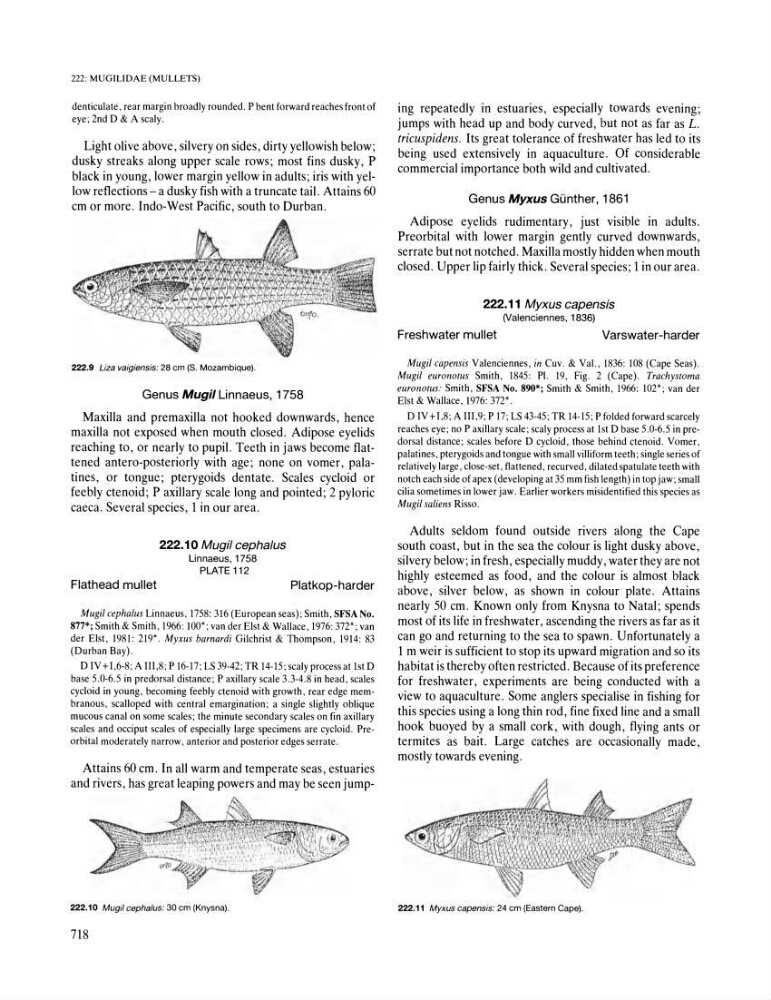
222.9 Liza vaigiensis: 28 em (S. Mozambique).
Genus Mugi/ Linnaeus, 1758
Maxilla and premaxilla not hooked downwards , hence
maxilla not exposed when mouth closed. Adipose eyelids
reaching to, or nearly to pupil. Teeth in jaws become flattened antero-posteriorly with age; none on vomer, palatines, or tongue; pterygoids dentate. Scales cycloid or
feebly ctenoid; P axillary scale long and pointed; 2 pyloric
caeca. Several species , 1 in our area.
Flathead mullet
222.10 Mugi/ cephalus
Linnaeus, 1758
PLATE 112
Platkop-harder
MugU cephalus Linnaeus, 1758: 316 (European seas); Smith, SFSA No.
877*; Smith & Smith, 1966: 100*; van der Elst & Wallace, 1976: 372 *; van
der Elst, 1981: 219*. Myxus barnardi Gilchrist & Thompson , 1914: 83
(Durban Bay).
D IV + I ,6-8; A III ,8; P 16-17; LS 39-42; TR 14-15; scaly process at 1st D
base 5.0-6.5 in predorsal distance; P axillary scale 3.3-4.8 in head, scales
cycloid in young, becoming feebly ctenoid with growth, rear edge membranous, scalloped with central emargination; a single slightly oblique
mucous canal on some scales; the minute secondary scales on fin axillary
scales and occiput scales of especially large specimens are cycloid . Preorbital moderately narrow, anterior and posterior edges serrate.
Attains 60 cm. In all warm and temperate seas, estuaries
and rivers, has great leaping powers and may be seen jump222.10 Mugil cepha/us: 30 em (Knysna).
718
ing repeatedly in estuaries, especially towards evening;
jumps with head up and body curved, but not as far as L.
tricuspidens. Its great tolerance of freshwater has led to its
being used extensively in aquaculture. Of considerable
commercial importance both wild and cultivated.
Genus Myxus Gunther, 1861
Adipose eyelids rudimentary, just visible in adults.
Preorbital with lower margin gently curved downwards,
serrate but not notched. Maxilla mostly hidden when mouth
closed. Upper lip fairly thick. Several species; 1 in our area.
222.11 Myxus capensis
(Valenciennes, 1836)
Freshwater mullet
Varswater-harder
Mugil capensis Valenciennes, in Cuv. & Val., 1836: 108 (Cape Seas).
Mugi/ euronOlus Smith , 1845: PI. 19, Fig. 2 (Cape). Trachystoma
euronOlllS: Smith, SFSA No. 890*; Smith & Smith, 1966: 102*; van der
Elst & Wallace, 1976: 372*.
D IV+I ,8; A III,9 ; P 17 ; LS43-45; TR 14-15; Pfolded forward scarcely
reaches eye ; no P axillary scale; scaly process at 1st Dbase 5.0-6.5 in predorsal distance; scales before D cycloid , those behind ctenoid. Vomer,
palatines, pterygoids and tongue with small villiform teeth; single series of
relatively large, close-set, flattened, recurved, dilated spatulate teeth with
notch each side of apex (developing at 35 mm fish length) in top jaw; small
cilia sometimes in lower jaw. Earlier workers misidentified this species as
MugU saliens Risso.
Adults seldom found outside rivers along the Cape
south coast, but in the sea the colour is light dusky above,
silvery below; in fresh, especially muddy, water they are not
highly esteemed as food, and the colour is almost black
above, silver below, as shown in colour plate. Attains
nearly 50 cm. Known only from Knysna to Natal; spends
most of its life in freshwater, ascending the rivers as far as it
can go and returning to the sea to spawn. Unfortunately a
1 m weir is sufficient to stop its upward migration and so its
habitat is thereby often restricted. Because of its preference
for freshwater, experiments are being conducted with a
view to aquaculture. Some anglers specialise in fishing for
this species using a long thin rod, fine fixed line and a small
hook buoyed by a small cork, with dough, flying ants or
termites as bait. Large catches are occasionally made,
mostly towards evening.
222.11 Myxus capensis: 24 em (Eastern Cape).
denticulate , rear margin broadly rounded. P bent forward reaches front of
eye; 2nd D & A scaly.
Light olive above, silvery on sides, dirty yellowish below;
dusky streaks along upper scale rows; most fins dusky, P
black in young, lower margin yellow in adults; iris with yellow reflections - a dusky fish with a truncate tail. Attains 60
cm or more. Indo-West Pacific, south to Durban.
222.9 Liza vaigiensis: 28 em (S. Mozambique).
Genus Mugi/ Linnaeus, 1758
Maxilla and premaxilla not hooked downwards , hence
maxilla not exposed when mouth closed. Adipose eyelids
reaching to, or nearly to pupil. Teeth in jaws become flattened antero-posteriorly with age; none on vomer, palatines, or tongue; pterygoids dentate. Scales cycloid or
feebly ctenoid; P axillary scale long and pointed; 2 pyloric
caeca. Several species , 1 in our area.
Flathead mullet
222.10 Mugi/ cephalus
Linnaeus, 1758
PLATE 112
Platkop-harder
MugU cephalus Linnaeus, 1758: 316 (European seas); Smith, SFSA No.
877*; Smith & Smith, 1966: 100*; van der Elst & Wallace, 1976: 372 *; van
der Elst, 1981: 219*. Myxus barnardi Gilchrist & Thompson , 1914: 83
(Durban Bay).
D IV + I ,6-8; A III ,8; P 16-17; LS 39-42; TR 14-15; scaly process at 1st D
base 5.0-6.5 in predorsal distance; P axillary scale 3.3-4.8 in head, scales
cycloid in young, becoming feebly ctenoid with growth, rear edge membranous, scalloped with central emargination; a single slightly oblique
mucous canal on some scales; the minute secondary scales on fin axillary
scales and occiput scales of especially large specimens are cycloid . Preorbital moderately narrow, anterior and posterior edges serrate.
Attains 60 cm. In all warm and temperate seas, estuaries
and rivers, has great leaping powers and may be seen jump222.10 Mugil cepha/us: 30 em (Knysna).
718
ing repeatedly in estuaries, especially towards evening;
jumps with head up and body curved, but not as far as L.
tricuspidens. Its great tolerance of freshwater has led to its
being used extensively in aquaculture. Of considerable
commercial importance both wild and cultivated.
Genus Myxus Gunther, 1861
Adipose eyelids rudimentary, just visible in adults.
Preorbital with lower margin gently curved downwards,
serrate but not notched. Maxilla mostly hidden when mouth
closed. Upper lip fairly thick. Several species; 1 in our area.
222.11 Myxus capensis
(Valenciennes, 1836)
Freshwater mullet
Varswater-harder
Mugil capensis Valenciennes, in Cuv. & Val., 1836: 108 (Cape Seas).
Mugi/ euronOlus Smith , 1845: PI. 19, Fig. 2 (Cape). Trachystoma
euronOlllS: Smith, SFSA No. 890*; Smith & Smith, 1966: 102*; van der
Elst & Wallace, 1976: 372*.
D IV+I ,8; A III,9 ; P 17 ; LS43-45; TR 14-15; Pfolded forward scarcely
reaches eye ; no P axillary scale; scaly process at 1st Dbase 5.0-6.5 in predorsal distance; scales before D cycloid , those behind ctenoid. Vomer,
palatines, pterygoids and tongue with small villiform teeth; single series of
relatively large, close-set, flattened, recurved, dilated spatulate teeth with
notch each side of apex (developing at 35 mm fish length) in top jaw; small
cilia sometimes in lower jaw. Earlier workers misidentified this species as
MugU saliens Risso.
Adults seldom found outside rivers along the Cape
south coast, but in the sea the colour is light dusky above,
silvery below; in fresh, especially muddy, water they are not
highly esteemed as food, and the colour is almost black
above, silver below, as shown in colour plate. Attains
nearly 50 cm. Known only from Knysna to Natal; spends
most of its life in freshwater, ascending the rivers as far as it
can go and returning to the sea to spawn. Unfortunately a
1 m weir is sufficient to stop its upward migration and so its
habitat is thereby often restricted. Because of its preference
for freshwater, experiments are being conducted with a
view to aquaculture. Some anglers specialise in fishing for
this species using a long thin rod, fine fixed line and a small
hook buoyed by a small cork, with dough, flying ants or
termites as bait. Large catches are occasionally made,
mostly towards evening.
222.11 Myxus capensis: 24 em (Eastern Cape).