

jaws; in the other subfamily, Agonostominae (which does
not occur in our seas) the teeth are fixed in the jaws.
Numerous long slender gill-rakers form a perfect filter:
those on the 3 inner arches are at right angles, extremely
close-set and meshed together by basal setiform processes
to form a rigid plane surface. The gill-raker numbers of our
species are not given as they increase in numbers with
growth and apparently have no systematic significance.
Circumglobal fishes of commercial importance, found in
all but the coldest seas near the coast, and in estuaries. Two
of our species migrate up rivers, and our endemic freshwater mullet returns to the sea only to spawn. All species
spawn offshore, mainly in winter and spring; the young
enter the nursery area, mostly estuaries, at about 10-15 mm.
Work has been done by Wallace and van der Elst (1975) on
the use of our estuaries as nursery areas. Some species commonly leap out of the water, especially towards a light at
night. In the Cape, large numbers are taken by seine nets,
on the west coast by floating gill nets and on the Agulhas
coast in summer by stonewalled traps called "fevres".
Larger specimens, occasionally caught by anglers using
bread, dough, stiff "mielie" porridge or even pilchard bait,
give excellent sport. Some success with certain "flies"
resembling soft-bodied insects has been claimed. The white
firm flesh is widely used as food, and frequently for bait.
Mullet feed mostly on detritus and algae, but if the opportunity arises will eat soft"bodied insects, fish eggs or the
larvae of marine creatures . The stomach, spindle-shaped
and muscular, is similar to a bird's gizzard and enables nutriment to be extracted from the large quantity of mud the
fish swallows.
Thirteen genera containing about 70 species accepted at
present (with 32 more of doubtful status); 5 genera and 15
species recorded from our area. The names of some species
have altered since the 1949 edition of The Sea Fishes of
Southern Africa, but only one, a new species, has been
added to our fauna. Pappe's and Castelnau's names have
been omitted from the references. Van der Elst and Wallace (1976) have published a useful paper on the identification of fry, and their key has been adapted at the end of this
family for workers needing it. Thomson (1954) revised the
Australian species. LS = number of scales in the 1st continuous row above the pectoral fin base from directly above
rear margin of head to the caudal fin base. TR = transverse
series of scales counted obliquely backwards from before
origin of 1st dorsal fin to midline of belly.
KEY TO GENERA
1a Upper lip wide, with prominent papillae .................... Crenimugil
1b No papillae on upper lip ....... ................. ..... ... ... .... ..... .... ... .. 2
2a Adipose eyelids well developed (in adults and large juveniles) .. ... 3
2b Adipose eyelids feeble or absent ....... ..... ..... .... .. ................ ... . 4
3a A 1II,8 ..... .... ... .... ...................... ...... ....... .... ..... ..... ... .. Mugil
3b A 1II,9 .... .... ... ..... ... ....... ..... ..... ... ... ...... .. ...... ..... .... Valamugil
222: MUGILIDAE (MULLETS)
4a P axillary scale pointed and long; body scales with
pliable membranous edges ... ...... ..... .. .. .. ...... ....... ...... Valamugil
4b P axillary scale small or absent ; no membranous edge to
body scales ............. .. ..... ....... .......... ............... ... ... ........... . S
Sa Maxilla end exposed when mouth shut; ............ ... ............... Liza
Sb Maxilla end almost completely concealed when
mouth shut ; ...... ... .. .......... .. ... ....... ............ ..... .. .. ...... .. Myxus
Genus Crenimugi/ Schultz, 1946
Lips with distinct papillae; P axillary scale present; pliable membranous edges to scales with digitations ornamenting the rear margin. Teeth absent on lips, present on
tongue; 9 pyloric caeca. Two species, 1 in our area.
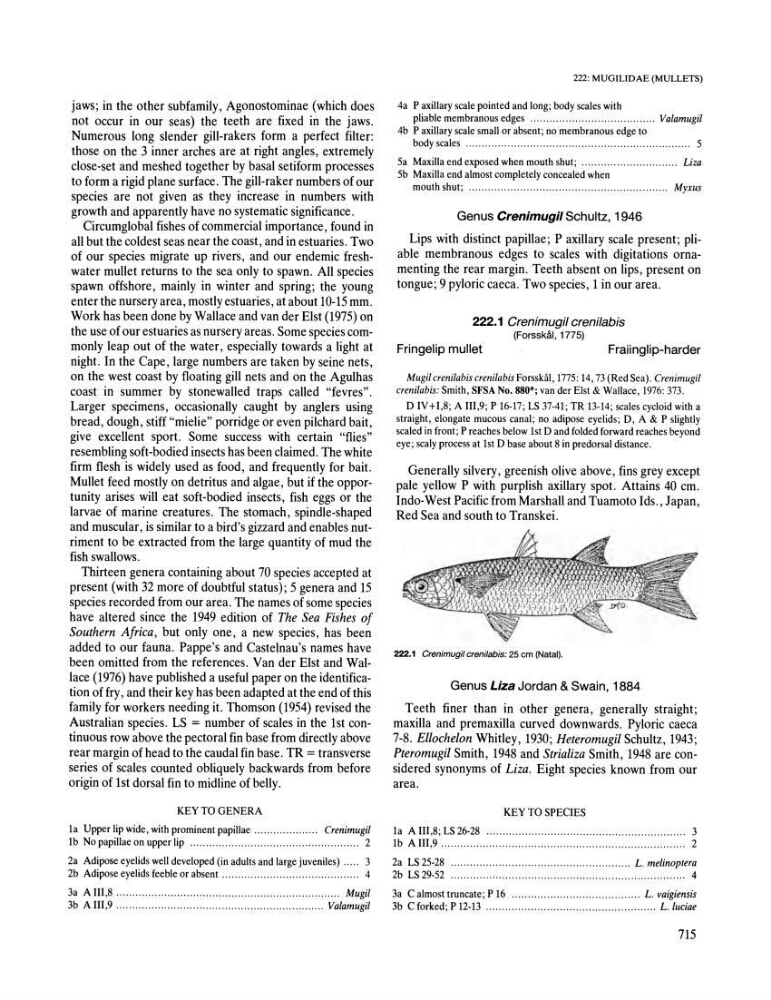
222.1 Crenimugil crenilabis
(Forsskal , 1775)
Fringelip mullet
Fraiinglip-harder
Mugil crenilabis crenilabis Forsskiil, 1775: 14, 73 (Red Sea). Crenimugil
crenilabis: Smith , SFSA No. 880*; van der Elst & Wallace, 1976: 373.
D IV+I ,8; A III,9; P 16-17; LS 37-41; TR 13-14; scales cycloid with a
straight, elongate mucous canal; no adipose eyelids; D, A & P slightly
scaled in front; P reaches below 1st D and folded forward reaches beyond
eye ; scaly process at 1st D base about 8 in predorsal distance.
Generally silvery, greenish olive above, fins grey except
pale yellow P with purplish axillary spot. Attains 40 cm.
Indo-West Pacific from Marshall and Tuamoto Ids., Japan,
Red Sea and south to Transkei.
222.1 Crenimugil crenilabis: 25 em (Natal).
Genus Liza Jordan & Swain, 1884
Teeth finer than in other genera, generally straight;
maxilla and premaxilla curved downwards. Pyloric caeca
7-8. Ellochelon Whitley, 1930; Heteromugil Schultz, 1943;
Pteromugil Smith, 1948 and Strializa Smith , 1948 are considered synonyms of Liza. Eight species known from our
area.
KEY TO SPECIES
1a A III,8; LS 26-28 .................. ........... ... ........... ... ... ....... ...... 3
1b A III,9 ...... ... .... ... .. ... ...... ... .. ...................... ...... .... ...... ... .. . 2
2a LS 2S-28 ... ... .. ... ... ..... ........ .. .. .......... .... ... ... ... .. L. melinoptera
2b LS 29-S2 .... .. ..... .. ; ... ........ .. ... ... ..... .. ... ..... ..... ...... ....... ....... 4
3a C almost truncate; P 16 ...... .. ....... .............. ... ........ L. vaigiensis
3b C forked; P 12-13 ...... .. ........ ......... ........ ...... ...... .. ... ... L. luciae
715
not occur in our seas) the teeth are fixed in the jaws.
Numerous long slender gill-rakers form a perfect filter:
those on the 3 inner arches are at right angles, extremely
close-set and meshed together by basal setiform processes
to form a rigid plane surface. The gill-raker numbers of our
species are not given as they increase in numbers with
growth and apparently have no systematic significance.
Circumglobal fishes of commercial importance, found in
all but the coldest seas near the coast, and in estuaries. Two
of our species migrate up rivers, and our endemic freshwater mullet returns to the sea only to spawn. All species
spawn offshore, mainly in winter and spring; the young
enter the nursery area, mostly estuaries, at about 10-15 mm.
Work has been done by Wallace and van der Elst (1975) on
the use of our estuaries as nursery areas. Some species commonly leap out of the water, especially towards a light at
night. In the Cape, large numbers are taken by seine nets,
on the west coast by floating gill nets and on the Agulhas
coast in summer by stonewalled traps called "fevres".
Larger specimens, occasionally caught by anglers using
bread, dough, stiff "mielie" porridge or even pilchard bait,
give excellent sport. Some success with certain "flies"
resembling soft-bodied insects has been claimed. The white
firm flesh is widely used as food, and frequently for bait.
Mullet feed mostly on detritus and algae, but if the opportunity arises will eat soft"bodied insects, fish eggs or the
larvae of marine creatures . The stomach, spindle-shaped
and muscular, is similar to a bird's gizzard and enables nutriment to be extracted from the large quantity of mud the
fish swallows.
Thirteen genera containing about 70 species accepted at
present (with 32 more of doubtful status); 5 genera and 15
species recorded from our area. The names of some species
have altered since the 1949 edition of The Sea Fishes of
Southern Africa, but only one, a new species, has been
added to our fauna. Pappe's and Castelnau's names have
been omitted from the references. Van der Elst and Wallace (1976) have published a useful paper on the identification of fry, and their key has been adapted at the end of this
family for workers needing it. Thomson (1954) revised the
Australian species. LS = number of scales in the 1st continuous row above the pectoral fin base from directly above
rear margin of head to the caudal fin base. TR = transverse
series of scales counted obliquely backwards from before
origin of 1st dorsal fin to midline of belly.
KEY TO GENERA
1a Upper lip wide, with prominent papillae .................... Crenimugil
1b No papillae on upper lip ....... ................. ..... ... ... .... ..... .... ... .. 2
2a Adipose eyelids well developed (in adults and large juveniles) .. ... 3
2b Adipose eyelids feeble or absent ....... ..... ..... .... .. ................ ... . 4
3a A 1II,8 ..... .... ... .... ...................... ...... ....... .... ..... ..... ... .. Mugil
3b A 1II,9 .... .... ... ..... ... ....... ..... ..... ... ... ...... .. ...... ..... .... Valamugil
222: MUGILIDAE (MULLETS)
4a P axillary scale pointed and long; body scales with
pliable membranous edges ... ...... ..... .. .. .. ...... ....... ...... Valamugil
4b P axillary scale small or absent ; no membranous edge to
body scales ............. .. ..... ....... .......... ............... ... ... ........... . S
Sa Maxilla end exposed when mouth shut; ............ ... ............... Liza
Sb Maxilla end almost completely concealed when
mouth shut ; ...... ... .. .......... .. ... ....... ............ ..... .. .. ...... .. Myxus
Genus Crenimugi/ Schultz, 1946
Lips with distinct papillae; P axillary scale present; pliable membranous edges to scales with digitations ornamenting the rear margin. Teeth absent on lips, present on
tongue; 9 pyloric caeca. Two species, 1 in our area.
222.1 Crenimugil crenilabis
(Forsskal , 1775)
Fringelip mullet
Fraiinglip-harder
Mugil crenilabis crenilabis Forsskiil, 1775: 14, 73 (Red Sea). Crenimugil
crenilabis: Smith , SFSA No. 880*; van der Elst & Wallace, 1976: 373.
D IV+I ,8; A III,9; P 16-17; LS 37-41; TR 13-14; scales cycloid with a
straight, elongate mucous canal; no adipose eyelids; D, A & P slightly
scaled in front; P reaches below 1st D and folded forward reaches beyond
eye ; scaly process at 1st D base about 8 in predorsal distance.
Generally silvery, greenish olive above, fins grey except
pale yellow P with purplish axillary spot. Attains 40 cm.
Indo-West Pacific from Marshall and Tuamoto Ids., Japan,
Red Sea and south to Transkei.
222.1 Crenimugil crenilabis: 25 em (Natal).
Genus Liza Jordan & Swain, 1884
Teeth finer than in other genera, generally straight;
maxilla and premaxilla curved downwards. Pyloric caeca
7-8. Ellochelon Whitley, 1930; Heteromugil Schultz, 1943;
Pteromugil Smith, 1948 and Strializa Smith , 1948 are considered synonyms of Liza. Eight species known from our
area.
KEY TO SPECIES
1a A III,8; LS 26-28 .................. ........... ... ........... ... ... ....... ...... 3
1b A III,9 ...... ... .... ... .. ... ...... ... .. ...................... ...... .... ...... ... .. . 2
2a LS 2S-28 ... ... .. ... ... ..... ........ .. .. .......... .... ... ... ... .. L. melinoptera
2b LS 29-S2 .... .. ..... .. ; ... ........ .. ... ... ..... .. ... ..... ..... ...... ....... ....... 4
3a C almost truncate; P 16 ...... .. ....... .............. ... ........ L. vaigiensis
3b C forked; P 12-13 ...... .. ........ ......... ........ ...... ...... .. ... ... L. luciae
715