

Wrasses
Family No. 220: LABRIDAE
by J.E. Randall
Lipvisse
A very large family (second in number of species within
the Indo-Pacific region only to the Gobiidae) and the most
diverse in size and form. Body shape varies from oblong to
elongate and slightly to strongly compressed. Size varies
from the slender little Minilabrus striatus Randall & Dor
1980 of the Red Sea (45 mm) to the wide-ranging gian~
humphead wrasse, Cheilinus undulatus (2 m). Dorsal fin
continuous (except for some species of Xyrichtys) , with 8-21
spines and 6-21 soft-rays (0 VIII-XIII, 7-14 for species in
our area); anal fin with 2 or 3 spines (4-6 in the European
Acantholabrus and Ctenolabrus) and 7-14 soft-rays; pelvic
fin 1,5. Scales cycloid; head often naked or cheeks and opercles scaled; lateral line continuous or interrupted. Vertebrae
23-41 (higher numbers in temperate species of Labrinae).
Branchiostegal rays 5 or 6. Mouth small to moderate, protractile, and terminal (or with lower jaw projecting, as in
some Cheilinus); lips often fleshy; teeth in jaws conical,
usually some canines anteriorly (but specialised incisiform
teeth in Anampses and Pseudodax); a canine may be present at corner of mouth; no teeth on palate (except rarely on
vomer of a few species); paired upper pharyngeal bones and
si?gle lo~er pharyngeal plate (triangular or Y - or T -shaped)
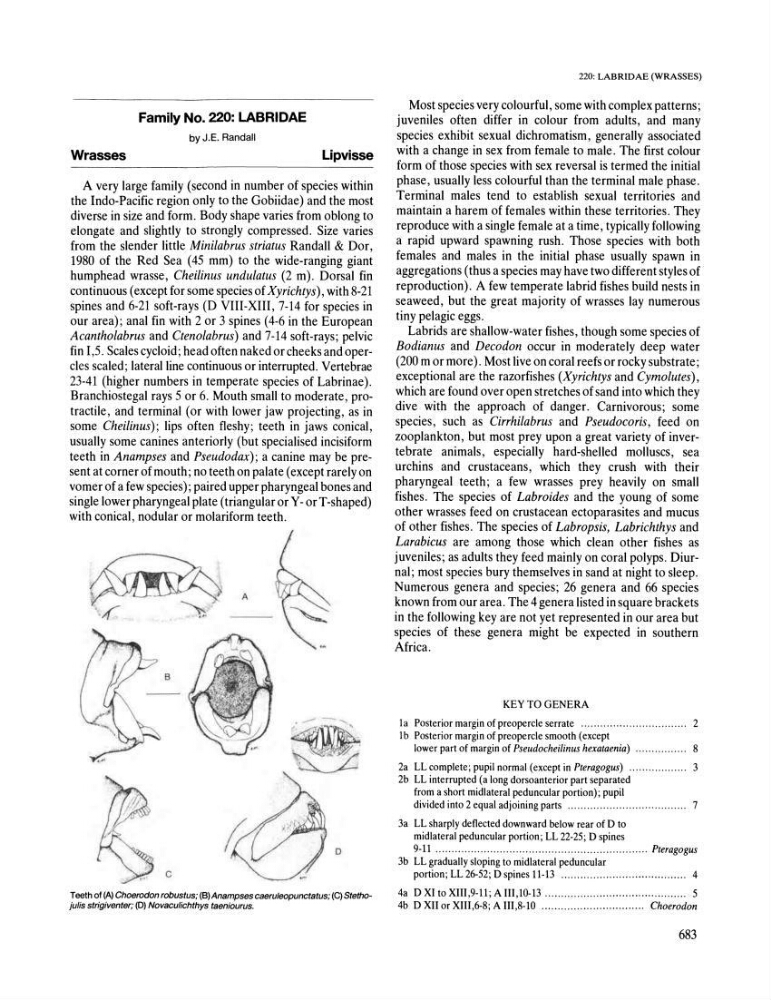
with conical, nodular or molariform teeth.
B
c
Teeth of (A) Choerodon robustus; (B) Anampses caeruleopunctatus; (C) Stethojulls stng/venter; (D) Novaculichthys taeniourus.
220: LABRIDAE (WRASSES)
Most species very colourful, some with complex patterns;
juveniles often differ in colour from adults, and many
species exhibit sexual dichromatism, generally associated
with a change in sex from female to male. The first colour
form of those species with sex reversal is termed the initial
phase, usually less colourful than the terminal male phase.
Terminal males tend to establish sexual territories and
maintain a harem of females within these territories. They
reproduce with a single female at a time, typically following
a rapid upward spawning rush. Those species with both
females and males in the initial phase usually spawn in
aggregations (thus a species may have two different styles of
reproduction). A few temperate labrid fishes build nests in
seaweed, but the great majority of wrasses lay numerous
tiny pelagic eggs.
Labrids are shallow-water fishes, though some species of
Bodianus and Decodon occur in moderately deep water
(200 m or more). Most live on coral reefs or rocky substrate;
ex~eptional are the razorfishes (Xyrichtys and Cymolutes),
w.hlch a.re found over open stretches of sand into which they
dive with the approach of danger. Carnivorous; some
species, such as Cirrhilabrus and Pseudocoris, feed on
zooplankton, but most prey upon a great variety of invertebrate animals, especially hard-shelled molluscs, sea
urchins and crustaceans, which they crush with their
pharyngeal teeth; a few wrasses prey heavily on small
fishes . The species of Labroides and the young of some
other wrasses feed on crustacean ectoparasites and mucus
of other fishes. The species of Labropsis, Labrichthys and
Larabicus are among those which clean other fishes as
juveniles; as adults they feed mainly on coral polyps. Diurnal; most species bury themselves in sand at night to sleep.
Numerous genera and species; 26 genera and 66 species
known from our area. The 4 genera listed in square brackets
in the following key are not yet represented in our area but
species of these genera might be expected in southern
Africa.
KEY TO GENERA
la Posterior margin of preopercle serrate ........ ..... ...... .... ........ .. 2
Ib Posterior margin of preopercle smooth (except
lower part of margin of Pseudocheilinus hexataenia) .......... ..... . 8
2a LL complete; pupil normal (except in Pteragogus) .. ..... ........... 3
2b LL interrupted (a long dorsoanterior part separated
from a short midlateral peduncular portion); pupil
divided into 2 equal adjoining parts .................... .. ...... .... ..... 7
3a LL sharply deflected downward below rear of D to
midlateral peduncular portion; LL 22-25; D spines
9-11 .................................................................. Pteragogus
3b LL gradually sloping to midlateral peduncular
portion; LL 26-52; D spines 11-13 ....................................... 4
4a DXltoXIII,9-11;AIII,1O-13 ....... ... .......................... .. ...... 5
4b D XII or XIII ,6-8; A III ,8-10 ............ ... ................. Choerodon
683
Family No. 220: LABRIDAE
by J.E. Randall
Lipvisse
A very large family (second in number of species within
the Indo-Pacific region only to the Gobiidae) and the most
diverse in size and form. Body shape varies from oblong to
elongate and slightly to strongly compressed. Size varies
from the slender little Minilabrus striatus Randall & Dor
1980 of the Red Sea (45 mm) to the wide-ranging gian~
humphead wrasse, Cheilinus undulatus (2 m). Dorsal fin
continuous (except for some species of Xyrichtys) , with 8-21
spines and 6-21 soft-rays (0 VIII-XIII, 7-14 for species in
our area); anal fin with 2 or 3 spines (4-6 in the European
Acantholabrus and Ctenolabrus) and 7-14 soft-rays; pelvic
fin 1,5. Scales cycloid; head often naked or cheeks and opercles scaled; lateral line continuous or interrupted. Vertebrae
23-41 (higher numbers in temperate species of Labrinae).
Branchiostegal rays 5 or 6. Mouth small to moderate, protractile, and terminal (or with lower jaw projecting, as in
some Cheilinus); lips often fleshy; teeth in jaws conical,
usually some canines anteriorly (but specialised incisiform
teeth in Anampses and Pseudodax); a canine may be present at corner of mouth; no teeth on palate (except rarely on
vomer of a few species); paired upper pharyngeal bones and
si?gle lo~er pharyngeal plate (triangular or Y - or T -shaped)
with conical, nodular or molariform teeth.
B
c
Teeth of (A) Choerodon robustus; (B) Anampses caeruleopunctatus; (C) Stethojulls stng/venter; (D) Novaculichthys taeniourus.
220: LABRIDAE (WRASSES)
Most species very colourful, some with complex patterns;
juveniles often differ in colour from adults, and many
species exhibit sexual dichromatism, generally associated
with a change in sex from female to male. The first colour
form of those species with sex reversal is termed the initial
phase, usually less colourful than the terminal male phase.
Terminal males tend to establish sexual territories and
maintain a harem of females within these territories. They
reproduce with a single female at a time, typically following
a rapid upward spawning rush. Those species with both
females and males in the initial phase usually spawn in
aggregations (thus a species may have two different styles of
reproduction). A few temperate labrid fishes build nests in
seaweed, but the great majority of wrasses lay numerous
tiny pelagic eggs.
Labrids are shallow-water fishes, though some species of
Bodianus and Decodon occur in moderately deep water
(200 m or more). Most live on coral reefs or rocky substrate;
ex~eptional are the razorfishes (Xyrichtys and Cymolutes),
w.hlch a.re found over open stretches of sand into which they
dive with the approach of danger. Carnivorous; some
species, such as Cirrhilabrus and Pseudocoris, feed on
zooplankton, but most prey upon a great variety of invertebrate animals, especially hard-shelled molluscs, sea
urchins and crustaceans, which they crush with their
pharyngeal teeth; a few wrasses prey heavily on small
fishes . The species of Labroides and the young of some
other wrasses feed on crustacean ectoparasites and mucus
of other fishes. The species of Labropsis, Labrichthys and
Larabicus are among those which clean other fishes as
juveniles; as adults they feed mainly on coral polyps. Diurnal; most species bury themselves in sand at night to sleep.
Numerous genera and species; 26 genera and 66 species
known from our area. The 4 genera listed in square brackets
in the following key are not yet represented in our area but
species of these genera might be expected in southern
Africa.
KEY TO GENERA
la Posterior margin of preopercle serrate ........ ..... ...... .... ........ .. 2
Ib Posterior margin of preopercle smooth (except
lower part of margin of Pseudocheilinus hexataenia) .......... ..... . 8
2a LL complete; pupil normal (except in Pteragogus) .. ..... ........... 3
2b LL interrupted (a long dorsoanterior part separated
from a short midlateral peduncular portion); pupil
divided into 2 equal adjoining parts .................... .. ...... .... ..... 7
3a LL sharply deflected downward below rear of D to
midlateral peduncular portion; LL 22-25; D spines
9-11 .................................................................. Pteragogus
3b LL gradually sloping to midlateral peduncular
portion; LL 26-52; D spines 11-13 ....................................... 4
4a DXltoXIII,9-11;AIII,1O-13 ....... ... .......................... .. ...... 5
4b D XII or XIII ,6-8; A III ,8-10 ............ ... ................. Choerodon
683