

212: RACHYCENTRIDAE (COBIAS)
212.1 Rachycentron canadum
(Linnaeus, 1766)
Prodigal son
Kobia
Gasterosteus canadus Linnaeus, 1766: 491 (Carolina, U.S.A.).
Rachycentron canadus: Smith, SFSA No. 548*. Rachycentron canadum:
Smith, 1980: 178; van der Elst, 1981: 260*.
D VII-IX + 1,33-36; A II-III ,22-28; P 21-22; LL over 300; GR 2+(9- 10).
D spines low, separate; 2 or 3 weak A spines; C rounded in young to lunate
in adults, upper lobe longer.
Dark brownish, silvery band (2 in juveniles) along body;
C with white outer edges. Attains about 2 m and 50 kg. Eggs
planktonic; adults migrate to our waters mainly during the
summer, occasionally reaches False Bay. Often caught
offshore over the continental shelf and frequently seen
swimming with remoras of similar appearance; a fine sporting fish, fights gamely and jumps repeatedly. Eats mainly
crustaceans. Often has parasitic worms in the stomach but
despite this the flesh is good eating. Warm waters of the
Mediterranean, Atlantic and Indo-Pacific (not in eastern
Pacific).
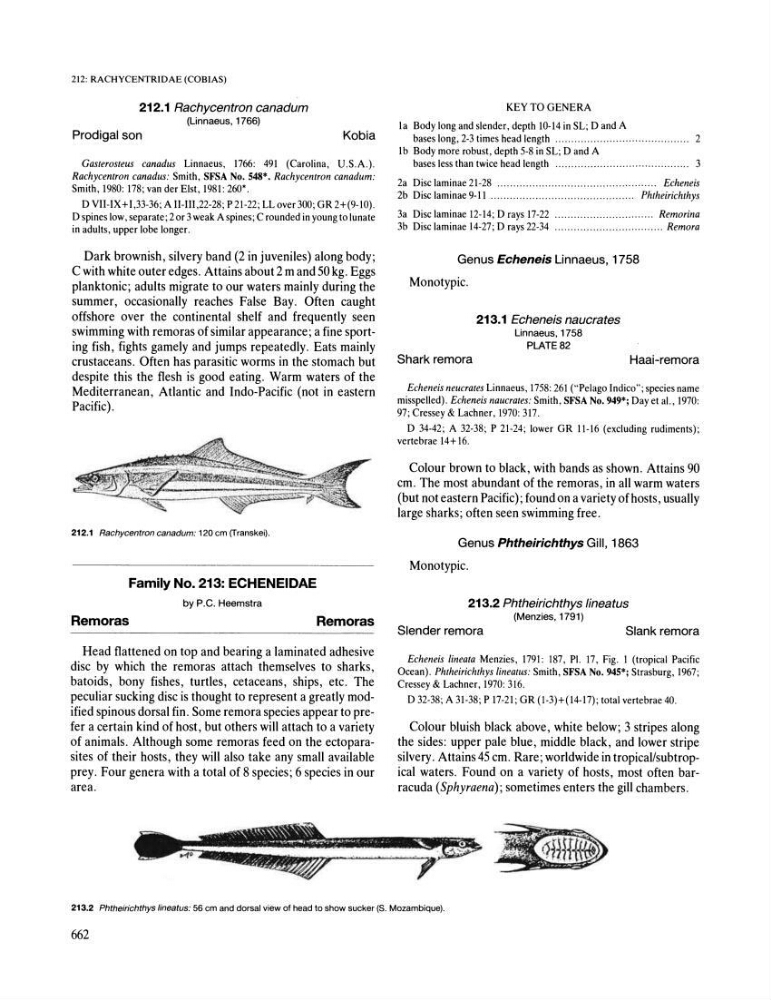
212.1 Rachycentron canadum: 120 em (Transkei) .
Family No. 213: ECHENEIDAE
by P.C. Heemstra
Remoras
Remoras
Head flattened on top and bearing a laminated adhesive
disc by which the remoras attach themselves to sharks,
batoids, bony fishes, turtles, cetaceans, ships, etc. The
peculiar sucking disc is thought to represent a greatly modified spinous dorsal fin. Some remora species appear to prefer a certain kind of host, but others will attach to a variety
of animals. Although some remoras feed on the ectoparasites of their hosts, they will also take any small available
prey. Four genera with a total of 8 species; 6 species in our
area.
KEY TO GENERA
1a Body long and slender, depth 10-14 in SL; D and A
bases long, 2-3 times head length ............. ................ . .. .. ........ 2
1b Body more robust, depth 5-8 in SL; D and A
bases less than twice head length . . . . . . . . . . . . .. . . . . . .. . . . . . . . . . . . . . . . . . . . .. 3
2a Disc laminae 21-28 ..... ................. ....... ..................... Echeneis
2b Disc laminae 9-11 .... ................... .... .. ........... ..... Phtheirichlhys
3a Disc laminae 12-14; Drays 17-22 .. ............................. Remorina
3b Disc laminae 14-27; Drays 22-34 ............. ..................... Remora
Genus Echeneis Linnaeus, 1758
Monotypic.
Shark remora
213.1 Echeneis naucrates
Linnaeus, 1758
PLATE 82
Haai-remora
Echeneis neucrates Linnaeus, 1758: 261 ("Pelago Indica"; species name
misspelled). Echeneis naucrates: Smith, SFSA No. 949*; Day et a!., 1970:
97; Cressey & Lachner, 1970: 317.
D 34-42; A 32-38; P 21-24; lower GR 11-16 (excluding rudiments) ;
vertebrae 14+ 16.
Colour brown to black, with bands as shown. Attains 90
cm. The most abundant of the remoras, in all warm waters
(but not eastern Pacific); found on a variety of hosts, usually
large sharks; often seen swimming free.
Genus Phtheirichthys Gill, 1863
Monotypic.
213.2 Phtheirichthys lineatus
(Menzies, 1791)
Slender remora
Siank remora
Echeneis lineata Menzies, 1791: 187, PI. 17, Fig. 1 (tropical Pacific
Ocean). Phtheirichthys lineatus: Smith, SFSA No. 945*; Strasburg, 1967;
Cressey & Lachner, 1970: 316.
D 32-38; A 31-38; P 17-21; GR (1-3)+(14-17); total vertebrae 40.
Colour bluish black above, white below; 3 stripes along
the sides: upper pale blue, middle black, and lower stripe
silvery. Attains 45 cm. Rare; worldwide in tropical/subtropical waters. Found on a variety of hosts, most often barracuda (Sphyraena); sometimes enters the gill chambers.
213.2 Phtheirichthys lineatus: 56 em and dorsal view of head to show sucker (S. Mozambique).
662
212.1 Rachycentron canadum
(Linnaeus, 1766)
Prodigal son
Kobia
Gasterosteus canadus Linnaeus, 1766: 491 (Carolina, U.S.A.).
Rachycentron canadus: Smith, SFSA No. 548*. Rachycentron canadum:
Smith, 1980: 178; van der Elst, 1981: 260*.
D VII-IX + 1,33-36; A II-III ,22-28; P 21-22; LL over 300; GR 2+(9- 10).
D spines low, separate; 2 or 3 weak A spines; C rounded in young to lunate
in adults, upper lobe longer.
Dark brownish, silvery band (2 in juveniles) along body;
C with white outer edges. Attains about 2 m and 50 kg. Eggs
planktonic; adults migrate to our waters mainly during the
summer, occasionally reaches False Bay. Often caught
offshore over the continental shelf and frequently seen
swimming with remoras of similar appearance; a fine sporting fish, fights gamely and jumps repeatedly. Eats mainly
crustaceans. Often has parasitic worms in the stomach but
despite this the flesh is good eating. Warm waters of the
Mediterranean, Atlantic and Indo-Pacific (not in eastern
Pacific).
212.1 Rachycentron canadum: 120 em (Transkei) .
Family No. 213: ECHENEIDAE
by P.C. Heemstra
Remoras
Remoras
Head flattened on top and bearing a laminated adhesive
disc by which the remoras attach themselves to sharks,
batoids, bony fishes, turtles, cetaceans, ships, etc. The
peculiar sucking disc is thought to represent a greatly modified spinous dorsal fin. Some remora species appear to prefer a certain kind of host, but others will attach to a variety
of animals. Although some remoras feed on the ectoparasites of their hosts, they will also take any small available
prey. Four genera with a total of 8 species; 6 species in our
area.
KEY TO GENERA
1a Body long and slender, depth 10-14 in SL; D and A
bases long, 2-3 times head length ............. ................ . .. .. ........ 2
1b Body more robust, depth 5-8 in SL; D and A
bases less than twice head length . . . . . . . . . . . . .. . . . . . .. . . . . . . . . . . . . . . . . . . . .. 3
2a Disc laminae 21-28 ..... ................. ....... ..................... Echeneis
2b Disc laminae 9-11 .... ................... .... .. ........... ..... Phtheirichlhys
3a Disc laminae 12-14; Drays 17-22 .. ............................. Remorina
3b Disc laminae 14-27; Drays 22-34 ............. ..................... Remora
Genus Echeneis Linnaeus, 1758
Monotypic.
Shark remora
213.1 Echeneis naucrates
Linnaeus, 1758
PLATE 82
Haai-remora
Echeneis neucrates Linnaeus, 1758: 261 ("Pelago Indica"; species name
misspelled). Echeneis naucrates: Smith, SFSA No. 949*; Day et a!., 1970:
97; Cressey & Lachner, 1970: 317.
D 34-42; A 32-38; P 21-24; lower GR 11-16 (excluding rudiments) ;
vertebrae 14+ 16.
Colour brown to black, with bands as shown. Attains 90
cm. The most abundant of the remoras, in all warm waters
(but not eastern Pacific); found on a variety of hosts, usually
large sharks; often seen swimming free.
Genus Phtheirichthys Gill, 1863
Monotypic.
213.2 Phtheirichthys lineatus
(Menzies, 1791)
Slender remora
Siank remora
Echeneis lineata Menzies, 1791: 187, PI. 17, Fig. 1 (tropical Pacific
Ocean). Phtheirichthys lineatus: Smith, SFSA No. 945*; Strasburg, 1967;
Cressey & Lachner, 1970: 316.
D 32-38; A 31-38; P 17-21; GR (1-3)+(14-17); total vertebrae 40.
Colour bluish black above, white below; 3 stripes along
the sides: upper pale blue, middle black, and lower stripe
silvery. Attains 45 cm. Rare; worldwide in tropical/subtropical waters. Found on a variety of hosts, most often barracuda (Sphyraena); sometimes enters the gill chambers.
213.2 Phtheirichthys lineatus: 56 em and dorsal view of head to show sucker (S. Mozambique).
662