

210: CARANGIDAE (KINGFISHES)
210.41 Selar crumenophthalmus
(Bloch,1793)
PLATE 82
Bigeye scad
Grootoog-skad
Scomber crumenophthalmus Bloch, 1793: 77, PI. 343 (Acara, Guinea).
Selar crumenophthalmus: Smith , SFSA No. 503*; Smith & Smith, 1963:
22* .
D VIII+I,24-27; A II+I,21-23; GR (9-12)+(27-31). Shoulder girdle
(cleithrum) margin with a furrow ventrally, a large papilla immediately
above it and a smaller papilla near upper edge; adipose eyelid completely
covering eye except for broad oval slit centered on pupil. Straight LL with
0-11 scales and 29-42 scutes .
Metallic blue to bluish green above, shading to white
below; yellow stripe sometimes present from opercle margin to upper part of C peduncle; blackish opercular spot.
Attains 30 cm. Forms small to large schools in inshore
waters and shallow reefs to 170 m. Durban northward;
worldwide in tropical and subtropical waters.
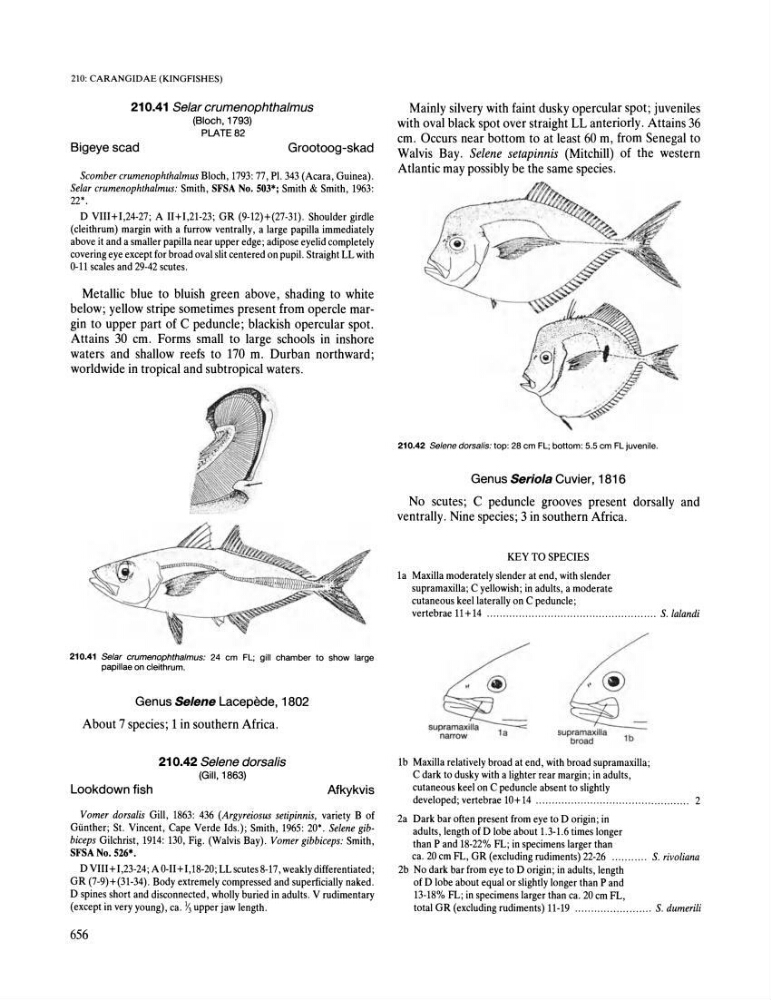
210.41 Selar crumenophthalmus: 24 em FL; gill chamber to show large
papillae on eleithrum.
Genus Selene Lacepede, 1802
About 7 species; 1 in southern Africa.
Lookdown fish
210.42 Selene dorsalis
(GiII,1863)
Afkykvis
Vomer dorsalis Gill, 1863: 436 (Argyreiosus setipinnis, variety B of
Gunther; St. Vincent, Cape Verde Ids.); Smith, 1965 : 20' . Selene gibbiceps Gilchrist, 1914: 130, Fig. (Walvis Bay). Vomer gibbiceps: Smith,
SFSA No. 526*.
D VIII + 1,23-24; A O-II + 1,18-20; LLscutes 8-17, weakly differentiated;
GR (7-9)+(31-34) . Body extremely compressed and superficially naked.
D spines short and disconnected, wholly buried in adults. V rudimentary
(except in very young), ca. ~ upper jaw length.
656
Mainly silvery with faint dusky opercular spot; juveniles
with oval black spot over straight LL anteriorly . Attains 36
cm. Occurs near bottom to at least 60 m, from Senegal to
Walvis Bay. Selene setapinnis (Mitchill) of the western
Atlantic may possibly be the same species.
210.42 Selene dorsalis: top: 28 em FL; bottom: 5.5 em FL juvenile.
Genus Seriola Cuvier, 1816
No scutes; C peduncle grooves present dorsally and
ventrally. Nine species; 3 in southern Africa.
KEY TO SPECIES
1 a Maxilla moderately slender at end, with slender
supramaxilla; C yellowish; in adults, a moderate
cutaneous keel laterally on C peduncle ;
vertebrae 11 +14 ............................. ........................ S. lalandi
supramaxilla
1 b
broad
1b Maxilla relatively broad at end, with broad supramaxilla;
C dark to dusky with a lighter rear margin; in adults,
cutaneous keel on C peduncle absent to slightly
developed; vertebrae 10+ 14 ... ....... .... ...... ........ .... .. .............. 2
2a Dark bar often present from eye to D origin; in
adults, length of D lobe about 1.3-1.6 times longer
than P and 18-22% FL; in specimens larger than
ca. 20 em FL, GR (excluding rudiments) 22-26 ......... .. S. rivoliana
2b No dark bar from eye to D origin; in adults, length
of D lobe about equal or slightly longer than P and
13-18% FL; in specimens larger than ca. 20 em FL,
total GR (excluding rudiments) 11-19 .................. ... ... S. dumerili
210.41 Selar crumenophthalmus
(Bloch,1793)
PLATE 82
Bigeye scad
Grootoog-skad
Scomber crumenophthalmus Bloch, 1793: 77, PI. 343 (Acara, Guinea).
Selar crumenophthalmus: Smith , SFSA No. 503*; Smith & Smith, 1963:
22* .
D VIII+I,24-27; A II+I,21-23; GR (9-12)+(27-31). Shoulder girdle
(cleithrum) margin with a furrow ventrally, a large papilla immediately
above it and a smaller papilla near upper edge; adipose eyelid completely
covering eye except for broad oval slit centered on pupil. Straight LL with
0-11 scales and 29-42 scutes .
Metallic blue to bluish green above, shading to white
below; yellow stripe sometimes present from opercle margin to upper part of C peduncle; blackish opercular spot.
Attains 30 cm. Forms small to large schools in inshore
waters and shallow reefs to 170 m. Durban northward;
worldwide in tropical and subtropical waters.
210.41 Selar crumenophthalmus: 24 em FL; gill chamber to show large
papillae on eleithrum.
Genus Selene Lacepede, 1802
About 7 species; 1 in southern Africa.
Lookdown fish
210.42 Selene dorsalis
(GiII,1863)
Afkykvis
Vomer dorsalis Gill, 1863: 436 (Argyreiosus setipinnis, variety B of
Gunther; St. Vincent, Cape Verde Ids.); Smith, 1965 : 20' . Selene gibbiceps Gilchrist, 1914: 130, Fig. (Walvis Bay). Vomer gibbiceps: Smith,
SFSA No. 526*.
D VIII + 1,23-24; A O-II + 1,18-20; LLscutes 8-17, weakly differentiated;
GR (7-9)+(31-34) . Body extremely compressed and superficially naked.
D spines short and disconnected, wholly buried in adults. V rudimentary
(except in very young), ca. ~ upper jaw length.
656
Mainly silvery with faint dusky opercular spot; juveniles
with oval black spot over straight LL anteriorly . Attains 36
cm. Occurs near bottom to at least 60 m, from Senegal to
Walvis Bay. Selene setapinnis (Mitchill) of the western
Atlantic may possibly be the same species.
210.42 Selene dorsalis: top: 28 em FL; bottom: 5.5 em FL juvenile.
Genus Seriola Cuvier, 1816
No scutes; C peduncle grooves present dorsally and
ventrally. Nine species; 3 in southern Africa.
KEY TO SPECIES
1 a Maxilla moderately slender at end, with slender
supramaxilla; C yellowish; in adults, a moderate
cutaneous keel laterally on C peduncle ;
vertebrae 11 +14 ............................. ........................ S. lalandi
supramaxilla
1 b
broad
1b Maxilla relatively broad at end, with broad supramaxilla;
C dark to dusky with a lighter rear margin; in adults,
cutaneous keel on C peduncle absent to slightly
developed; vertebrae 10+ 14 ... ....... .... ...... ........ .... .. .............. 2
2a Dark bar often present from eye to D origin; in
adults, length of D lobe about 1.3-1.6 times longer
than P and 18-22% FL; in specimens larger than
ca. 20 em FL, GR (excluding rudiments) 22-26 ......... .. S. rivoliana
2b No dark bar from eye to D origin; in adults, length
of D lobe about equal or slightly longer than P and
13-18% FL; in specimens larger than ca. 20 em FL,
total GR (excluding rudiments) 11-19 .................. ... ... S. dumerili