

Genus Pentaceros Cuvier, 1829
D XI-XIII,12-14; soft D rays much shorter than head; a
trigger mechanism locking front D spines in some species;
A spines 4-6. Vertebrae 24 or 25. Three species; 1 in our
area.
203.2 Pentaceros capensis
Cuvier, 1829
Cape armourhead
Kaapse pantserkop
Pentaceros capensis Cuvier, in Cuv. & Val., 1829: 30, PI. 43 (Cape of
Good Hope); Smith, 1964: 575*; Hardy, 1983: 197*. Quinquarius capensis: Smith, SFSA No. 621*.
D XII-XIII, 12-13; A IV-VI,7-9; GR (5-6)+(15-17); P 16-18; LL about
50; 7 or 8 scale rows from D origin to LL. Body depth 1.7-2.3 in SL.
Uniformly brownish. Attains 35 cm. From Point Nolloth
(western Cape Province) to ~outhern Mozambique in 70300m.
203.2 Pentaceros capensis: 32 cm (off South Africa).
Genus Pseudopentaceros Bleeker, 1876
D XIII-XV,8-1O; soft D rays much shorter than head; A
III-V,6-8; vertebrae 24-26. Three species, 1 in our area.
203.3 Pseudopentaceros richardsoni
(Smith, 1844)
Pelagic armourhead
Pelagiese pantserkop
Pentaceros richardsoni Smith, 1844: 51 (pages not numbered), PI. 21
(Cape of Good Hope); Smith, SFSA No. 622*; 1964: 572*; Penrith, 1967:
533; Hardy, 1983: 206*.
D XIV-XV,8-1O; A IV-V,7-8; P 17-18; LL 74-86; 12-15 scale rows from
DorigintoLL;GR6+17.
'
Head and body bluish dorsally, pale ventrally. Attains
56 cm. Cape Town to Natal in 50 - 600 m; Australia, New
Zealand, Cape Horn, Tristan da Cunha.
204: POMACANTHIDAE (ANGELFISHES)
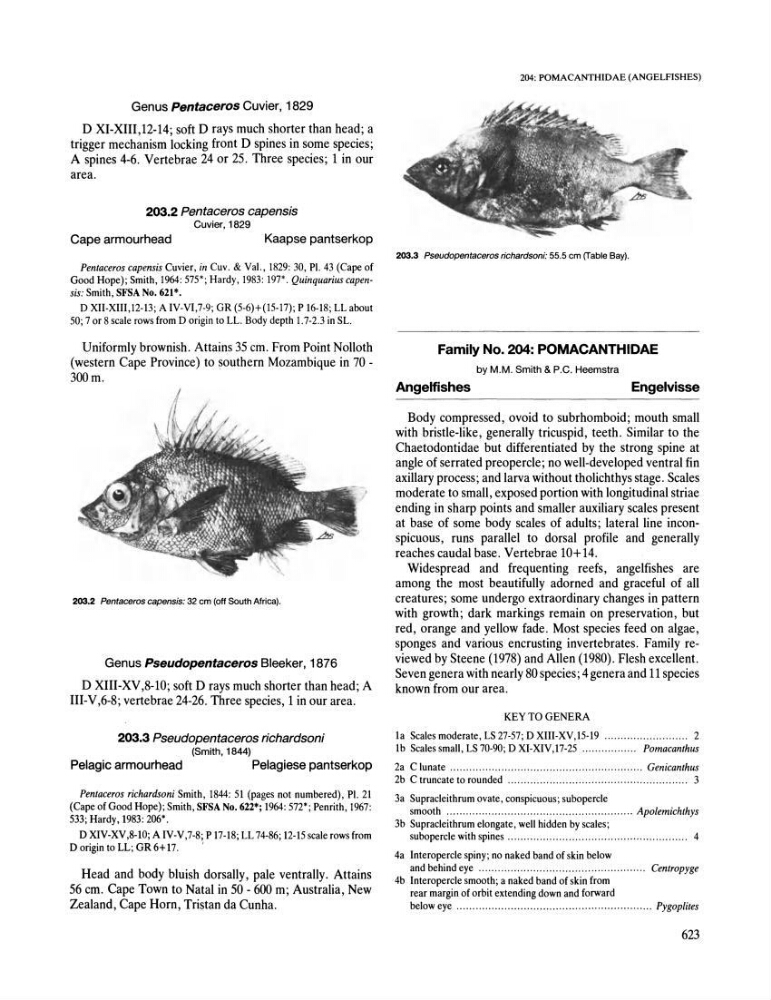
203.3 Pseudopentaceros richardsoni: 55.5 cm (Table Bay).
Family No. 204: POMACANTHIDAE
by M.M. Smith & P.C. Heemstra
Angelfishes
Engelvisse
Body compressed, ovoid to subrhomboid; mouth small
with bristle-like, generally tricuspid, teeth. Similar to the
Chaetodontidae but differentiated by the strong spine at
angle of serrated preoperc\e; no well-developed ventral fin
axillary process; and larva without tholichthys stage. Scales
moderate to small, exposed portion with longitudinal striae
ending in sharp points and smaller auxiliary scales present
at base of some body scales of adults; lateral line inconspicuous, runs parallel to dorsal profile and generally
reaches caudal base. Vertebrae 10+ 14.
Widespread and frequenting reefs, angelfishes are
among the most beautifully adorned and graceful of all
creatures; some undergo extraordinary changes in pattern
with growth; dark markings remain on preservation, but
red, orange and yellow fade. Most species feed on algae,
sponges and various encrusting invertebrates. Family reviewed by Steene (1978) and Allen (1980). Flesh excellent.
Seven genera with nearly 80 species; 4 genera and 11 species
known from our area.
KEY TO GENERA
la Scales moderate, LS 27-57; D XIII-XV,15-19 .......................... 2
Ib Scales small, LS 70-90; D XI-XIV,17-25 ................. Pomacanthus
2a C lunate ............................................................ Genicanthus
2b C truncate to rounded ........................................................ 3
3a Supracleithrum ovate, conspicuous; subopercle
smooth .......................................................... Apolemichthys
3b Supracleithrum elongate, well hidden by scales;
subopercle with spines........................................................ 4
4a Interopercle spiny; no naked band of skin below
and behind eye .................................................... Centropyge
4b Interopercle smooth; a naked band of skin from
rear margin of orbit extending down and forward
below eye ............................................................. Pygoplites
623
D XI-XIII,12-14; soft D rays much shorter than head; a
trigger mechanism locking front D spines in some species;
A spines 4-6. Vertebrae 24 or 25. Three species; 1 in our
area.
203.2 Pentaceros capensis
Cuvier, 1829
Cape armourhead
Kaapse pantserkop
Pentaceros capensis Cuvier, in Cuv. & Val., 1829: 30, PI. 43 (Cape of
Good Hope); Smith, 1964: 575*; Hardy, 1983: 197*. Quinquarius capensis: Smith, SFSA No. 621*.
D XII-XIII, 12-13; A IV-VI,7-9; GR (5-6)+(15-17); P 16-18; LL about
50; 7 or 8 scale rows from D origin to LL. Body depth 1.7-2.3 in SL.
Uniformly brownish. Attains 35 cm. From Point Nolloth
(western Cape Province) to ~outhern Mozambique in 70300m.
203.2 Pentaceros capensis: 32 cm (off South Africa).
Genus Pseudopentaceros Bleeker, 1876
D XIII-XV,8-1O; soft D rays much shorter than head; A
III-V,6-8; vertebrae 24-26. Three species, 1 in our area.
203.3 Pseudopentaceros richardsoni
(Smith, 1844)
Pelagic armourhead
Pelagiese pantserkop
Pentaceros richardsoni Smith, 1844: 51 (pages not numbered), PI. 21
(Cape of Good Hope); Smith, SFSA No. 622*; 1964: 572*; Penrith, 1967:
533; Hardy, 1983: 206*.
D XIV-XV,8-1O; A IV-V,7-8; P 17-18; LL 74-86; 12-15 scale rows from
DorigintoLL;GR6+17.
'
Head and body bluish dorsally, pale ventrally. Attains
56 cm. Cape Town to Natal in 50 - 600 m; Australia, New
Zealand, Cape Horn, Tristan da Cunha.
204: POMACANTHIDAE (ANGELFISHES)
203.3 Pseudopentaceros richardsoni: 55.5 cm (Table Bay).
Family No. 204: POMACANTHIDAE
by M.M. Smith & P.C. Heemstra
Angelfishes
Engelvisse
Body compressed, ovoid to subrhomboid; mouth small
with bristle-like, generally tricuspid, teeth. Similar to the
Chaetodontidae but differentiated by the strong spine at
angle of serrated preoperc\e; no well-developed ventral fin
axillary process; and larva without tholichthys stage. Scales
moderate to small, exposed portion with longitudinal striae
ending in sharp points and smaller auxiliary scales present
at base of some body scales of adults; lateral line inconspicuous, runs parallel to dorsal profile and generally
reaches caudal base. Vertebrae 10+ 14.
Widespread and frequenting reefs, angelfishes are
among the most beautifully adorned and graceful of all
creatures; some undergo extraordinary changes in pattern
with growth; dark markings remain on preservation, but
red, orange and yellow fade. Most species feed on algae,
sponges and various encrusting invertebrates. Family reviewed by Steene (1978) and Allen (1980). Flesh excellent.
Seven genera with nearly 80 species; 4 genera and 11 species
known from our area.
KEY TO GENERA
la Scales moderate, LS 27-57; D XIII-XV,15-19 .......................... 2
Ib Scales small, LS 70-90; D XI-XIV,17-25 ................. Pomacanthus
2a C lunate ............................................................ Genicanthus
2b C truncate to rounded ........................................................ 3
3a Supracleithrum ovate, conspicuous; subopercle
smooth .......................................................... Apolemichthys
3b Supracleithrum elongate, well hidden by scales;
subopercle with spines........................................................ 4
4a Interopercle spiny; no naked band of skin below
and behind eye .................................................... Centropyge
4b Interopercle smooth; a naked band of skin from
rear margin of orbit extending down and forward
below eye ............................................................. Pygoplites
623