

pressed. in about 4 rows; outer row with 18-20 teeth in each jaw; inner
teeth embedded in fleshy pads; palate and tongue edentate. Juveniles
orbicular, body depth decreases with growth.
Silvery brown; dark crossbars, generally narrower than
interspaces, disappear with growth. Attains 50 cm. Kenya
south to Algoa Bay; not uncommon about reefs in Mozambique, where large specimens have been seen to jerk the
head up and allow cleaner wrasses to enter and clean the
mouth. Young taken in nets, larger specimens fight quite
gamely when hooked. Flesh palatable.
Family No. 193: MONODACTYLIDAE
by P.C. Heemstra
Moonies
Maanskynvisse
Body deep, compressed, covered with small deciduous
scales extending onto median fins and head. Dorsal and
anal fin spines reduced, mostly covered by skin and scales at
front margin of these fins. Pelvic fins present in juveniles,
rudimentary or absent in adults. Jaws with bands of tiny
flattened or conical teeth; maxilla exposed; upper jaw
slightly protrusile.
Two genera; Psettus is mono typic (P. sebae Cuvier,
1831 occurs in tropical west Africa and has the body depth
greater than its length).
Genus Monodactylus Lacepede, 1800
Body depth 1.2-2.0 in SL; villiform or granular teeth on
vomer, palatines, endopterygoids and tongue. Two species,
both represented in our area. Moonies occur in large shoals
in estuaries and over shallow reefs; they are at home in fresh
or saltwater. Readily take a fly; eat almost anything. Flesh
soft and spoils rapidly.
KEY TO SPECIES
la Body depth 1.2-1.6 in SL; GR 8 + (18-22); maxilla
width 3.4-5.0 in eye diameter; juveniles with only
2 dark vertical stripes .......................................... M. argenteus
/
~
:@ . ~ :; 1. /l
'. ~- KJ
~~
~ ,
1a ~
1b
Ib Body depth 1.5-2.0 in SL; GR 9 + (22-24);
maxilla width 2.7-3.7 in eye diameter; juveniles
with 11-12 dark vertical stripes ............................. M. falciformis
193: MONODACfYLIDAE (MOONIES)
193.1 Monodactylus argenteus
(Linnaeus, 1758)
Natal moony
Natalse maanskynvis
Chaetodon argenteus Linnaeus, 1758: 272 (Indies). Monodactylus
argenteus: Smith, SFSA No. 581*; Penrith, 1969: 225.
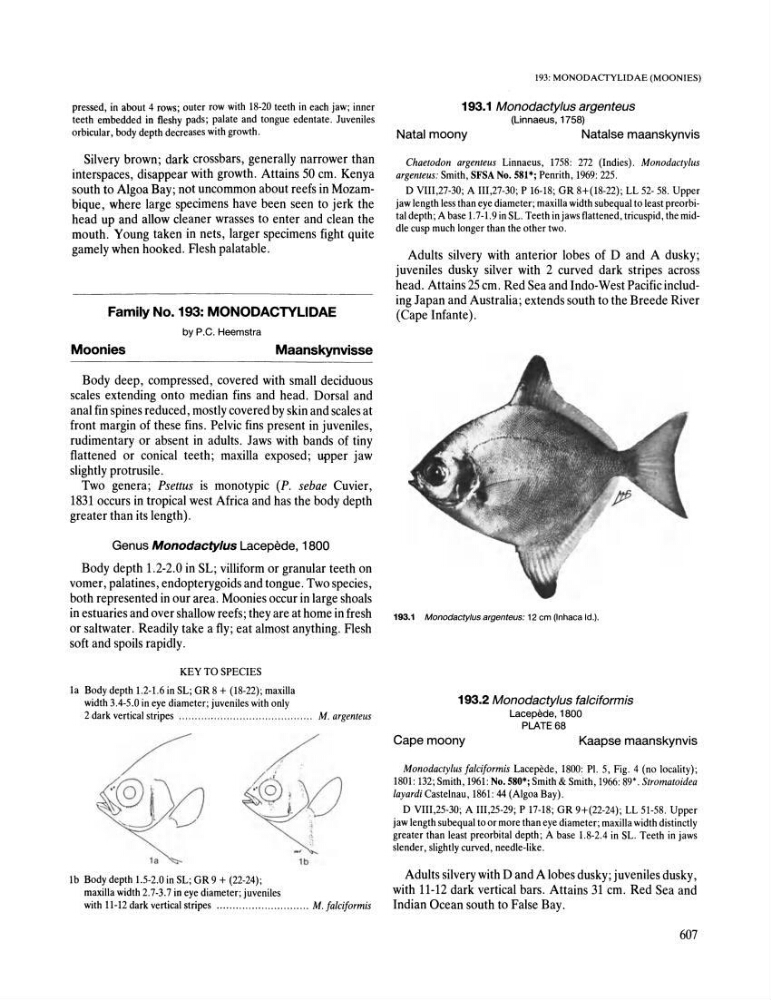
D VIII,27-30; A III,27-30; P 16-18; GR 8+(18-22); LL 52- 58. Upper
jaw length less than eye diameter; maxilla width subequal to least preorbital depth; A base 1.7-1.9 in SL. Teeth in jaws flattened, tricuspid, the middle cusp much longer than the other two.
Adults silvery with anterior lobes of D and A dusky;
juveniles dusky silver with 2 curved dark stripes across
head. Attains 25 cm. Red Sea and Indo-West Pacific including Japan and Australia; extends south to the Breede River
(Cape Infante).
193.1 Monodactylus argenteus: 12 em (Inhaea Id.).
193.2 Monodactylus falciformis
Lacepede,1800
PLATE 68
Cape moony
Kaapse maanskynvis
Monodactylus falciformis Lacepede, 1800: PI. 5, Fig. 4 (no locality);
1801: 132; Smith, 1961: No. 580*; Smith & Smith, 1966: 89*. Stromatoidea
layardi Castelnau, 1861: 44 (Algoa Bay).
D VIII,25-30; A III,25-29; P 17-18; GR 9+(22-24); LL 51-58. Upper
jaw length subequal to or more than eye diameter; maxilla width distinctly
greater than least preorbital depth; A base 1.8-2.4 in SL. Teeth in jaws
slender, slightly curved, needle-like.
Adults silvery with D and A lobes dusky; juveniles dusky,
with 11-12 dark vertical bars. Attains 31 cm. Red Sea and
Indian Ocean south to False Bay.
607
teeth embedded in fleshy pads; palate and tongue edentate. Juveniles
orbicular, body depth decreases with growth.
Silvery brown; dark crossbars, generally narrower than
interspaces, disappear with growth. Attains 50 cm. Kenya
south to Algoa Bay; not uncommon about reefs in Mozambique, where large specimens have been seen to jerk the
head up and allow cleaner wrasses to enter and clean the
mouth. Young taken in nets, larger specimens fight quite
gamely when hooked. Flesh palatable.
Family No. 193: MONODACTYLIDAE
by P.C. Heemstra
Moonies
Maanskynvisse
Body deep, compressed, covered with small deciduous
scales extending onto median fins and head. Dorsal and
anal fin spines reduced, mostly covered by skin and scales at
front margin of these fins. Pelvic fins present in juveniles,
rudimentary or absent in adults. Jaws with bands of tiny
flattened or conical teeth; maxilla exposed; upper jaw
slightly protrusile.
Two genera; Psettus is mono typic (P. sebae Cuvier,
1831 occurs in tropical west Africa and has the body depth
greater than its length).
Genus Monodactylus Lacepede, 1800
Body depth 1.2-2.0 in SL; villiform or granular teeth on
vomer, palatines, endopterygoids and tongue. Two species,
both represented in our area. Moonies occur in large shoals
in estuaries and over shallow reefs; they are at home in fresh
or saltwater. Readily take a fly; eat almost anything. Flesh
soft and spoils rapidly.
KEY TO SPECIES
la Body depth 1.2-1.6 in SL; GR 8 + (18-22); maxilla
width 3.4-5.0 in eye diameter; juveniles with only
2 dark vertical stripes .......................................... M. argenteus
/
~
:@ . ~ :; 1. /l
'. ~- KJ
~~
~ ,
1a ~
1b
Ib Body depth 1.5-2.0 in SL; GR 9 + (22-24);
maxilla width 2.7-3.7 in eye diameter; juveniles
with 11-12 dark vertical stripes ............................. M. falciformis
193: MONODACfYLIDAE (MOONIES)
193.1 Monodactylus argenteus
(Linnaeus, 1758)
Natal moony
Natalse maanskynvis
Chaetodon argenteus Linnaeus, 1758: 272 (Indies). Monodactylus
argenteus: Smith, SFSA No. 581*; Penrith, 1969: 225.
D VIII,27-30; A III,27-30; P 16-18; GR 8+(18-22); LL 52- 58. Upper
jaw length less than eye diameter; maxilla width subequal to least preorbital depth; A base 1.7-1.9 in SL. Teeth in jaws flattened, tricuspid, the middle cusp much longer than the other two.
Adults silvery with anterior lobes of D and A dusky;
juveniles dusky silver with 2 curved dark stripes across
head. Attains 25 cm. Red Sea and Indo-West Pacific including Japan and Australia; extends south to the Breede River
(Cape Infante).
193.1 Monodactylus argenteus: 12 em (Inhaea Id.).
193.2 Monodactylus falciformis
Lacepede,1800
PLATE 68
Cape moony
Kaapse maanskynvis
Monodactylus falciformis Lacepede, 1800: PI. 5, Fig. 4 (no locality);
1801: 132; Smith, 1961: No. 580*; Smith & Smith, 1966: 89*. Stromatoidea
layardi Castelnau, 1861: 44 (Algoa Bay).
D VIII,25-30; A III,25-29; P 17-18; GR 9+(22-24); LL 51-58. Upper
jaw length subequal to or more than eye diameter; maxilla width distinctly
greater than least preorbital depth; A base 1.8-2.4 in SL. Teeth in jaws
slender, slightly curved, needle-like.
Adults silvery with D and A lobes dusky; juveniles dusky,
with 11-12 dark vertical bars. Attains 31 cm. Red Sea and
Indian Ocean south to False Bay.
607