

187: CORACINIDAE (GALJOENS)
Galjoen
187.1 Coracinus capensis
(Cuvier, 1831)
PLATE 67
Galjoen
Dipterodon capensis Cuvier, 1831: 276 (Cape of Good Hope). Dichistius
falcatus Smith, 1935: 272, Pis 14 & 17 (Great Fish Point, South Africa).
Coracinus capensis: Smith, SFSA No. 644*; Smith & Smith, 1966: 46*; van
der Elst, 1981: 161*.
D X,18-19; A m,13-14; P 16-17; GR (7-8)+(13-15); LL 60-64.
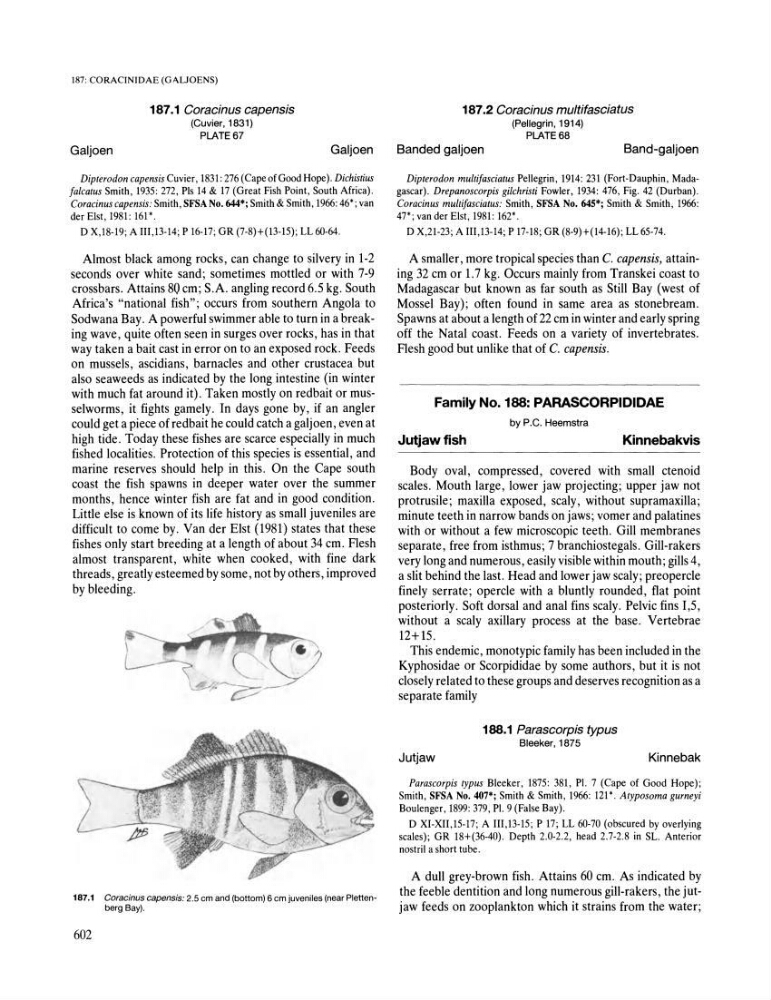
Almost black among rocks, can change to silvery in 1-2
seconds over white sand; sometimes mottled or with 7-9
crossbars. Attains 80 cm; S.A. angling record 6.5 kg. South
Africa's "national fish"; occurs from southern Angola to
Sodwana Bay. A powerful swimmer able to turn in a breaking wave, quite often seen in surges over rocks, has in that
way taken a bait cast in error on to an exposed rock. Feeds
on mussels, ascidians, barnacles and other crustacea but
also seaweeds as indicated by the long intestine (in winter
with much fat around it). Taken mostly on redbait or musselworms, it fights gamely. In days gone by, if an angler
could get a piece of redbait he could catch a galjoen, even at
high tide. Today these fishes are scarce especially in much
fished localities. Protection of this species is essential, and
marine reserves should help in this. On the Cape south
coast the fish spawns in deeper water over the summer
months, hence winter fish are fat and in good condition.
Little else is known of its life history as small juveniles are
difficult to come by. Van der Elst (1981) states that these
fishes only start breeding at a length of about 34 cm. Flesh
almost transparent, white when cooked, with fine dark
threads, greatly esteemed by some, not by others, improved
by bleeding.
187.1 Coracinus capensis: 2.5 em and (bottom) 6 em juveniles (near Plettenberg Bay).
602
187.2 Coracinus multifasciatus
(Pellegrin, 1914)
PLATE 68
Banded galjoen
Band-galjoen
Dipterodon multifasciatus Pellegrin, 1914: 231 (Fort-Dauphin, Madagascar). Drepanoscorpis gilchristi Fowler, 1934: 476, Fig. 42 (Durban).
Coracinus multifasciatus: Smith, SFSA No. 645*; Smith & Smith, 1966:
47*; van der Elst, 1981: 162*.
D X,21-23; A m,13-14; P 17-18; GR (8-9)+(14-16); LL65-74.
A smaller, more tropical species than C. capensis, attaining 32 cm or 1.7 kg. Occurs mainly from Transkei coast to
Madagascar but known as far south as Still Bay (west of
Mossel Bay); often found in same area as stonebream.
Spawns at about a length of 22 cm in winter and early spring
off the Natal coast. Feeds on a variety of invertebrates.
Flesh good but unlike that of C. capensis.
Family No. 188: PARASCORPIDIDAE
by P.C. Heemstra
Jut jaw fish
Kinnebakvis
Body oval, compressed, covered with small ctenoid
scales. Mouth large, lower jaw projecting; upper jaw not
protrusile; maxilla exposed, scaly, without supramaxilla;
minute teeth in narrow bands on jaws; vomer and palatines
with or without a few microscopic teeth. Gill membranes
separate, free from isthmus; 7 branchiostegals. Gill-rakers
very long and numerous, easily visible within mouth; gills 4,
a slit behind the last. Head and lower jaw scaly; preopercle
finely serrate; opercle with a bluntly rounded, flat point
posteriorly. Soft dorsal and anal fins scaly. Pelvic fins 1,5,
without a scaly axillary process at the base. Vertebrae
12+ 15.
This endemic, monotypic family has been included in the
Kyphosidae or Scorpididae by some authors, but it is not
closely related to these groups and deserves recognition as a
separate family
Jut jaw
188.1 Parascorpis typus
Bleeker, 1875
Kinnebak
Parascorpis typus Bleeker, 1875: 381, PI. 7 (Cape of Good Hope);
Smith, SFSA No. 407*; Smith & Smith, 1966: 121*. Atyposoma gurneyi
Boulenger, 1899: 379, PI. 9 (False Bay).
D XI-XJI,15-17; A m,13-15; P 17; LL 60-70 (obscured by overlying
scales); GR 18+(36-40). Depth 2.0-2.2, head 2.7-2.8 in SL. Anterior
nostril a short tube.
A dull grey-brown fish. Attains 60 cm. As indicated by
the feeble dentition and long numerous gill-rakers, the jutjaw feeds on zooplankton which it strains from the water;
Galjoen
187.1 Coracinus capensis
(Cuvier, 1831)
PLATE 67
Galjoen
Dipterodon capensis Cuvier, 1831: 276 (Cape of Good Hope). Dichistius
falcatus Smith, 1935: 272, Pis 14 & 17 (Great Fish Point, South Africa).
Coracinus capensis: Smith, SFSA No. 644*; Smith & Smith, 1966: 46*; van
der Elst, 1981: 161*.
D X,18-19; A m,13-14; P 16-17; GR (7-8)+(13-15); LL 60-64.
Almost black among rocks, can change to silvery in 1-2
seconds over white sand; sometimes mottled or with 7-9
crossbars. Attains 80 cm; S.A. angling record 6.5 kg. South
Africa's "national fish"; occurs from southern Angola to
Sodwana Bay. A powerful swimmer able to turn in a breaking wave, quite often seen in surges over rocks, has in that
way taken a bait cast in error on to an exposed rock. Feeds
on mussels, ascidians, barnacles and other crustacea but
also seaweeds as indicated by the long intestine (in winter
with much fat around it). Taken mostly on redbait or musselworms, it fights gamely. In days gone by, if an angler
could get a piece of redbait he could catch a galjoen, even at
high tide. Today these fishes are scarce especially in much
fished localities. Protection of this species is essential, and
marine reserves should help in this. On the Cape south
coast the fish spawns in deeper water over the summer
months, hence winter fish are fat and in good condition.
Little else is known of its life history as small juveniles are
difficult to come by. Van der Elst (1981) states that these
fishes only start breeding at a length of about 34 cm. Flesh
almost transparent, white when cooked, with fine dark
threads, greatly esteemed by some, not by others, improved
by bleeding.
187.1 Coracinus capensis: 2.5 em and (bottom) 6 em juveniles (near Plettenberg Bay).
602
187.2 Coracinus multifasciatus
(Pellegrin, 1914)
PLATE 68
Banded galjoen
Band-galjoen
Dipterodon multifasciatus Pellegrin, 1914: 231 (Fort-Dauphin, Madagascar). Drepanoscorpis gilchristi Fowler, 1934: 476, Fig. 42 (Durban).
Coracinus multifasciatus: Smith, SFSA No. 645*; Smith & Smith, 1966:
47*; van der Elst, 1981: 162*.
D X,21-23; A m,13-14; P 17-18; GR (8-9)+(14-16); LL65-74.
A smaller, more tropical species than C. capensis, attaining 32 cm or 1.7 kg. Occurs mainly from Transkei coast to
Madagascar but known as far south as Still Bay (west of
Mossel Bay); often found in same area as stonebream.
Spawns at about a length of 22 cm in winter and early spring
off the Natal coast. Feeds on a variety of invertebrates.
Flesh good but unlike that of C. capensis.
Family No. 188: PARASCORPIDIDAE
by P.C. Heemstra
Jut jaw fish
Kinnebakvis
Body oval, compressed, covered with small ctenoid
scales. Mouth large, lower jaw projecting; upper jaw not
protrusile; maxilla exposed, scaly, without supramaxilla;
minute teeth in narrow bands on jaws; vomer and palatines
with or without a few microscopic teeth. Gill membranes
separate, free from isthmus; 7 branchiostegals. Gill-rakers
very long and numerous, easily visible within mouth; gills 4,
a slit behind the last. Head and lower jaw scaly; preopercle
finely serrate; opercle with a bluntly rounded, flat point
posteriorly. Soft dorsal and anal fins scaly. Pelvic fins 1,5,
without a scaly axillary process at the base. Vertebrae
12+ 15.
This endemic, monotypic family has been included in the
Kyphosidae or Scorpididae by some authors, but it is not
closely related to these groups and deserves recognition as a
separate family
Jut jaw
188.1 Parascorpis typus
Bleeker, 1875
Kinnebak
Parascorpis typus Bleeker, 1875: 381, PI. 7 (Cape of Good Hope);
Smith, SFSA No. 407*; Smith & Smith, 1966: 121*. Atyposoma gurneyi
Boulenger, 1899: 379, PI. 9 (False Bay).
D XI-XJI,15-17; A m,13-15; P 17; LL 60-70 (obscured by overlying
scales); GR 18+(36-40). Depth 2.0-2.2, head 2.7-2.8 in SL. Anterior
nostril a short tube.
A dull grey-brown fish. Attains 60 cm. As indicated by
the feeble dentition and long numerous gill-rakers, the jutjaw feeds on zooplankton which it strains from the water;