

Genus Diagramma Oken, 1917
Recognisable by the 1st D spine short and 2nd (with the
3rd) abruptly the longest of 9-10 D spines; scales small,
adherent, extend to front of nostrils, and whole pre orbital
scaly; teeth not enlarged. C peduncle slender, length about
equals P. An Indo-West Pacific genus generally considered
monotypic, but may contain 2 species.
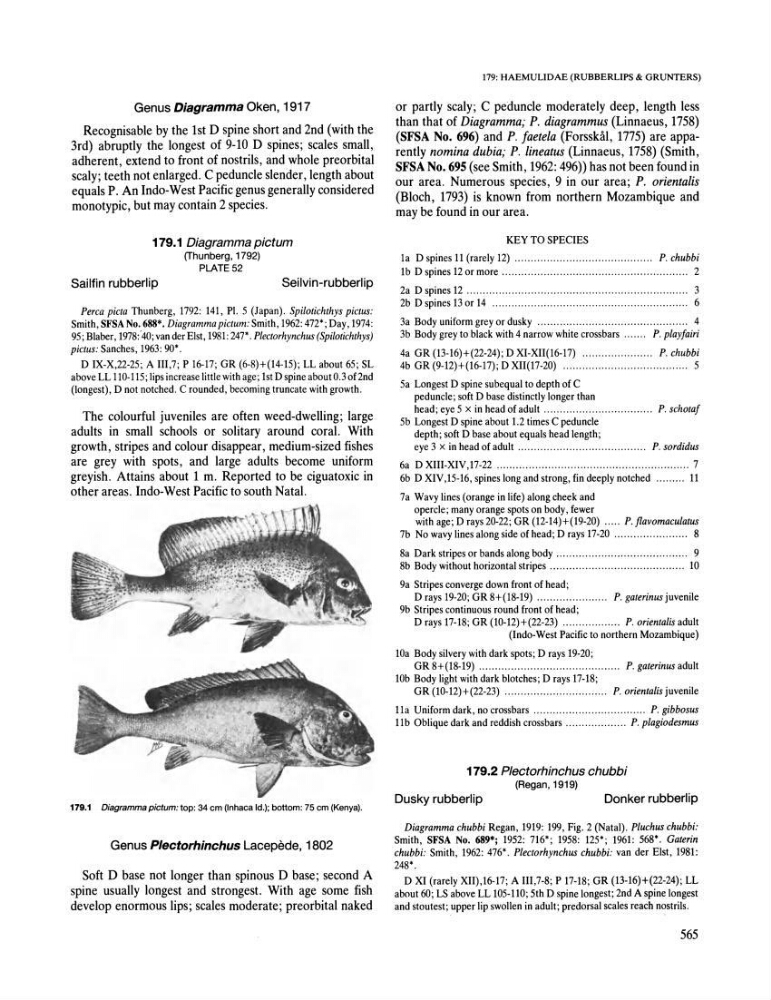
179.1 Diagramma pictum
(Thunberg, 1792)
PLATE 52
Sailfin rubberlip
Seilvin-rubberlip
Perea picta Thunberg, 1792: 141 , PI. 5 (Japan). Spilotichthys pictus:
Smith , SFSA No. 688*. Diagramma pictum: Smith , 1962: 472*; Day, 1974:
95; Blaber, 1978: ' 40; van der Elst, 1981: 247* . Plectorhynchus (Spilotichthys)
pictus: Sanches , 1963: 90* .
D IX-X,22-25; A I1I,7; P 16-17; GR (6-8)+(14-15) ; LL about 65; SL
above LL 110-115; lips increase little with age ; 1st D spine about 0.3 of 2nd
(longest) , D not notched . C rounded , becoming truncate with growth .
The colourful juveniles are often weed-dwelling; large
adults in small schools or solitary around coral. With
growth, stripes and colour disappear, medium-sized fishes
are grey with spots, and large adults become uniform
greyish. Attains about 1 m. Reported to be ciguatoxic in
other areas. Indo-West Pacific to south Natal.
179.1 Diagrammapictum: top: 34 em (Inhaea Id.); bottom: 75 em (Kenya).
Genus Plectorhinchus Lacepede, 1802
Soft D base not longer than spinous D base; second A
spine usually longest and strongest. With age some fish
develop enormous lips; scales moderate; preorbital naked
179: HAEMULIDAE (RUBBERLIPS & GRUNTERS)
or partly scaly; C peduncle moderately deep, length less
than that of Diagramma; P. diagrammus (Linnaeus, 1758)
(SFSA No. 696) and P. faetela (Forsskal, 1775) are apparently nomina dubia; P. lineatus (Linnaeus, 1758) (Smith,
SFSA No. 695 (see Smith, 1962: 496)) has not been found in
our area. Numerous species, 9 in our area; P. orientalis
(Bloch , 1793) is known from northern Mozambique and
may be found in our area.
KEY TO SPECIES
la D spines 11 (rarely 12) ......... .... ...... .. .. .......... ...... .... P. chubbi
Ib D spines 12 or more .. .................... .... ......... ... .. .... ... ....... .. .. 2
2a D spines 12 ..... ............ ............. .... ... .. .... .... ... ...... ... .... ...... 3
2b D spines 13 or 14 .......... ... ... ....... ... .... .. ... ..... ..................... 6
3a Body uniform grey or dusky ... ..... ........ .......... ...... ..... .. .. ..... . 4
3b Body grey to black with 4 narrow white crossbars .. ..... P. playfairi
4a GR (13-16)+(22-24); D XI-XII(16-17) ..... ............. .... P. chubbi
4b GR (9-12)+(16-17); D XII(17-20) ... .... ..... ..... ... ... ... ... .. .... .... 5
5a Longest D spine subequal to depth of C
peduncle; soft D base distinctly longer than
head ; eye 5 x in head of adult ... .. .... .. .......... ........ .. .. . P. schotaf
5b Longest D spine about 1.2 times C peduncle
depth ; soft D base about equals head length;
eye 3 x in head of adult ...... .... .... ... .... ... ... .. ... ... ... .. P. sordidus
6a D XIII-XIV,17-22 ............ ...... ..... ..... ...... ........ ..... ... ... ...... . 7
6b D XIV,15-16, spines long and strong, fin deeply notched ......... 11
7a Wavy lines (orange in life) along cheek and
opercle ; many orange spots on body, fewer
with age; Drays 20-22; GR (12-14)+(19-20) ... .. P. Jlavomaculatus
7b No wavy lines along side of head; Drays 17-20 .... ... ........ .. .... .. 8
8a Dark stripes or bands along body. .. ...... ..... ..... ...... ....... .. ..... .. 9
8b Body without horizontal stripes ... ... .... ... .. .... .. .. ............. .... .. 10
9a Stripes converge down front of head;
Drays 19-20; GR 8+(18-19) ... .................. . P. gaterinus juvenile
9b Stripes continuous round front of head;
Drays 17-18; GR (10-12)+(22-23) .... ............. . P. orientalis adult
(Indo-West Pacific to northern Mozambique)
lOa Body silvery with dark spots; Drays 19-20;
GR 8+(18-19) ... ... ............ .. .. ................... ... P. gaterinus adult
lOb Body light with dark blotches; Drays 17-18;
GR (10-12)+(22-23) ... .. .... ... .. ...... ... ..... .. .. P. orientalis juvenile
lla Uniform dark, no crossbars .... .... ... ............. ... ........ P. gibbosus
lIb Oblique dark and reddish crossbars ...... ........ ... .. P. plagiodesmus
179.2 Plectorhinchus chubbi
(Regan, 1919)
Dusky rubberlip
Donker rubberlip
Diagramma chubbi Regan , 1919: 199, Fig. 2 (Natal). Pluchus chubbi:
Smith, SFSA No. 689*; 1952: 716*; 1958: 125*; 1961: 568* . Gaterin
chubbi: Smith, 1962: 476*. Plectorhynchus chubbi: van der Elst, 1981 :
248*.
D XI (rarely XII),16-17; A III,7-8; P 17-18; GR (13-16)+(22-24); LL
about 60; LS above LL 105-110; 5th D spine longest; 2nd A spine longest
and stoutest; upper lip swollen in adult; predorsal scales reach nostrils.
565
Recognisable by the 1st D spine short and 2nd (with the
3rd) abruptly the longest of 9-10 D spines; scales small,
adherent, extend to front of nostrils, and whole pre orbital
scaly; teeth not enlarged. C peduncle slender, length about
equals P. An Indo-West Pacific genus generally considered
monotypic, but may contain 2 species.
179.1 Diagramma pictum
(Thunberg, 1792)
PLATE 52
Sailfin rubberlip
Seilvin-rubberlip
Perea picta Thunberg, 1792: 141 , PI. 5 (Japan). Spilotichthys pictus:
Smith , SFSA No. 688*. Diagramma pictum: Smith , 1962: 472*; Day, 1974:
95; Blaber, 1978: ' 40; van der Elst, 1981: 247* . Plectorhynchus (Spilotichthys)
pictus: Sanches , 1963: 90* .
D IX-X,22-25; A I1I,7; P 16-17; GR (6-8)+(14-15) ; LL about 65; SL
above LL 110-115; lips increase little with age ; 1st D spine about 0.3 of 2nd
(longest) , D not notched . C rounded , becoming truncate with growth .
The colourful juveniles are often weed-dwelling; large
adults in small schools or solitary around coral. With
growth, stripes and colour disappear, medium-sized fishes
are grey with spots, and large adults become uniform
greyish. Attains about 1 m. Reported to be ciguatoxic in
other areas. Indo-West Pacific to south Natal.
179.1 Diagrammapictum: top: 34 em (Inhaea Id.); bottom: 75 em (Kenya).
Genus Plectorhinchus Lacepede, 1802
Soft D base not longer than spinous D base; second A
spine usually longest and strongest. With age some fish
develop enormous lips; scales moderate; preorbital naked
179: HAEMULIDAE (RUBBERLIPS & GRUNTERS)
or partly scaly; C peduncle moderately deep, length less
than that of Diagramma; P. diagrammus (Linnaeus, 1758)
(SFSA No. 696) and P. faetela (Forsskal, 1775) are apparently nomina dubia; P. lineatus (Linnaeus, 1758) (Smith,
SFSA No. 695 (see Smith, 1962: 496)) has not been found in
our area. Numerous species, 9 in our area; P. orientalis
(Bloch , 1793) is known from northern Mozambique and
may be found in our area.
KEY TO SPECIES
la D spines 11 (rarely 12) ......... .... ...... .. .. .......... ...... .... P. chubbi
Ib D spines 12 or more .. .................... .... ......... ... .. .... ... ....... .. .. 2
2a D spines 12 ..... ............ ............. .... ... .. .... .... ... ...... ... .... ...... 3
2b D spines 13 or 14 .......... ... ... ....... ... .... .. ... ..... ..................... 6
3a Body uniform grey or dusky ... ..... ........ .......... ...... ..... .. .. ..... . 4
3b Body grey to black with 4 narrow white crossbars .. ..... P. playfairi
4a GR (13-16)+(22-24); D XI-XII(16-17) ..... ............. .... P. chubbi
4b GR (9-12)+(16-17); D XII(17-20) ... .... ..... ..... ... ... ... ... .. .... .... 5
5a Longest D spine subequal to depth of C
peduncle; soft D base distinctly longer than
head ; eye 5 x in head of adult ... .. .... .. .......... ........ .. .. . P. schotaf
5b Longest D spine about 1.2 times C peduncle
depth ; soft D base about equals head length;
eye 3 x in head of adult ...... .... .... ... .... ... ... .. ... ... ... .. P. sordidus
6a D XIII-XIV,17-22 ............ ...... ..... ..... ...... ........ ..... ... ... ...... . 7
6b D XIV,15-16, spines long and strong, fin deeply notched ......... 11
7a Wavy lines (orange in life) along cheek and
opercle ; many orange spots on body, fewer
with age; Drays 20-22; GR (12-14)+(19-20) ... .. P. Jlavomaculatus
7b No wavy lines along side of head; Drays 17-20 .... ... ........ .. .... .. 8
8a Dark stripes or bands along body. .. ...... ..... ..... ...... ....... .. ..... .. 9
8b Body without horizontal stripes ... ... .... ... .. .... .. .. ............. .... .. 10
9a Stripes converge down front of head;
Drays 19-20; GR 8+(18-19) ... .................. . P. gaterinus juvenile
9b Stripes continuous round front of head;
Drays 17-18; GR (10-12)+(22-23) .... ............. . P. orientalis adult
(Indo-West Pacific to northern Mozambique)
lOa Body silvery with dark spots; Drays 19-20;
GR 8+(18-19) ... ... ............ .. .. ................... ... P. gaterinus adult
lOb Body light with dark blotches; Drays 17-18;
GR (10-12)+(22-23) ... .. .... ... .. ...... ... ..... .. .. P. orientalis juvenile
lla Uniform dark, no crossbars .... .... ... ............. ... ........ P. gibbosus
lIb Oblique dark and reddish crossbars ...... ........ ... .. P. plagiodesmus
179.2 Plectorhinchus chubbi
(Regan, 1919)
Dusky rubberlip
Donker rubberlip
Diagramma chubbi Regan , 1919: 199, Fig. 2 (Natal). Pluchus chubbi:
Smith, SFSA No. 689*; 1952: 716*; 1958: 125*; 1961: 568* . Gaterin
chubbi: Smith, 1962: 476*. Plectorhynchus chubbi: van der Elst, 1981 :
248*.
D XI (rarely XII),16-17; A III,7-8; P 17-18; GR (13-16)+(22-24); LL
about 60; LS above LL 105-110; 5th D spine longest; 2nd A spine longest
and stoutest; upper lip swollen in adult; predorsal scales reach nostrils.
565