

Specimens < 8 cm SL with a dark band on peduncle at C
base and a thin black ring on central part of peduncle; ring
and band gradually disappear with size and are absent in
specimens> 11 cm SL; GR and gill chamber black (light in
specimens < 5 cm); fins dark. Attains 20 cm. Caribbean,
Gulf of Mexico and Gulf of Guinea south to Agulhas Bank;
depth range 200 - 600 m.
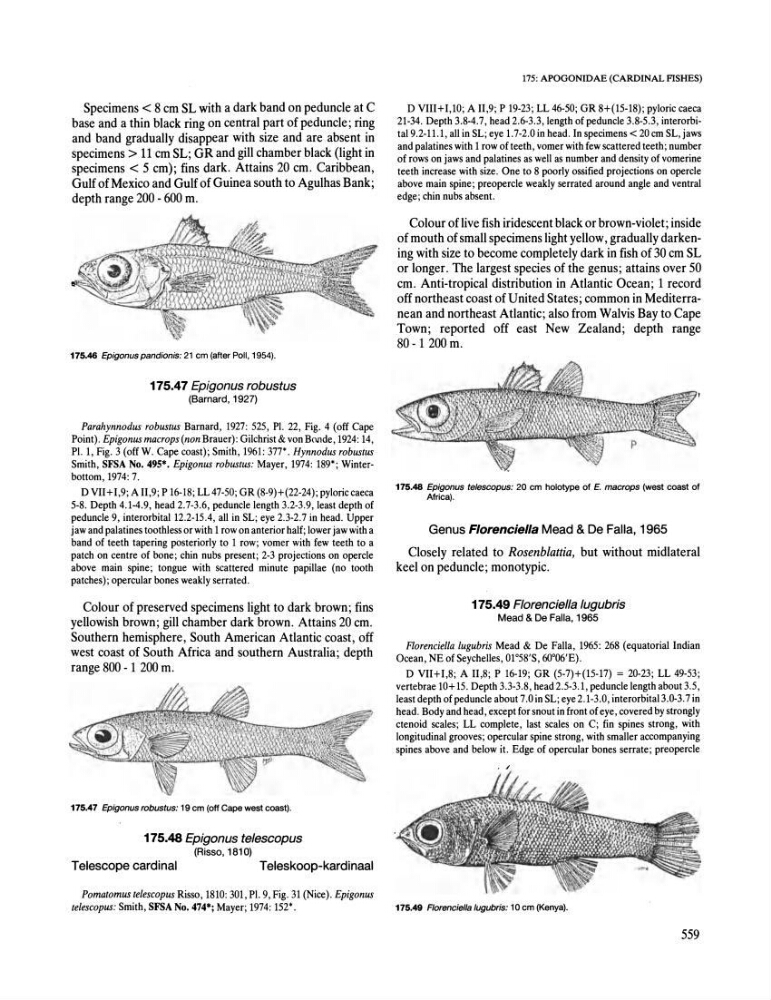
175.46 Epigonuspandionis: 21 cm (after Poll. 1954).
175.47 Epigonus robustus
(Barnard, 1927)
Parahynnodus robustus Barnard, 1927: 525, PI. 22, Fig. 4 (off Cape
Point). Epigonus macrops (non Brauer): Gilchrist & von BOlIde, 1924: 14,
PI. 1, Fig. 3 (off W. Cape coast); Smith, 1961: 377*. Hynnodus robustus
Smith, SFSA No. 495*. Epigonus robustus: Mayer, 1974: 189*; Winterbottom, 1974: 7.
D VII + 1,9; A 11,9; P 16-18; LL 47-50; GR (8-9)+(22-24); pyloric caeca
5-8. Depth 4.1-4.9, head 2.7-3.6, peduncle length 3.2-3.9, least depth of
peduncle 9, interorbital 12.2-15.4, all in SL; eye 2.3-2.7 in head. Upper
jaw and palatines toothless or with 1 row on anterior half; lower jaw with a
band of teeth tapering posteriorly to 1 row; vomer with few teeth to a
patch on centre of bone; chin nubs present; 2-3 projections on opercle
above main spine; tongue with scattered minute papillae (no tooth
patches); opercular bones weakly serrated.
Colour of preserved specimens light to dark brown; fins
yellowish brown; gill chamber dark brown. Attains 20 cm.
Southern hemisphere, South American Atlantic coast, off
west coast of South Africa and southern Australia; depth
range 800 - 1 200 m.
175.47 Epigonus robustus: 19 cm (off Cape west coast).
175.48 Epigonus telescopus
(Risso, 1810)
Telescope cardinal
Teleskoop-kardinaal
Pomatomus telescopus Risso, 1810: 301, PI. 9, Fig. 31 (Nice). Epigonus
telescopus: Smith, SFSA No. 474*; Mayer; 1974: 152*.
175: APOGONIDAE (CARDINAL FISHES)
D VIII+I,1O; A 11,9; P 19-23; LL 46-50; GR 8+(15-18); pyloric caeca
21-34. Depth 3.8-4.7, head 2.6-3.3, length of peduncle 3.8-5.3, interorbital 9.2-11.1, all in SL; eye 1.7-2.0 in head. In specimens < 20 cm SL, jaws
and palatines with 1 row of teeth, vomer with few scattered teeth; number
of rows on jaws and palatines as well as number and density of vomerine
teeth increase with size. One to 8 poorly ossified projections on opercJe
above main spine; preopercle weakly serrated around angle and ventral
edge; chin nubs absent.
Colour oflive fish iridescent black or brown-violet; inside
of mouth of small specimens light yellow, gradually darkening with size to become completely dark in fish of 30 cm SL
or longer. The largest species of the genus; attains over 50
cm. Anti-tropical distribution in Atlantic Ocean; 1 record
off northeast coast of United States; common in Mediterranean and northeast Atlantic; also from Walvis Bay to Cape
Town; reported off east New Zealand; depth range
80 -1200 m.
175.48 Epigonus telescopus: 20 cm hoiotype of E. macrops (west coast of
Africa).
Genus Florenciella Mead & De Falla, 1965
Closely related to Rosenblattia, but without midlateral
keel on peduncle; monotypic.
175.49 Florenciella lugubris
Mead & De Falla, 1965
Florenciella lugubris Mead & De Falla, 1965: 268 (equatorial Indian
Ocean, NE of Seychelles, 01°58'S, 60
0
06'E).
D VII+I,8; A 11,8; P 16-19; GR (5-7)+(15-17) = 20-23; LL 49-53;
vertebrae 10+ 15. Depth 3.3-3.8, head 2.5-3.1, peduncle length about 3.5,
least depth of peduncle about 7.0 in SL; eye 2.1-3.0, interorbital 3.0-3.7 in
head. Body and head, except for snout in front of eye, covered by strongly
ctenoid scales; LL complete, last scales on C; fin spines strong, with
longitudinal grooves; opercular spine strong, with smaller accompanying
spines above and below it. Edge of opercular bones serrate; preopercle
• f
175.49 Florenciella lugubris: 10 cm (Kenya).
559
base and a thin black ring on central part of peduncle; ring
and band gradually disappear with size and are absent in
specimens> 11 cm SL; GR and gill chamber black (light in
specimens < 5 cm); fins dark. Attains 20 cm. Caribbean,
Gulf of Mexico and Gulf of Guinea south to Agulhas Bank;
depth range 200 - 600 m.
175.46 Epigonuspandionis: 21 cm (after Poll. 1954).
175.47 Epigonus robustus
(Barnard, 1927)
Parahynnodus robustus Barnard, 1927: 525, PI. 22, Fig. 4 (off Cape
Point). Epigonus macrops (non Brauer): Gilchrist & von BOlIde, 1924: 14,
PI. 1, Fig. 3 (off W. Cape coast); Smith, 1961: 377*. Hynnodus robustus
Smith, SFSA No. 495*. Epigonus robustus: Mayer, 1974: 189*; Winterbottom, 1974: 7.
D VII + 1,9; A 11,9; P 16-18; LL 47-50; GR (8-9)+(22-24); pyloric caeca
5-8. Depth 4.1-4.9, head 2.7-3.6, peduncle length 3.2-3.9, least depth of
peduncle 9, interorbital 12.2-15.4, all in SL; eye 2.3-2.7 in head. Upper
jaw and palatines toothless or with 1 row on anterior half; lower jaw with a
band of teeth tapering posteriorly to 1 row; vomer with few teeth to a
patch on centre of bone; chin nubs present; 2-3 projections on opercle
above main spine; tongue with scattered minute papillae (no tooth
patches); opercular bones weakly serrated.
Colour of preserved specimens light to dark brown; fins
yellowish brown; gill chamber dark brown. Attains 20 cm.
Southern hemisphere, South American Atlantic coast, off
west coast of South Africa and southern Australia; depth
range 800 - 1 200 m.
175.47 Epigonus robustus: 19 cm (off Cape west coast).
175.48 Epigonus telescopus
(Risso, 1810)
Telescope cardinal
Teleskoop-kardinaal
Pomatomus telescopus Risso, 1810: 301, PI. 9, Fig. 31 (Nice). Epigonus
telescopus: Smith, SFSA No. 474*; Mayer; 1974: 152*.
175: APOGONIDAE (CARDINAL FISHES)
D VIII+I,1O; A 11,9; P 19-23; LL 46-50; GR 8+(15-18); pyloric caeca
21-34. Depth 3.8-4.7, head 2.6-3.3, length of peduncle 3.8-5.3, interorbital 9.2-11.1, all in SL; eye 1.7-2.0 in head. In specimens < 20 cm SL, jaws
and palatines with 1 row of teeth, vomer with few scattered teeth; number
of rows on jaws and palatines as well as number and density of vomerine
teeth increase with size. One to 8 poorly ossified projections on opercJe
above main spine; preopercle weakly serrated around angle and ventral
edge; chin nubs absent.
Colour oflive fish iridescent black or brown-violet; inside
of mouth of small specimens light yellow, gradually darkening with size to become completely dark in fish of 30 cm SL
or longer. The largest species of the genus; attains over 50
cm. Anti-tropical distribution in Atlantic Ocean; 1 record
off northeast coast of United States; common in Mediterranean and northeast Atlantic; also from Walvis Bay to Cape
Town; reported off east New Zealand; depth range
80 -1200 m.
175.48 Epigonus telescopus: 20 cm hoiotype of E. macrops (west coast of
Africa).
Genus Florenciella Mead & De Falla, 1965
Closely related to Rosenblattia, but without midlateral
keel on peduncle; monotypic.
175.49 Florenciella lugubris
Mead & De Falla, 1965
Florenciella lugubris Mead & De Falla, 1965: 268 (equatorial Indian
Ocean, NE of Seychelles, 01°58'S, 60
0
06'E).
D VII+I,8; A 11,8; P 16-19; GR (5-7)+(15-17) = 20-23; LL 49-53;
vertebrae 10+ 15. Depth 3.3-3.8, head 2.5-3.1, peduncle length about 3.5,
least depth of peduncle about 7.0 in SL; eye 2.1-3.0, interorbital 3.0-3.7 in
head. Body and head, except for snout in front of eye, covered by strongly
ctenoid scales; LL complete, last scales on C; fin spines strong, with
longitudinal grooves; opercular spine strong, with smaller accompanying
spines above and below it. Edge of opercular bones serrate; preopercle
• f
175.49 Florenciella lugubris: 10 cm (Kenya).
559