

166: SERRANIDAE (ROCKCODS & SEABASSES)
26b Midlateral body scales smooth ; no dark streaks
backwards from eye; midlateral part of lower jaw
with 3-5 rows of teeth .... .... .. .... .... ... ........ ... ............ E. lauvina
27a Body with 4-6 subvertical, broad, dark bars (often
indistinct); tip of operculum nearer LL than P base ............. .. . 28
27b No subvertical dark bars on body; tip of operculum
generally about halfway between LL and P base .. .... .... .. .. .. .... 29
28a Outer margin of interspinous D membranes
black (red on specimens from deep water); orbit
with a narrow dark brown edge; scales without
a pale dot; dark bars on body vertical with straight
edges; D XI ,15-17 .................................. .... .. .... .. E. fascialus
28b Margin of interspinous D membranes not black
or red; orbit without brown edge; each body scale
usually with a bluish white dot; dark bars on
body irregular, slightly oblique, often indistinct;
D XI,16-18 ................................ : .. .............. ...... E. rivulalus
29a Whitish spots and/or blotches present on body;
D XI,15-16 ................ .... ......... .. .... ........ .. .... .......... .. .. .... 30
29b No whitish spots or blotches on body; D XI,13-15 ........ .... ...... 32
30a Lower part of head and body usually yellowish;
LL 66-73 .............................................................. E. guaza
30b No yellow on head or body ; LL 47-62 .............. .. ........ .... ...... 31
31a P 15-17 ; rear margin of operculum obtuse, the upper
edge very convex; pale spots on body of large adults
joined to form horizontal pale lines; LL 47-53 .............. E. ongus
31b P 17-19; rear margin of operculum acute, the
upper edge straight or slightly convex; in large
adults (larger than 30 cm SL) the white spots
on body have merged to form wavy pale lines
and mottlings; LL 52-62 .......... .. ........ .. ..... E. caeruleopunclatus
32a No dark bands or lines on body; body brownish,
with dark brown or black dots, not in regular rows
(these dots may be faint or absent on some
specimens) ; faint dark stripe from lower edge
of eye to above corner of preopercle .... .... E. sp. (brown rockcod)
32b Body with curved, dark brown bands or lines
(which divide into rows of spots on large specimens);
rows of dark spots also sometimes present paralleling
the dark bands .............................. .. .... .... ........... ............ 33
33a Posterior nostrils of adults about twice as large
as anterior nostrils ; dark bands (or rows of spots)
on head and body with middle of each band lower
than the ends ................................................................. 34
33b Posterior nostrils not notably larger than anterior;
5 dark brown bands (with age , only the edges of
these bands remain dark) passing downward and
anteriorly from upper edge of body: 1st from nape
to eye, 2nd from middle D spines to upper edge
of opercle, 3rd and 4th from soft D (both
branching ventrally) and 5th on C peduncle ............... E. radialUs
34a An isolated, dark brown or black blotch (or group
of small spots) at base of middle D spines and
not joined to an oblique dark band on body;
a curved, dark brown band or double row of dark
spots from nape to anterior soft D rays paralleling
the curve of the dark blotch at base of spinous D .. E. poecilonotus
34b Dark blotch at base of middle D spines joined
522
to a dark band from upper edge of operculum;
no continuous curved band from nape to anterior
D soft-rays ........ .. ............ .. .......... .... .................. E. morrhua
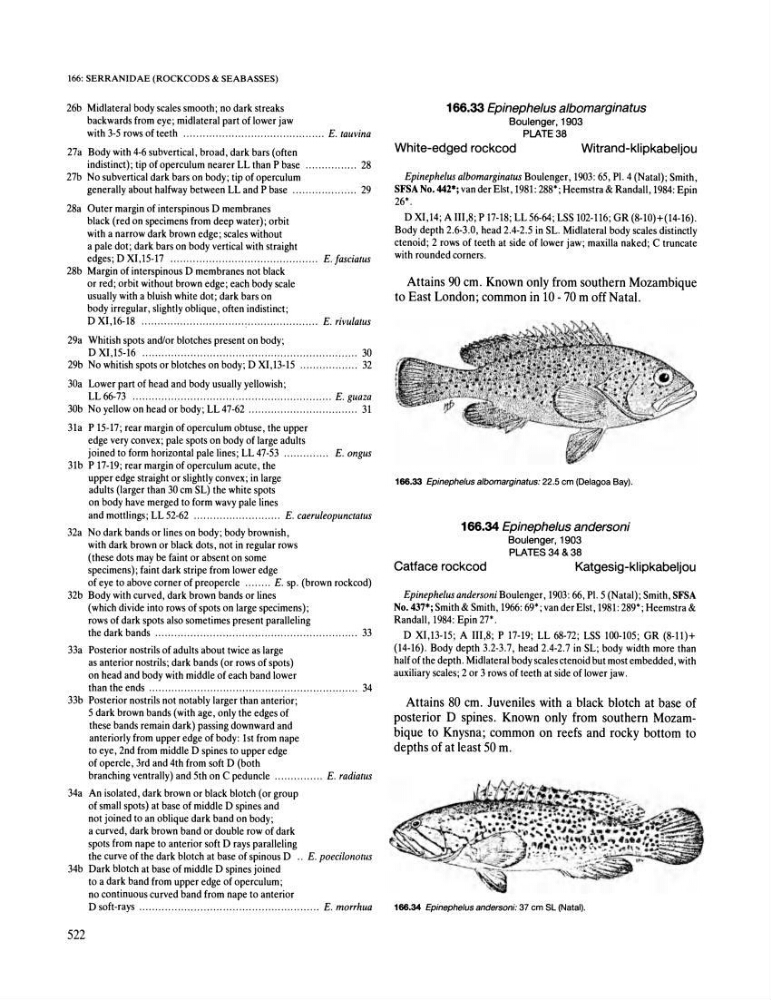
166.33 Epinephelus albomarginatus
Boulenger, 1903
PLATE 38
White-edged rockcod
Witrand-klipkabeljou
Epinephelus albomarginalus Boulenger, 1903: 65 , PI. 4 (Natal) ; Smith,
SFSA No. 442*; van der Elst , 1981: 288*; Heemstra & Randall, 1984: Epin
26* .
D XI,14; A III,8; P 17-18; LL56-64; LSS 102-116; GR (8-10)+(14-16).
Body depth 2.6-3.0, head 2.4-2.5 in SL. Midlateral body scales distinctly
ctenoid; 2 rows of teeth at side of lower jaw; maxilla naked; C truncate
with rounded corners.
Attains 90 cm. Known only from sOijthern Mozambique
to East London; common in 10 - 70 m off Natal.
166.33 Epinephelus albomarginatus: 22.5 em (Delagoa Bay).
166.34 Epinephelus andersoni
Boulenger, 1903
PLATES 34 & 38
Catface rockcod
Katgesig-klipkabeljou
Epinephelus andersoni Boulenger, 1903: 66, PI. 5 (Natal); Smith, SFSA
No. 437*; Smith & Smith, 1966: 69*; van derElst, 1981: 289*; Heemstra &
Randall , 1984: Epin 27* .
D XI ,13-15; A 1II ,8; P 17-19; LL 68-72; LSS 100-105; GR (8-11)+
(14-16). Body depth 3.2-3 .7, head 2.4-2.7 in SL; body width more than
half of the depth. Midlateral body scales ctenoid but most embedded, with
auxiliary scales; 2 or 3 rows of teeth at side of lower jaw .
Attains 80 cm. Juveniles with a black blotch at base of
posterior D spines. Known only from southern Mozambique to Knysna; common on reefs and rocky bottom to
depths of at least 50 m.
166.34 Epinephelus andersoni: 37 em SL (Natal).
26b Midlateral body scales smooth ; no dark streaks
backwards from eye; midlateral part of lower jaw
with 3-5 rows of teeth .... .... .. .... .... ... ........ ... ............ E. lauvina
27a Body with 4-6 subvertical, broad, dark bars (often
indistinct); tip of operculum nearer LL than P base ............. .. . 28
27b No subvertical dark bars on body; tip of operculum
generally about halfway between LL and P base .. .... .... .. .. .. .... 29
28a Outer margin of interspinous D membranes
black (red on specimens from deep water); orbit
with a narrow dark brown edge; scales without
a pale dot; dark bars on body vertical with straight
edges; D XI ,15-17 .................................. .... .. .... .. E. fascialus
28b Margin of interspinous D membranes not black
or red; orbit without brown edge; each body scale
usually with a bluish white dot; dark bars on
body irregular, slightly oblique, often indistinct;
D XI,16-18 ................................ : .. .............. ...... E. rivulalus
29a Whitish spots and/or blotches present on body;
D XI,15-16 ................ .... ......... .. .... ........ .. .... .......... .. .. .... 30
29b No whitish spots or blotches on body; D XI,13-15 ........ .... ...... 32
30a Lower part of head and body usually yellowish;
LL 66-73 .............................................................. E. guaza
30b No yellow on head or body ; LL 47-62 .............. .. ........ .... ...... 31
31a P 15-17 ; rear margin of operculum obtuse, the upper
edge very convex; pale spots on body of large adults
joined to form horizontal pale lines; LL 47-53 .............. E. ongus
31b P 17-19; rear margin of operculum acute, the
upper edge straight or slightly convex; in large
adults (larger than 30 cm SL) the white spots
on body have merged to form wavy pale lines
and mottlings; LL 52-62 .......... .. ........ .. ..... E. caeruleopunclatus
32a No dark bands or lines on body; body brownish,
with dark brown or black dots, not in regular rows
(these dots may be faint or absent on some
specimens) ; faint dark stripe from lower edge
of eye to above corner of preopercle .... .... E. sp. (brown rockcod)
32b Body with curved, dark brown bands or lines
(which divide into rows of spots on large specimens);
rows of dark spots also sometimes present paralleling
the dark bands .............................. .. .... .... ........... ............ 33
33a Posterior nostrils of adults about twice as large
as anterior nostrils ; dark bands (or rows of spots)
on head and body with middle of each band lower
than the ends ................................................................. 34
33b Posterior nostrils not notably larger than anterior;
5 dark brown bands (with age , only the edges of
these bands remain dark) passing downward and
anteriorly from upper edge of body: 1st from nape
to eye, 2nd from middle D spines to upper edge
of opercle, 3rd and 4th from soft D (both
branching ventrally) and 5th on C peduncle ............... E. radialUs
34a An isolated, dark brown or black blotch (or group
of small spots) at base of middle D spines and
not joined to an oblique dark band on body;
a curved, dark brown band or double row of dark
spots from nape to anterior soft D rays paralleling
the curve of the dark blotch at base of spinous D .. E. poecilonotus
34b Dark blotch at base of middle D spines joined
522
to a dark band from upper edge of operculum;
no continuous curved band from nape to anterior
D soft-rays ........ .. ............ .. .......... .... .................. E. morrhua
166.33 Epinephelus albomarginatus
Boulenger, 1903
PLATE 38
White-edged rockcod
Witrand-klipkabeljou
Epinephelus albomarginalus Boulenger, 1903: 65 , PI. 4 (Natal) ; Smith,
SFSA No. 442*; van der Elst , 1981: 288*; Heemstra & Randall, 1984: Epin
26* .
D XI,14; A III,8; P 17-18; LL56-64; LSS 102-116; GR (8-10)+(14-16).
Body depth 2.6-3.0, head 2.4-2.5 in SL. Midlateral body scales distinctly
ctenoid; 2 rows of teeth at side of lower jaw; maxilla naked; C truncate
with rounded corners.
Attains 90 cm. Known only from sOijthern Mozambique
to East London; common in 10 - 70 m off Natal.
166.33 Epinephelus albomarginatus: 22.5 em (Delagoa Bay).
166.34 Epinephelus andersoni
Boulenger, 1903
PLATES 34 & 38
Catface rockcod
Katgesig-klipkabeljou
Epinephelus andersoni Boulenger, 1903: 66, PI. 5 (Natal); Smith, SFSA
No. 437*; Smith & Smith, 1966: 69*; van derElst, 1981: 289*; Heemstra &
Randall , 1984: Epin 27* .
D XI ,13-15; A 1II ,8; P 17-19; LL 68-72; LSS 100-105; GR (8-11)+
(14-16). Body depth 3.2-3 .7, head 2.4-2.7 in SL; body width more than
half of the depth. Midlateral body scales ctenoid but most embedded, with
auxiliary scales; 2 or 3 rows of teeth at side of lower jaw .
Attains 80 cm. Juveniles with a black blotch at base of
posterior D spines. Known only from southern Mozambique to Knysna; common on reefs and rocky bottom to
depths of at least 50 m.
166.34 Epinephelus andersoni: 37 em SL (Natal).