

166: SERRANIDAE (ROCKCODS & SEABASSES)
Genus Dermato/epis Gill, 1861
Body and head deep and strongly compressed: body
depth 2.2-2.8 in SL; body width 2.6-3.6 in depth. Body
scales smooth, except those covered by P. D XI,17-19;
A III,9-1O; C rounded to nearly truncate. Preopercle edge
finely serrate, mostly covered by skin; opercle with only 2
apparent "spines", the third is covered by skin and scales.
Jaws with a band of small teeth; no distinct canines; vomer
and palatines with teeth.
Three species: 1 western Indian Ocean, 1 eastern Pacific
and 1 western Atlantic.
166.32 Dermatolepis striolatus
(Playfair & Gunther, 1867)
PLATE 36
Smooth rockcod
Gladde klipkabeljou
Serranus striolatus Playfair & Giinther, 1867: 11, PI. 3, Fig. 2 (Zanzibar).
Dermatolepis aldabrensis Smith, 1955: 311, PI. 1B (Aldabra). Dermatolepis striolatus: Morgans, 1982: 28*; Heemstra & Randall, 1984: Dermat 1 *.
D XI,17-19; A III,9-1O; P 18; GR 8 +(13-15). Body scales with many
auxiliary scales and mostly covered by skin, hence difficult to count.
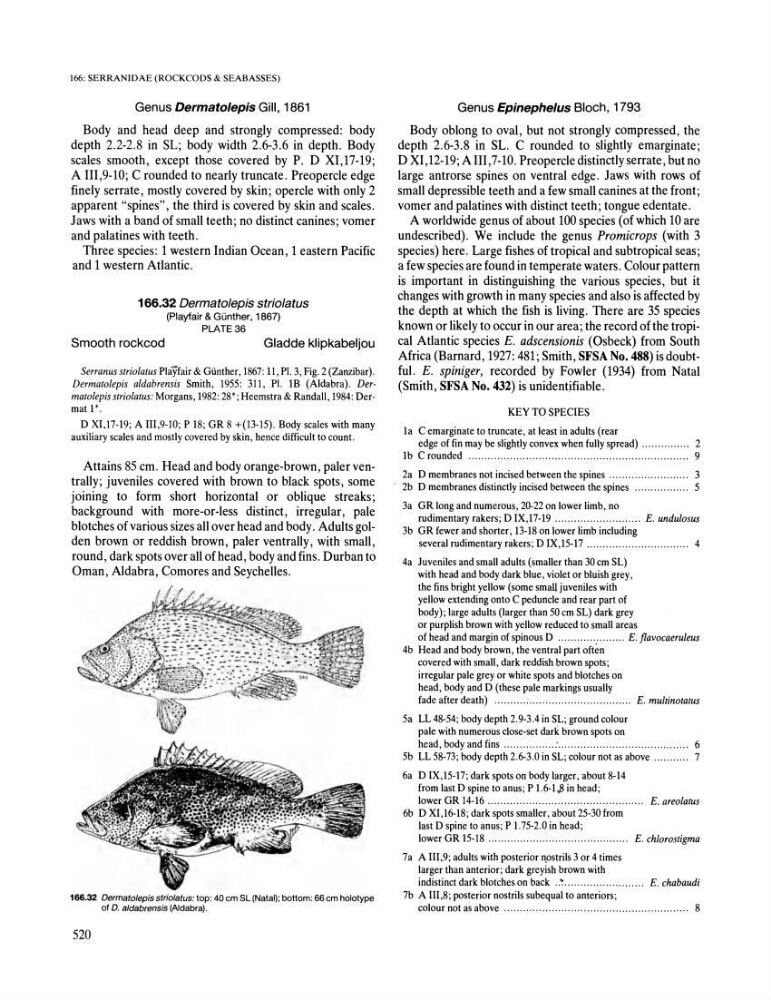
Attains 85 cm. Head and body orange-brown, paler ventrally; juveniles covered with brown to black spots, some
joining to form short horizontal or oblique streaks;
background with more-or-Iess distinct, irregular, pale
blotches of various sizes all over head and body. Adults golden brown or reddish brown, paler ventrally, with small,
round, dark spots over all of head, body and fins. Durban to
Oman, Aldabra, Comores and Seychelles.
166.32 Dermatolepis striolatus: top: 40 em SL (Natal); bottom: 66 em holotype
of D. aldabrensis (Aldabra).
520
Genus Epinephe/us Bloch, 1793
Body oblong to oval, but not strongly compressed, the
depth 2.6-3.8 in SL. C rounded to slightly emarginate;
D XI,12-19; A III ,7-10. Preopercle distinctly serrate, but no
large antrorse spines on ventral edge. Jaws with rows of
small depressible teeth and a few small canines at the front;
vomer and palatines with distinct teeth; tongue edentate.
A worldwide genus of about 100 species (of which 10 are
undescribed). We include the genus Promicrops (with 3
species) here. Large fishes of tropical and subtropical seas;
a few species are found in temperate waters. Colour pattern
is important in distinguishing the various species, but it
changes with growth in many species and also is affected by
the depth at which the fish is living. There are 35 species
known or likely to occur in our area; the record of the tropical Atlantic species E. adscensionis (Osbeck) from South
Africa (Barnard, 1927: 481; Smith, SFSA No. 488) is doubtful. E. spiniger, recorded by Fowler (1934) from Natal
(Smith, SFSA No. 432) is unidentjfiable.
KEY TO SPECIES
la C emarginate to truncate, at least in adults (rear
edge of fin may be slightly convex when fully spread) ............... 2
Ib C rounded ..................................................................... 9
2a D membranes not incised between the spines ......................... 3
2b D membranes distinctly incised between the spines ................. 5
3a GR long and numerous, 20-22 on lower limb, no
rudimentary rakers; D IX,17-19 ........................... E. undulosus
3b GR fewer and shorter, 13-18 on lower limb including
several rudimentary rakers; D IX,15-17 ...................... .......... 4
4a Juveniles and small adults (smaller than 30 em SL)
with head and body dark blue, violet or bluish grey,
the fins bright yellow (some smaU juveniles with
yellow extending onto C peduncle and rear part of
body); large adults (larger than 50 em SL) dark grey
or purplish brown with yellow reduced to small areas
of head and margin of spinous D ..................... E. flavocaeruleus
4b Head and body brown, the ventral part often
covered with small, dark reddish brown spots;
irregular pale grey or white spots and blotches on
head, body and D (these pale markings usually
fade after death) ........................... " . .. ... . . .... .. E. multinotatus
5a LL 48-54; body depth 2.9-3.4 in SL; ground colour
pale with numerous close-set dark brown spots on
head, body and fins ................ : ......................................... 6
5b LL 58-73; body depth 2.6-3.0 in SL; colour not as above ........... 7
6a D IX,15-17; dark spots on body larger, about 8-14
from last D spine to anus; P 1.6-1.,8 in head;
lower GR 14-16 ................................................. E. areolatus
6b D XI,16-18; dark spots smaller, about 25-30 from
last D spine to anus; P 1.75-2.0 in head;
lower GR 15-18 ............................................ E. chlorostigma
7a A III,9; adults with posterior n.ostrils 3 or 4 times
larger than anterior; dark greyish brown with
indistinct dark blotches on back .. ~......................... E. chabaudi
7b A III,8; posterior nostrils subequal to anteriors;
colour not as above .......................................................... 8
Genus Dermato/epis Gill, 1861
Body and head deep and strongly compressed: body
depth 2.2-2.8 in SL; body width 2.6-3.6 in depth. Body
scales smooth, except those covered by P. D XI,17-19;
A III,9-1O; C rounded to nearly truncate. Preopercle edge
finely serrate, mostly covered by skin; opercle with only 2
apparent "spines", the third is covered by skin and scales.
Jaws with a band of small teeth; no distinct canines; vomer
and palatines with teeth.
Three species: 1 western Indian Ocean, 1 eastern Pacific
and 1 western Atlantic.
166.32 Dermatolepis striolatus
(Playfair & Gunther, 1867)
PLATE 36
Smooth rockcod
Gladde klipkabeljou
Serranus striolatus Playfair & Giinther, 1867: 11, PI. 3, Fig. 2 (Zanzibar).
Dermatolepis aldabrensis Smith, 1955: 311, PI. 1B (Aldabra). Dermatolepis striolatus: Morgans, 1982: 28*; Heemstra & Randall, 1984: Dermat 1 *.
D XI,17-19; A III,9-1O; P 18; GR 8 +(13-15). Body scales with many
auxiliary scales and mostly covered by skin, hence difficult to count.
Attains 85 cm. Head and body orange-brown, paler ventrally; juveniles covered with brown to black spots, some
joining to form short horizontal or oblique streaks;
background with more-or-Iess distinct, irregular, pale
blotches of various sizes all over head and body. Adults golden brown or reddish brown, paler ventrally, with small,
round, dark spots over all of head, body and fins. Durban to
Oman, Aldabra, Comores and Seychelles.
166.32 Dermatolepis striolatus: top: 40 em SL (Natal); bottom: 66 em holotype
of D. aldabrensis (Aldabra).
520
Genus Epinephe/us Bloch, 1793
Body oblong to oval, but not strongly compressed, the
depth 2.6-3.8 in SL. C rounded to slightly emarginate;
D XI,12-19; A III ,7-10. Preopercle distinctly serrate, but no
large antrorse spines on ventral edge. Jaws with rows of
small depressible teeth and a few small canines at the front;
vomer and palatines with distinct teeth; tongue edentate.
A worldwide genus of about 100 species (of which 10 are
undescribed). We include the genus Promicrops (with 3
species) here. Large fishes of tropical and subtropical seas;
a few species are found in temperate waters. Colour pattern
is important in distinguishing the various species, but it
changes with growth in many species and also is affected by
the depth at which the fish is living. There are 35 species
known or likely to occur in our area; the record of the tropical Atlantic species E. adscensionis (Osbeck) from South
Africa (Barnard, 1927: 481; Smith, SFSA No. 488) is doubtful. E. spiniger, recorded by Fowler (1934) from Natal
(Smith, SFSA No. 432) is unidentjfiable.
KEY TO SPECIES
la C emarginate to truncate, at least in adults (rear
edge of fin may be slightly convex when fully spread) ............... 2
Ib C rounded ..................................................................... 9
2a D membranes not incised between the spines ......................... 3
2b D membranes distinctly incised between the spines ................. 5
3a GR long and numerous, 20-22 on lower limb, no
rudimentary rakers; D IX,17-19 ........................... E. undulosus
3b GR fewer and shorter, 13-18 on lower limb including
several rudimentary rakers; D IX,15-17 ...................... .......... 4
4a Juveniles and small adults (smaller than 30 em SL)
with head and body dark blue, violet or bluish grey,
the fins bright yellow (some smaU juveniles with
yellow extending onto C peduncle and rear part of
body); large adults (larger than 50 em SL) dark grey
or purplish brown with yellow reduced to small areas
of head and margin of spinous D ..................... E. flavocaeruleus
4b Head and body brown, the ventral part often
covered with small, dark reddish brown spots;
irregular pale grey or white spots and blotches on
head, body and D (these pale markings usually
fade after death) ........................... " . .. ... . . .... .. E. multinotatus
5a LL 48-54; body depth 2.9-3.4 in SL; ground colour
pale with numerous close-set dark brown spots on
head, body and fins ................ : ......................................... 6
5b LL 58-73; body depth 2.6-3.0 in SL; colour not as above ........... 7
6a D IX,15-17; dark spots on body larger, about 8-14
from last D spine to anus; P 1.6-1.,8 in head;
lower GR 14-16 ................................................. E. areolatus
6b D XI,16-18; dark spots smaller, about 25-30 from
last D spine to anus; P 1.75-2.0 in head;
lower GR 15-18 ............................................ E. chlorostigma
7a A III,9; adults with posterior n.ostrils 3 or 4 times
larger than anterior; dark greyish brown with
indistinct dark blotches on back .. ~......................... E. chabaudi
7b A III,8; posterior nostrils subequal to anteriors;
colour not as above .......................................................... 8