

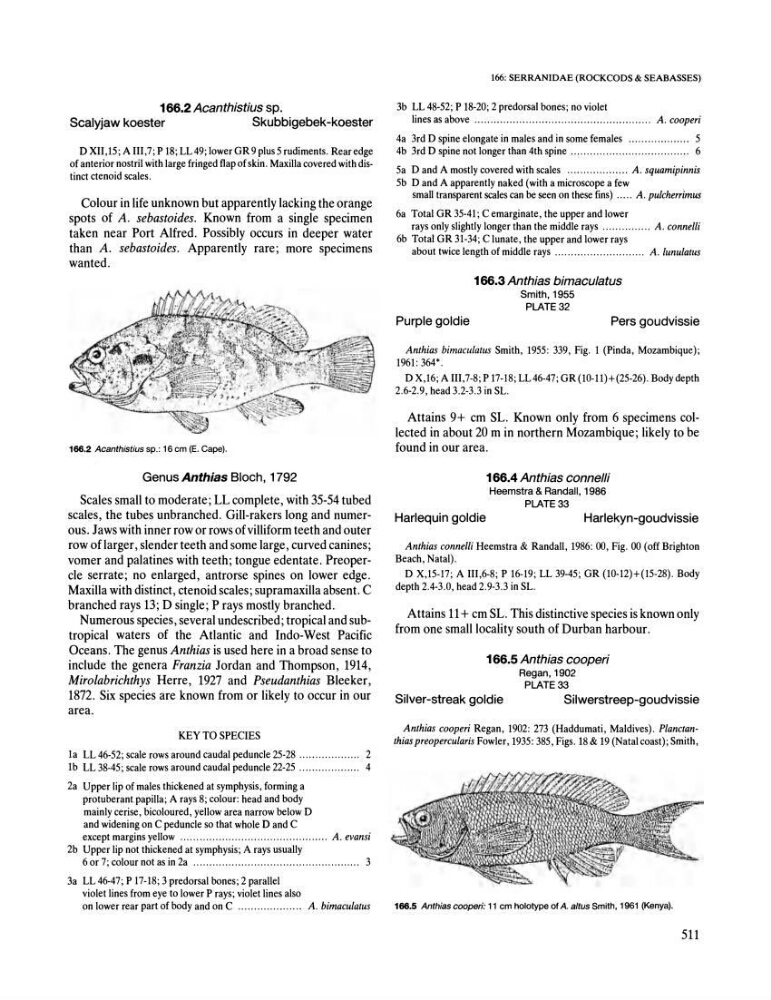
166.2 Acanthistius sp.
Scaly jaw koester
Skubbigebek-koester
D XII,15; A III,7; P 18; LL49; 10werGR 9 plus 5 rudiments. Rear edge
of anterior nostril with large fringed flap of skin. Maxilla covered with distinct ctenoid scales.
Colour in life unknown but apparently lacking the orange
spots of A. sebastoides. Known from a single specimen
taken near Port Alfred. Possibly occurs in deeper water
than A. sebastoides. Apparently rare; more specimens
wanted.
166.2 Acanthistius sp.: 16 em (E. Cape).
Genus Anthias Bloch, 1792
Scales small to moderate; LL complete, with 35-54 tubed
scales, the tubes unbranched. Gill-rakers long and numerous. Jaws with inner row or rows of villi form teeth and outer
row oflarger, slender teeth and some large, curved canines;
vomer and palatines with teeth; tongue edentate. Preopercle serrate; no enlarged, antrorse spines on lower edge.
Maxilla with distinct, ctenoid scales; supramaxilla absent. C
branched rays 13; D single; P rays mostly branched.
Numerous species, several undescribed; tropical and subtropical waters of the Atlantic and Indo-West Pacific
Oceans. The genus Anthias is used here in a broad sense to
include the genera Franzia Jordan and Thompson, 1914,
Mirolabrichthys Herre, 1927 and Pseudanthias Bleeker,
1872. Six species are known from or likely to occur in our
area.
KEY TO SPECIES
la LL 46-52; scale rows around caudal peduncle 25-28 ................... 2
Ib LL 38-45; scale rows around caudal peduncle 22-25 ................... 4
2a Upper lip of males thickened at symphysis, forming a
protuberant papilla; A rays 8; colour: head and body
mainly cerise, bicoloured, yellow area narrow below D
and widening on C peduncle so that whole D and C
except margins yellow .............................................. A. evansi
2b Upper lip not thickened at symphysis; A rays usually
6 or 7; colour not as in 2a .................................................... 3
3a LL 46-47; P 17-18; 3 predorsal bones; 2 parallel
violet lines from eye to lower P rays; violet lines also
on lower rear part of body and on C .................... A. bimaculatus
166: SERRANIDAE (ROCKCODS & SEABASSES)
3b LL 48-52; P 18-20; 2 predorsal bones; no violet
lines as above ....................................................... A. cooperi
4a 3rd D spine elongate in males and in some females ................... 5
4b 3rd D spine not longer than 4th spine ..................................... 6
5a D and A mostly covered with scales ................... A. squamipinnis
5b D and A apparently naked (with a microscope a few
small transparent scales can be seen on these fins) ..... A. pulcherrimus
6a Total GR 35-41; C emarginate, the upper and lower
rays only slightly longer than the middle rays ............... A. connelli
6b Total GR 31-34; C lunate, the upper and lower rays
about twice length of middle rays ............................ A. lunulatus
Purple goldie
166.3 Anthias bimaculatus
Smith, 1955
PLATE 32
Pers goudvissie
Anthias bimaculatus Smith, 1955: 339, Fig. 1 (Pinda, Mozambique);
1961: 364*.
D X,16; A III,7-8; P 17-18; LL46-47; GR (10-11)+(25-26). Body depth
2.6-2.9, head 3.2-3.3 in SL.
Attains 9+ em SL. Known only from 6 specimens collected in about 20 m in northern Mozambique; likely to be
found in our area.
166.4 Anthias connelli
Heemstra & Randall, 1986
PLATE 33
Harlequin goldie
Harlekyn-goudvissie
Anthias connelli Heemstra & Randall, 1986: 00, Fig. 00 (off Brighton
Beach, Natal).
D X,15-17; A III,6-8; P 16-19; LL 39-45; GR (10-12)+(15-28). Body
depth 2.4-3.0, head 2.9-3.3 in SL.
Attains 11 + cm SL. This distinctive species is known only
from one small locality south of Durban harbour.
166.5 Anthias cooperi
Regan, 1902
PLATE 33
Silver-streak goldie
Silwerstreep-goudvissie
Anthias cooperi Regan, 1902: 273 (Haddumati, Maldives). Planctanthias preopercularis Fowler, 1935: 385, Figs. 18 & 19 (Natal coast); Smith,
166.5 Anthias cooperi: 11 em holotype of A. altus Smith, 1961 (Kenya).
511
Scaly jaw koester
Skubbigebek-koester
D XII,15; A III,7; P 18; LL49; 10werGR 9 plus 5 rudiments. Rear edge
of anterior nostril with large fringed flap of skin. Maxilla covered with distinct ctenoid scales.
Colour in life unknown but apparently lacking the orange
spots of A. sebastoides. Known from a single specimen
taken near Port Alfred. Possibly occurs in deeper water
than A. sebastoides. Apparently rare; more specimens
wanted.
166.2 Acanthistius sp.: 16 em (E. Cape).
Genus Anthias Bloch, 1792
Scales small to moderate; LL complete, with 35-54 tubed
scales, the tubes unbranched. Gill-rakers long and numerous. Jaws with inner row or rows of villi form teeth and outer
row oflarger, slender teeth and some large, curved canines;
vomer and palatines with teeth; tongue edentate. Preopercle serrate; no enlarged, antrorse spines on lower edge.
Maxilla with distinct, ctenoid scales; supramaxilla absent. C
branched rays 13; D single; P rays mostly branched.
Numerous species, several undescribed; tropical and subtropical waters of the Atlantic and Indo-West Pacific
Oceans. The genus Anthias is used here in a broad sense to
include the genera Franzia Jordan and Thompson, 1914,
Mirolabrichthys Herre, 1927 and Pseudanthias Bleeker,
1872. Six species are known from or likely to occur in our
area.
KEY TO SPECIES
la LL 46-52; scale rows around caudal peduncle 25-28 ................... 2
Ib LL 38-45; scale rows around caudal peduncle 22-25 ................... 4
2a Upper lip of males thickened at symphysis, forming a
protuberant papilla; A rays 8; colour: head and body
mainly cerise, bicoloured, yellow area narrow below D
and widening on C peduncle so that whole D and C
except margins yellow .............................................. A. evansi
2b Upper lip not thickened at symphysis; A rays usually
6 or 7; colour not as in 2a .................................................... 3
3a LL 46-47; P 17-18; 3 predorsal bones; 2 parallel
violet lines from eye to lower P rays; violet lines also
on lower rear part of body and on C .................... A. bimaculatus
166: SERRANIDAE (ROCKCODS & SEABASSES)
3b LL 48-52; P 18-20; 2 predorsal bones; no violet
lines as above ....................................................... A. cooperi
4a 3rd D spine elongate in males and in some females ................... 5
4b 3rd D spine not longer than 4th spine ..................................... 6
5a D and A mostly covered with scales ................... A. squamipinnis
5b D and A apparently naked (with a microscope a few
small transparent scales can be seen on these fins) ..... A. pulcherrimus
6a Total GR 35-41; C emarginate, the upper and lower
rays only slightly longer than the middle rays ............... A. connelli
6b Total GR 31-34; C lunate, the upper and lower rays
about twice length of middle rays ............................ A. lunulatus
Purple goldie
166.3 Anthias bimaculatus
Smith, 1955
PLATE 32
Pers goudvissie
Anthias bimaculatus Smith, 1955: 339, Fig. 1 (Pinda, Mozambique);
1961: 364*.
D X,16; A III,7-8; P 17-18; LL46-47; GR (10-11)+(25-26). Body depth
2.6-2.9, head 3.2-3.3 in SL.
Attains 9+ em SL. Known only from 6 specimens collected in about 20 m in northern Mozambique; likely to be
found in our area.
166.4 Anthias connelli
Heemstra & Randall, 1986
PLATE 33
Harlequin goldie
Harlekyn-goudvissie
Anthias connelli Heemstra & Randall, 1986: 00, Fig. 00 (off Brighton
Beach, Natal).
D X,15-17; A III,6-8; P 16-19; LL 39-45; GR (10-12)+(15-28). Body
depth 2.4-3.0, head 2.9-3.3 in SL.
Attains 11 + cm SL. This distinctive species is known only
from one small locality south of Durban harbour.
166.5 Anthias cooperi
Regan, 1902
PLATE 33
Silver-streak goldie
Silwerstreep-goudvissie
Anthias cooperi Regan, 1902: 273 (Haddumati, Maldives). Planctanthias preopercularis Fowler, 1935: 385, Figs. 18 & 19 (Natal coast); Smith,
166.5 Anthias cooperi: 11 em holotype of A. altus Smith, 1961 (Kenya).
511