

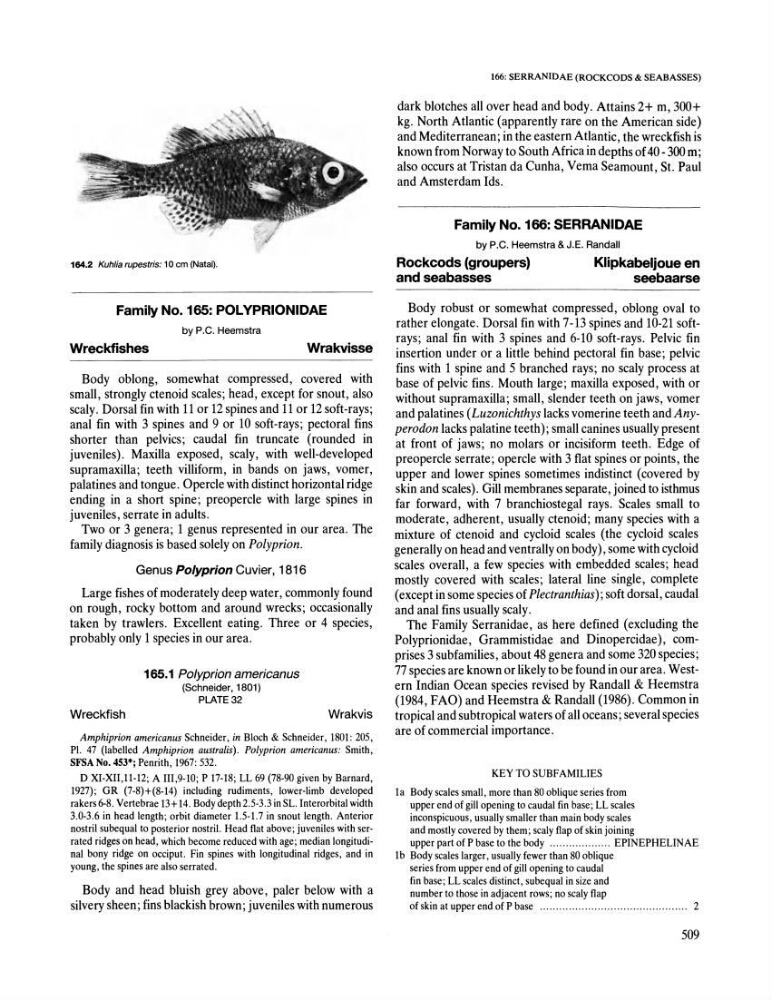
164.2 Kuhlia rupestris: 10 em (Natal).
Family No. 165: POLYPRIONIDAE
by P.C. Heemstra
Wreckfishes
Wrakvisse
Body oblong, somewhat compressed, covered with
small, strongly ctenoid scales; head, except for snout, also
scaly. Dorsal fin with 11 or 12 spines and 11 or 12 soft-rays;
anal fin with 3 spines and 9 or 10 soft-rays; pectoral fins
shorter than pelvics; caudal fin truncate (rounded in
juveniles). Maxilla exposed, scaly, with well-developed
supramaxilla; teeth villi form , in bands on jaws, vomer,
palatines and tongue. Opercle with distinct horizontal ridge
ending in a short spine; preopercle with large spines in
juveniles, serrate in adults.
Two or 3 genera; 1 genus represented in our area. The
family diagnosis is based solely on Polyprion.
Genus Polyprion Cuvier, 1816
Large fishes of moderately deep water, commonly found
on rough, rocky bottom and around wrecks; occasionally
taken by trawlers. Excellent eating. Three or 4 species,
probably only 1 species in our area.
Wreckfish
165.1 Polyprion american us
(Schneider, 1801)
PLATE 32
Wrakvis
Amphiprion american us Schneider, in Bloch & Schneider, 1801: 205,
PI. 47 (labelled Amphiprion australis). Poiyprion americanus: Smith,
SFSA No. 453*; Penrith, 1967: 532.
D XI-XII,1l·12; A III,9-1O; P 17-18; LL 69 (78-90 given by Barnard,
1927); GR (7-8)+(8-14) including rudiments, lower-limb developed
rakers 6-8. Vertebrae 13+ 14. Body depth 2.5-3.3 in SL. Interorbital width
3.0-3.6 in head length; orbit diameter 1.5-1.7 in snout length. Anterior
nostril subequal to posterior nostril. Head flat above; juveniles with serrated ridges on head, which become reduced with age; median longitudinal bony ridge on occiput. Fin spines with longitudinal ridges, and in
young, the spines are also serrated.
Body and head bluish grey above, paler below with a
silvery sheen; fins blackish brown; juveniles with numerous
166: SERRANIDAE (ROCKCODS & SEABASSES)
dark blotches all over head and body. Attains 2+ m, 300+
kg. North Atlantic (apparently rare on the American side)
and Mediterranean; in the eastern Atlantic, the wreckfish is
known from Norway to South Africa in depths of 40 -300 m;
also occurs at Tristan da Cunha, Vema Seamount, St. Paul
and Amsterdam Ids.
Family No. 166: SERRANIDAE
by P.C. Heemstra & J.E. Randall
Rockcods (groupers)
Klipkabeljoue en
and seabasses
seebaarse
Body robust or somewhat compressed, oblong oval to
rather elongate. Dorsal fin with 7 -13 spines and 10-21 softrays; anal fin with 3 spines and 6-10 soft-rays. Pelvic fin
insertion under or a little behind pectoral fin base; pelvic
fins with 1 spine and 5 branched rays; no scaly process at
base of pelvic fins. Mouth large; maxilla exposed, with or
without supramaxilla; small, slender teeth on jaws, vomer
and palatines (Luzonichthys lacks vomerine teeth and Anyperodon lacks palatine teeth); small canines usually present
at front of jaws; no molars or incisiform teeth. Edge of
preopercle serrate; opercle with 3 flat spines or points, the
upper and lower spines sometimes indistinct (covered by
skin and scales). Gill membranes separate, joined to isthmus
far forward, with 7 branchiostegal rays. Scales small to
moderate, adherent, usually ctenoid; many species with a
mixture of ctenoid and cycloid scales (the cycloid scales
generally on head and ventrally on body), some with cycloid
scales overall, a few species with embedded scales; head
mostly covered with scales; lateral line single, complete
(except in some species of Plectranthias); soft dorsal, caudal
and anal fins usually scaly.
The Family Serranidae, as here defined (excluding the
Polyprionidae, Grammistidae and Dinopercidae), comprises 3 subfamilies, about 48 genera and some 320 species;
77 species are known or likely to be found in our area. Western Indian Ocean species revised by Randall & Heemstra
(1984, FAO) and Heemstra & Randall (1986). Common in
tropical and subtropical waters of all oceans; several species
are of commercial importance.
KEY TO SUBFAMILIES
la Body scales small, more than 80 oblique series from
upper end of gill opening to caudal fin base; LL scales
inconspicuous, usually smaller than main body scales
and mostly covered by them; scaly flap of skin joining
upper part of P base to the body ................... EPINEPHELINAE
Ib Body scales larger, usually fewer than 80 oblique
series from upper end of gill opening to caudal
fin base; LL scales distinct, subequal in size and
number to those in adjacent rows; no scaly flap
of skin at upper end of P base .............................................. 2
509
Family No. 165: POLYPRIONIDAE
by P.C. Heemstra
Wreckfishes
Wrakvisse
Body oblong, somewhat compressed, covered with
small, strongly ctenoid scales; head, except for snout, also
scaly. Dorsal fin with 11 or 12 spines and 11 or 12 soft-rays;
anal fin with 3 spines and 9 or 10 soft-rays; pectoral fins
shorter than pelvics; caudal fin truncate (rounded in
juveniles). Maxilla exposed, scaly, with well-developed
supramaxilla; teeth villi form , in bands on jaws, vomer,
palatines and tongue. Opercle with distinct horizontal ridge
ending in a short spine; preopercle with large spines in
juveniles, serrate in adults.
Two or 3 genera; 1 genus represented in our area. The
family diagnosis is based solely on Polyprion.
Genus Polyprion Cuvier, 1816
Large fishes of moderately deep water, commonly found
on rough, rocky bottom and around wrecks; occasionally
taken by trawlers. Excellent eating. Three or 4 species,
probably only 1 species in our area.
Wreckfish
165.1 Polyprion american us
(Schneider, 1801)
PLATE 32
Wrakvis
Amphiprion american us Schneider, in Bloch & Schneider, 1801: 205,
PI. 47 (labelled Amphiprion australis). Poiyprion americanus: Smith,
SFSA No. 453*; Penrith, 1967: 532.
D XI-XII,1l·12; A III,9-1O; P 17-18; LL 69 (78-90 given by Barnard,
1927); GR (7-8)+(8-14) including rudiments, lower-limb developed
rakers 6-8. Vertebrae 13+ 14. Body depth 2.5-3.3 in SL. Interorbital width
3.0-3.6 in head length; orbit diameter 1.5-1.7 in snout length. Anterior
nostril subequal to posterior nostril. Head flat above; juveniles with serrated ridges on head, which become reduced with age; median longitudinal bony ridge on occiput. Fin spines with longitudinal ridges, and in
young, the spines are also serrated.
Body and head bluish grey above, paler below with a
silvery sheen; fins blackish brown; juveniles with numerous
166: SERRANIDAE (ROCKCODS & SEABASSES)
dark blotches all over head and body. Attains 2+ m, 300+
kg. North Atlantic (apparently rare on the American side)
and Mediterranean; in the eastern Atlantic, the wreckfish is
known from Norway to South Africa in depths of 40 -300 m;
also occurs at Tristan da Cunha, Vema Seamount, St. Paul
and Amsterdam Ids.
Family No. 166: SERRANIDAE
by P.C. Heemstra & J.E. Randall
Rockcods (groupers)
Klipkabeljoue en
and seabasses
seebaarse
Body robust or somewhat compressed, oblong oval to
rather elongate. Dorsal fin with 7 -13 spines and 10-21 softrays; anal fin with 3 spines and 6-10 soft-rays. Pelvic fin
insertion under or a little behind pectoral fin base; pelvic
fins with 1 spine and 5 branched rays; no scaly process at
base of pelvic fins. Mouth large; maxilla exposed, with or
without supramaxilla; small, slender teeth on jaws, vomer
and palatines (Luzonichthys lacks vomerine teeth and Anyperodon lacks palatine teeth); small canines usually present
at front of jaws; no molars or incisiform teeth. Edge of
preopercle serrate; opercle with 3 flat spines or points, the
upper and lower spines sometimes indistinct (covered by
skin and scales). Gill membranes separate, joined to isthmus
far forward, with 7 branchiostegal rays. Scales small to
moderate, adherent, usually ctenoid; many species with a
mixture of ctenoid and cycloid scales (the cycloid scales
generally on head and ventrally on body), some with cycloid
scales overall, a few species with embedded scales; head
mostly covered with scales; lateral line single, complete
(except in some species of Plectranthias); soft dorsal, caudal
and anal fins usually scaly.
The Family Serranidae, as here defined (excluding the
Polyprionidae, Grammistidae and Dinopercidae), comprises 3 subfamilies, about 48 genera and some 320 species;
77 species are known or likely to be found in our area. Western Indian Ocean species revised by Randall & Heemstra
(1984, FAO) and Heemstra & Randall (1986). Common in
tropical and subtropical waters of all oceans; several species
are of commercial importance.
KEY TO SUBFAMILIES
la Body scales small, more than 80 oblique series from
upper end of gill opening to caudal fin base; LL scales
inconspicuous, usually smaller than main body scales
and mostly covered by them; scaly flap of skin joining
upper part of P base to the body ................... EPINEPHELINAE
Ib Body scales larger, usually fewer than 80 oblique
series from upper end of gill opening to caudal
fin base; LL scales distinct, subequal in size and
number to those in adjacent rows; no scaly flap
of skin at upper end of P base .............................................. 2
509