

PERCIFORMES
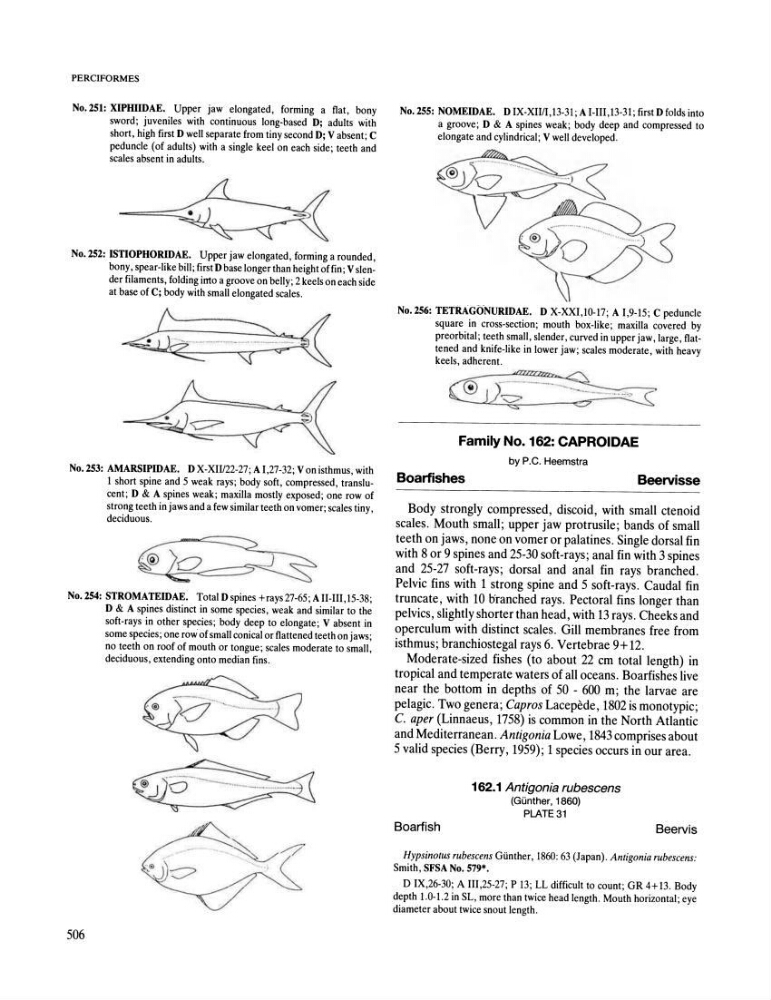
No. 251: XIPHIIDAE. Upper jaw elongated, forming a flat, bony
sword; juveniles with continuous long-based Dj adults with
short, high first D well separate from tiny second Dj V absent; C
peduncle (of adults) with a single keel on each side ; teeth and
scales absent in adults.
No. 252: ISTIOPHORIDAE. Upper jaw elongated, forming a rounded,
bony, spear-like bill; first D base longer than height offin; V slender filaments, folding into a groove on belly; 2 keels on each side
at base of Cj body with small elongated scales.
-42 . . . . . . . . . . . ~
~~
No. 253: AMARSIPIDAE. D X-XIII22-27; A 1,27-32; Von isthmus, with
1 short spine and 5 weak rays; body soft, compressed, translucent; D & A spines weak; maxilla mostly exposed; one row of
strong teeth in jaws and a few similar teeth on vomer; scales tiny,
deciduous.
No. 254: STROMATEIDAE. Total D spines +rays 27-65; A II-III,15-38;
D & A spines distinct in some species, weak and similar to the
soft-rays in other species; body deep to elongate; V absent in
some species; one row of small conical or flattened teeth on jaws;
no teeth on roof of mouth or tongue; scales moderate to small,
deciduous, extending onto median fins.
506
No. 255: NOMEIDAE. D IX-XIIII,13-31; A I-III,13-31; first D folds into
a groove; D & A spines weak; body deep and compressed to
elongate and cylindrical; V well developed.
No. 256: TETRAGONURIDAE. D X-XXI,lO-17; A 1,9-15; C peduncle
square in cross-section; mouth box-like; maxilla covered by
preorbital; teeth small, slender, curved in upper jaw, large, flattened and knife-like in lower jaw; scales moderate, with heavy
keels, adherent.
~)~
Family No. 162: CAPROIDAE
by P.C. Heemstra
Boarfishes
Beervisse
Body strongly compressed, discoid, with small ctenoid
scales. Mouth small; upper jaw protrusile; bands of small
teeth on jaws, none on vomer or palatines. Single dorsal fin
with 8 or 9 spines and 25-30 soft-rays; anal fin with 3 spines
and 25-27 soft-rays; dorsal and anal fin rays branched.
Pelvic fins with 1 strong spine and 5 soft-rays. Caudal fin
truncate, with 10 branched rays. Pectoral fins longer than
pelvics, slightly shorter than head, with 13 rays. Cheeks and
operculum with distinct scales. Gill membranes free from
isthmus; branchiostegal rays 6. Vertebrae 9+ 12.
Moderate-sized fishes (to about 22 cm total length) in
tropical and temperate waters of all oceans. Boarfishes live
near the bottom in depths of 50 - 600 m; the larvae are
pelagic. Two genera; Capros Lacepecte, 1802 is monotypic;
C. aper (Linnaeus, 1758) is common in the North Atlantic
and Mediterranean. Antigonia Lowe, 1843 comprises about
5 valid species (Berry, 1959); 1 species occurs in our area.
Boarfish
162.1 Antigonia rubescens
(Gunther, 1860)
PLATE 31
Beervis
Hypsinotus rubescens Gunther, 1860: 63 (Japan) . Antigonia rubescens:
Smith, SFSA No. 579*.
D IX,26-30; A III,25-27; P 13; LL difficult to count; GR 4+ 13. Body
depth 1.0-1.2 in SL, more than twice head length. Mouth horizontal; eye
diameter about twice snout length.
No. 251: XIPHIIDAE. Upper jaw elongated, forming a flat, bony
sword; juveniles with continuous long-based Dj adults with
short, high first D well separate from tiny second Dj V absent; C
peduncle (of adults) with a single keel on each side ; teeth and
scales absent in adults.
No. 252: ISTIOPHORIDAE. Upper jaw elongated, forming a rounded,
bony, spear-like bill; first D base longer than height offin; V slender filaments, folding into a groove on belly; 2 keels on each side
at base of Cj body with small elongated scales.
-42 . . . . . . . . . . . ~
~~
No. 253: AMARSIPIDAE. D X-XIII22-27; A 1,27-32; Von isthmus, with
1 short spine and 5 weak rays; body soft, compressed, translucent; D & A spines weak; maxilla mostly exposed; one row of
strong teeth in jaws and a few similar teeth on vomer; scales tiny,
deciduous.
No. 254: STROMATEIDAE. Total D spines +rays 27-65; A II-III,15-38;
D & A spines distinct in some species, weak and similar to the
soft-rays in other species; body deep to elongate; V absent in
some species; one row of small conical or flattened teeth on jaws;
no teeth on roof of mouth or tongue; scales moderate to small,
deciduous, extending onto median fins.
506
No. 255: NOMEIDAE. D IX-XIIII,13-31; A I-III,13-31; first D folds into
a groove; D & A spines weak; body deep and compressed to
elongate and cylindrical; V well developed.
No. 256: TETRAGONURIDAE. D X-XXI,lO-17; A 1,9-15; C peduncle
square in cross-section; mouth box-like; maxilla covered by
preorbital; teeth small, slender, curved in upper jaw, large, flattened and knife-like in lower jaw; scales moderate, with heavy
keels, adherent.
~)~
Family No. 162: CAPROIDAE
by P.C. Heemstra
Boarfishes
Beervisse
Body strongly compressed, discoid, with small ctenoid
scales. Mouth small; upper jaw protrusile; bands of small
teeth on jaws, none on vomer or palatines. Single dorsal fin
with 8 or 9 spines and 25-30 soft-rays; anal fin with 3 spines
and 25-27 soft-rays; dorsal and anal fin rays branched.
Pelvic fins with 1 strong spine and 5 soft-rays. Caudal fin
truncate, with 10 branched rays. Pectoral fins longer than
pelvics, slightly shorter than head, with 13 rays. Cheeks and
operculum with distinct scales. Gill membranes free from
isthmus; branchiostegal rays 6. Vertebrae 9+ 12.
Moderate-sized fishes (to about 22 cm total length) in
tropical and temperate waters of all oceans. Boarfishes live
near the bottom in depths of 50 - 600 m; the larvae are
pelagic. Two genera; Capros Lacepecte, 1802 is monotypic;
C. aper (Linnaeus, 1758) is common in the North Atlantic
and Mediterranean. Antigonia Lowe, 1843 comprises about
5 valid species (Berry, 1959); 1 species occurs in our area.
Boarfish
162.1 Antigonia rubescens
(Gunther, 1860)
PLATE 31
Beervis
Hypsinotus rubescens Gunther, 1860: 63 (Japan) . Antigonia rubescens:
Smith, SFSA No. 579*.
D IX,26-30; A III,25-27; P 13; LL difficult to count; GR 4+ 13. Body
depth 1.0-1.2 in SL, more than twice head length. Mouth horizontal; eye
diameter about twice snout length.