

Order PERCIFORMES
The Perciformes is the largest order of fishes, comprising
about 150 families and some 7 800 species (Nelson, 1984).
About one third of all fish species are perciforms. This
order is an unnatural (polyphyletic) assemblage of acanthopterygians that have attained a vaguely defined "grade"
of evolution and lack the specialisations of the various
derivative orders (e.g. Scorpaeniformes). Without any
unique specialised characters to serve as diagnostic features
of this order, membership of the Perciformes is uncertain at
best. Thus the Callionymidae and Caproidae are here
included in the Perciformes, whereas Gosline (1968)
excludes the Callionymidae and Rosen (1984) assigns the
Caproidae to the Tetraodontiformes! Likewise, Gosline
(1968) includes the Ophidiiformes as a suborder of the Perciformes, but here. they are accorded ordinal status.
Most perciforms have the following characters in common: dorsal, anal and pelvic fin spines present; pelvic fins
with a spine and 5 or fewer soft -rays (usually 1,5); caudal fin
skeleton with 5 or fewer hypurals; no free second ural
centrum; caudal fin with 17 or fewer principal rays; no
adipose fin; scales (usually) ctenoid; gills 4, a slit behind the
last; branchiostegal rays 7 or fewer.
There are 95 families of perciforms represented in our
area. Because of the large number of families, the superficial similarity of many families , the great morphological
diversity within some families and the relatively minor
anatomical features that distinguish some families, a workable dichotomous key to the families (as constructed for the
other orders) would be exceedingly tedious to use. In lieu of
such a key, we shall simply list the families with a few of
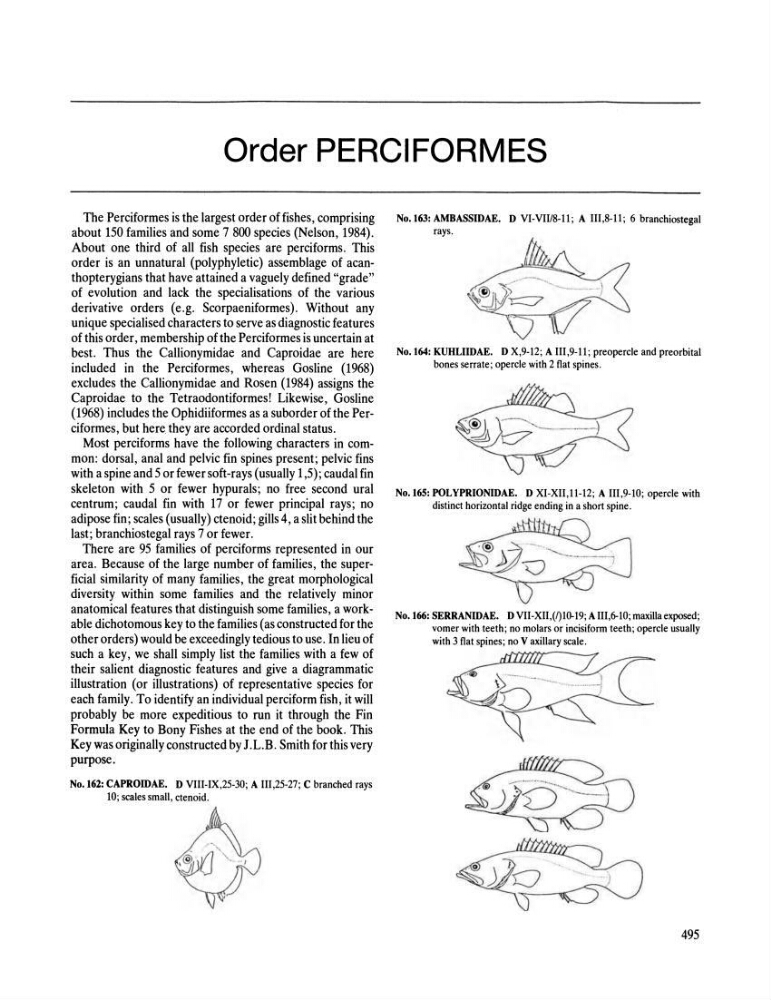
their salient diagnostic features and give a diagrammatic
illustration (or illustrations) of representative species for
each family. To identify an individual perciform fish, it will
probably be more expeditious to run it through the Fin
Formula Key to Bony Fishes at the end of the book. This
Key was originally constructed by J .L.B. Smith for this very
purpose.
No. 162: CAPROIDAE. D VIII-IX,25-30; A I1I,25-27; C branched rays
10; scales small, ctenoid.
No. 163: AMBASSIDAE. D VI-VII/S-ll; A I1I,S-ll; 6 branchiostegal
rays.
No. 164: KUHLIIDAE. D X,9-12; A I1I,9-11; preoperc1e and preorbital
bones serrate; operc1e with 2 flat spines.
No. 165: POLYPRIONIDAE. D XI-XII,1l-12; A III,9-1O; operc1e with
distinct horizontal ridge ending in a short spine.
No. 166: SERRANIDAE. D VII-XII,(/)10-19; A III,6-1O; maxilla exposed;
vomer with teeth; no molars or incisiform teeth; operc1e usually
with 3 flat spines; no V axillary scale.
495
The Perciformes is the largest order of fishes, comprising
about 150 families and some 7 800 species (Nelson, 1984).
About one third of all fish species are perciforms. This
order is an unnatural (polyphyletic) assemblage of acanthopterygians that have attained a vaguely defined "grade"
of evolution and lack the specialisations of the various
derivative orders (e.g. Scorpaeniformes). Without any
unique specialised characters to serve as diagnostic features
of this order, membership of the Perciformes is uncertain at
best. Thus the Callionymidae and Caproidae are here
included in the Perciformes, whereas Gosline (1968)
excludes the Callionymidae and Rosen (1984) assigns the
Caproidae to the Tetraodontiformes! Likewise, Gosline
(1968) includes the Ophidiiformes as a suborder of the Perciformes, but here. they are accorded ordinal status.
Most perciforms have the following characters in common: dorsal, anal and pelvic fin spines present; pelvic fins
with a spine and 5 or fewer soft -rays (usually 1,5); caudal fin
skeleton with 5 or fewer hypurals; no free second ural
centrum; caudal fin with 17 or fewer principal rays; no
adipose fin; scales (usually) ctenoid; gills 4, a slit behind the
last; branchiostegal rays 7 or fewer.
There are 95 families of perciforms represented in our
area. Because of the large number of families, the superficial similarity of many families , the great morphological
diversity within some families and the relatively minor
anatomical features that distinguish some families, a workable dichotomous key to the families (as constructed for the
other orders) would be exceedingly tedious to use. In lieu of
such a key, we shall simply list the families with a few of
their salient diagnostic features and give a diagrammatic
illustration (or illustrations) of representative species for
each family. To identify an individual perciform fish, it will
probably be more expeditious to run it through the Fin
Formula Key to Bony Fishes at the end of the book. This
Key was originally constructed by J .L.B. Smith for this very
purpose.
No. 162: CAPROIDAE. D VIII-IX,25-30; A I1I,25-27; C branched rays
10; scales small, ctenoid.
No. 163: AMBASSIDAE. D VI-VII/S-ll; A I1I,S-ll; 6 branchiostegal
rays.
No. 164: KUHLIIDAE. D X,9-12; A I1I,9-11; preoperc1e and preorbital
bones serrate; operc1e with 2 flat spines.
No. 165: POLYPRIONIDAE. D XI-XII,1l-12; A III,9-1O; operc1e with
distinct horizontal ridge ending in a short spine.
No. 166: SERRANIDAE. D VII-XII,(/)10-19; A III,6-1O; maxilla exposed;
vomer with teeth; no molars or incisiform teeth; operc1e usually
with 3 flat spines; no V axillary scale.
495