

155: PLATYCEPHALIDAE (FLATHEADS)
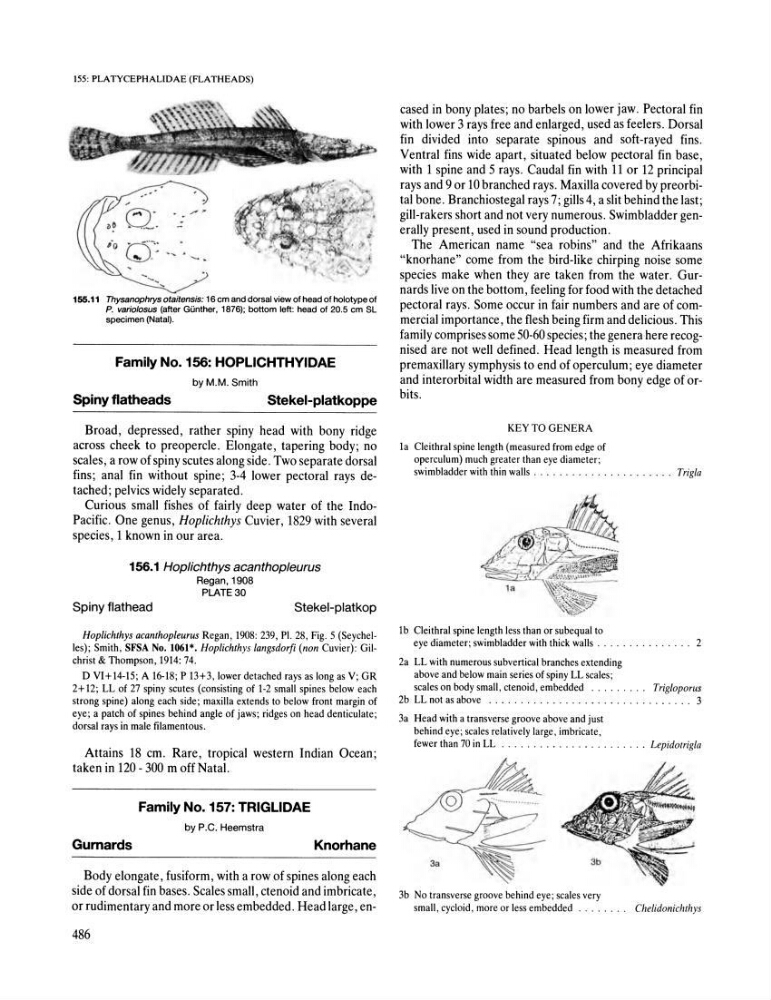
155.11 Thysanophrys otaitensis: 16 em and dorsal view of head of holotype of
P. variolosus (after Gunther, 1876); bottom left: head of 20.5 em SL
specimen (Natal).
Family No. 156: HOPLICHTHYIDAE
by M.M. Smith
Spiny flatheads
Stekel-platkoppe
Broad, depressed, rather spiny head with bony ridge
across cheek to preopercle. Elongate, tapering body; no
scales, a row of spiny scutes along side. Two separate dorsal
fins; anal fin without spine; 3-4 lower pectoral rays detached; pelvics widely separated.
Curious small fishes of fairly deep water of the IndoPacific. One genus, Hoplichthys Cuvier, 1829 with several
species, 1 known in our area.
156.1 Hoplichthys acanthop/eurus
Regan, 1908
PLATE 30
Spiny flathead
Stekel-platkop
Hop/ichthys acanthopleurus Regan, 1908: 239, PI. 28, Fig. 5 (Seychelles); Smith, SFSA No. 1061*. Hop/ichthys langsdorfi (non Cuvier) : Gilchrist & Thompson, 1914: 74 .
D VI+ 14-15; A 16-18; P 13+3, lower detached rays as long as V; GR
2+ 12; LL of 27 spiny scutes (consisting of 1-2 small spines below each
strong spine) along each side; maxilla extends to below front margin of
eye; a patch of spines behind angle of jaws; ridges on head denticulate;
dorsal rays in male filamentous .
Attains 18 cm. Rare, tropical western Indian Ocean;
taken in 120 - 300 m off Natal.
Family No. 157: TRIGLIDAE
by P.C. Heemstra
Gurnards
Knorhane
Body elongate, fusiform, with a row of spines along each
side of dorsal fin bases. Scales small, ctenoid and imbricate,
or rudimentary and more or less embedded. Head large, en486
cased in bony plates; no barbels on lower jaw. Pectoral fin
with lower 3 rays free and enlarged, used as feelers. Dorsal
fin divided into separate spinous and soft-rayed fins.
Ventral fins wide apart, situated below pectoral fin base,
with 1 spine and 5 rays. Caudal fin with 11 or 12 principal
rays and 9 or 10 branched rays. Maxilla covered by preorbital bone. Branchiostegal rays 7; gills 4, a slit behind the last;
gill-rakers short and not very numerous. Swim bladder generally present, used in sound production.
The American name "sea robins" and the Afrikaans
"knorhane" come from the bird-like chirping noise some
species make when they are taken from the water. Gurnards live on the bottom, feeling for food with the detached
pectoral rays. Some occur in fair numbers and are of commercial importance, the flesh being firm and delicious. This
family comprises some 50-60 species; the genera here recognised are not well defined. Head length is measured from
premaxillary symphysis to end of operculum; eye diameter
and interorbital width are measured from bony edge of orbits.
KEY TO GENERA
la Cleithral spine length (measured from edge of
operculum) much greater than eye diameter;
swimbladder with thin walls . . . . . . . . . . . . . . . . . . . . . . Trigla
1 b Cleithral spine length less than or subequal to
eye diameter; swimbladder with thick walls . . . . . . . . . . . . . . . 2
2a LL with numerous subvertical branches extending
above and below main series of spiny LL scales;
scales on body small, ctenoid, embedded ......... Trigloporus
2b LL not as above . . . . . . . . . . . . . . . . . . . . . . . . . . . . . . . . 3
3a Head with a transverse groove above and just
behind eye; scales relatively large, imbricate,
fewer than 70 in LL . . . . . . . . . . . . . . . . . . . . . . . Lepidotrigla
3b No transverse groove behind eye; scales very
small, cycloid, more or less embedded . . . . . . .. Chelidonichthys
155.11 Thysanophrys otaitensis: 16 em and dorsal view of head of holotype of
P. variolosus (after Gunther, 1876); bottom left: head of 20.5 em SL
specimen (Natal).
Family No. 156: HOPLICHTHYIDAE
by M.M. Smith
Spiny flatheads
Stekel-platkoppe
Broad, depressed, rather spiny head with bony ridge
across cheek to preopercle. Elongate, tapering body; no
scales, a row of spiny scutes along side. Two separate dorsal
fins; anal fin without spine; 3-4 lower pectoral rays detached; pelvics widely separated.
Curious small fishes of fairly deep water of the IndoPacific. One genus, Hoplichthys Cuvier, 1829 with several
species, 1 known in our area.
156.1 Hoplichthys acanthop/eurus
Regan, 1908
PLATE 30
Spiny flathead
Stekel-platkop
Hop/ichthys acanthopleurus Regan, 1908: 239, PI. 28, Fig. 5 (Seychelles); Smith, SFSA No. 1061*. Hop/ichthys langsdorfi (non Cuvier) : Gilchrist & Thompson, 1914: 74 .
D VI+ 14-15; A 16-18; P 13+3, lower detached rays as long as V; GR
2+ 12; LL of 27 spiny scutes (consisting of 1-2 small spines below each
strong spine) along each side; maxilla extends to below front margin of
eye; a patch of spines behind angle of jaws; ridges on head denticulate;
dorsal rays in male filamentous .
Attains 18 cm. Rare, tropical western Indian Ocean;
taken in 120 - 300 m off Natal.
Family No. 157: TRIGLIDAE
by P.C. Heemstra
Gurnards
Knorhane
Body elongate, fusiform, with a row of spines along each
side of dorsal fin bases. Scales small, ctenoid and imbricate,
or rudimentary and more or less embedded. Head large, en486
cased in bony plates; no barbels on lower jaw. Pectoral fin
with lower 3 rays free and enlarged, used as feelers. Dorsal
fin divided into separate spinous and soft-rayed fins.
Ventral fins wide apart, situated below pectoral fin base,
with 1 spine and 5 rays. Caudal fin with 11 or 12 principal
rays and 9 or 10 branched rays. Maxilla covered by preorbital bone. Branchiostegal rays 7; gills 4, a slit behind the last;
gill-rakers short and not very numerous. Swim bladder generally present, used in sound production.
The American name "sea robins" and the Afrikaans
"knorhane" come from the bird-like chirping noise some
species make when they are taken from the water. Gurnards live on the bottom, feeling for food with the detached
pectoral rays. Some occur in fair numbers and are of commercial importance, the flesh being firm and delicious. This
family comprises some 50-60 species; the genera here recognised are not well defined. Head length is measured from
premaxillary symphysis to end of operculum; eye diameter
and interorbital width are measured from bony edge of orbits.
KEY TO GENERA
la Cleithral spine length (measured from edge of
operculum) much greater than eye diameter;
swimbladder with thin walls . . . . . . . . . . . . . . . . . . . . . . Trigla
1 b Cleithral spine length less than or subequal to
eye diameter; swimbladder with thick walls . . . . . . . . . . . . . . . 2
2a LL with numerous subvertical branches extending
above and below main series of spiny LL scales;
scales on body small, ctenoid, embedded ......... Trigloporus
2b LL not as above . . . . . . . . . . . . . . . . . . . . . . . . . . . . . . . . 3
3a Head with a transverse groove above and just
behind eye; scales relatively large, imbricate,
fewer than 70 in LL . . . . . . . . . . . . . . . . . . . . . . . Lepidotrigla
3b No transverse groove behind eye; scales very
small, cycloid, more or less embedded . . . . . . .. Chelidonichthys