

149: SCORPAENIDAE (SCORPIONFISHES)
by Eschmeyer & Collette (1966); also see Eschmeyer &
Randall, 1975. Five species in 3 genera; 1 species known in
our area, and another likely to be found here.
KEY TO GENERA
la A rays usually 6Yz; orbit diameter about Yz
interobital width ....................... Ectreposebastes
(E. imus Garman, 1899 known from off Kenya, and both sides of
Atlantic and Pacific oceans.)
Ib A rays usually 5Yz; orbit diameter about equal to
interorbital width .......................... Setarches
Genus Setarches Johnson, 1862
Two species; 1 in our area. Setarches longimanus (Alcock, 1894), from the Andaman Sea, has the 2nd preopercular spine much shorter than the 1st or 3rd.
149.45 Setarches guentheri
Johnson, 1862
Setarches giintheri Johnson, 1862: 177 (Madeira); Smith, 1957: 85*.
Setarches marleyi Fowler, 1935: 398 Figs. 28-29 (Natal). Setarches
longiceps (non Alcock): Smith, SFSA No. 1036*. Setarches guntheri:
Smith, 1961: 571, No. 1036. Setarches guentheri: Eschmeyer & Collette,
1966: 357*.
D XII,9-1O; A III,S; P 20-25 (21-23 in our area).
Attains 23 cm. Trawled at about 400 m. Occurs nearly
worldwide in warm seas. Lives near or on bottom but feeds
in the water column.
149.45 Setarches guentheri: 18 em (off South Africa).
Subfamily SYNANCEIINAE
Scales not apparent. No free P rays. Indo-West Pacific.
Subfamily reviewed by Eschmeyer & Rama Rao (1973). Six
genera, 10 species; 1 species known in our area, and another
likely to be found here.
KEY TO GENERA
(Westcrn Indian Ocean)
la D spines 15-17; V 1,3 ................... Pseudosynanceia
(P. melanostigma Day, 1875; Persian Gulf and Arabian Sea)
Ib D spines 12-14; V 1,3 or 1,4 ................... Synanceia
478
Genus Synanceia Bloch & Schneider, 1801
The most venomous of all fishes. The grooved dorsal fin
spines are needle sharp and penetrate the careless wader's
foot with ease. In this process the enveloping skin is forced
down, compressing the gland on the spine, and the venom is
forced into the wound under great pressure. Pain starts immediately and rapidly becomes intolerable. Stonefish stabs
are often fatal within an hour or two. Immediately soaking
the wound in hot water, as hot as the victim can bear, will relieve the pain and destroy the venom. The wound should be
kept in the hot water for 30-90 minutes.
Stonefishes (as the name implies) are very well camouflaged and can be expected on shallow coral reefs throughout the Indo-Pacific region. They often lie half-buried in
sand, and usually will not move unless they are actually
touched. N.B. Wading on coral reefs must be done with the
utmost caution. Four or 5 species; 1 in our area.
Stonefish
149.46 Synanceia verrucosa
Bloch & Schneider, 1801
PLATE 27
Steenvis
Synanceia verrucosa Bloch & Schneider, 1801: 195, PI. 45 (India);
Eschmeyer & Rama Rao, 1973: 357*. Synanceja verrucosa: Smith, SFSA
No. 1052*. Synanceichthys verrucosus: Smith, 1958: 173*.
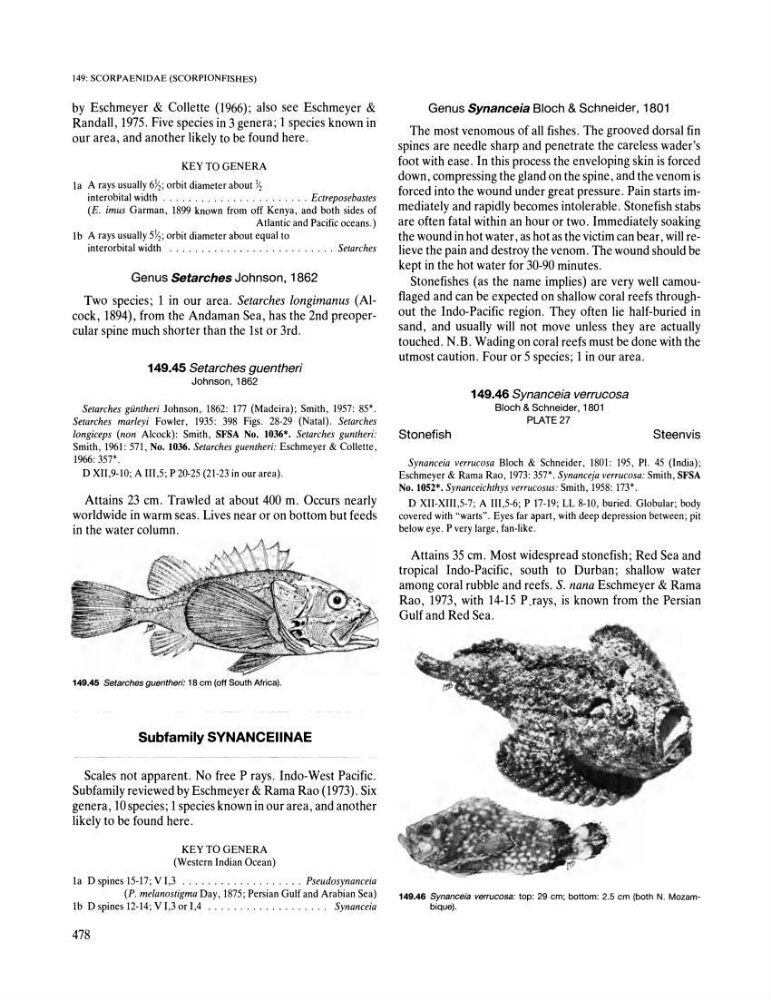
D XII-XIII,5-7; A 1II,5-6; P 17-19; LL 8-10, buried. Globular; body
covered with "warts". Eyes far apart, with deep depression between; pit
below eye. P very large, fan-like.
Attains 35 cm. Most widespread stonefish; Red Sea and
tropical Indo-Pacific, south to Durban; shallow water
among coral rubble and reefs. S. nana Eschmeyer & Rama
Rao, 1973, with 14-15 P ,rays, is known from the Persian
Gulf and Red Sea.
149.46 Synanceia verrucosa: top: 29 em; bottom: 2.5 em (both N. Mozambique).
by Eschmeyer & Collette (1966); also see Eschmeyer &
Randall, 1975. Five species in 3 genera; 1 species known in
our area, and another likely to be found here.
KEY TO GENERA
la A rays usually 6Yz; orbit diameter about Yz
interobital width ....................... Ectreposebastes
(E. imus Garman, 1899 known from off Kenya, and both sides of
Atlantic and Pacific oceans.)
Ib A rays usually 5Yz; orbit diameter about equal to
interorbital width .......................... Setarches
Genus Setarches Johnson, 1862
Two species; 1 in our area. Setarches longimanus (Alcock, 1894), from the Andaman Sea, has the 2nd preopercular spine much shorter than the 1st or 3rd.
149.45 Setarches guentheri
Johnson, 1862
Setarches giintheri Johnson, 1862: 177 (Madeira); Smith, 1957: 85*.
Setarches marleyi Fowler, 1935: 398 Figs. 28-29 (Natal). Setarches
longiceps (non Alcock): Smith, SFSA No. 1036*. Setarches guntheri:
Smith, 1961: 571, No. 1036. Setarches guentheri: Eschmeyer & Collette,
1966: 357*.
D XII,9-1O; A III,S; P 20-25 (21-23 in our area).
Attains 23 cm. Trawled at about 400 m. Occurs nearly
worldwide in warm seas. Lives near or on bottom but feeds
in the water column.
149.45 Setarches guentheri: 18 em (off South Africa).
Subfamily SYNANCEIINAE
Scales not apparent. No free P rays. Indo-West Pacific.
Subfamily reviewed by Eschmeyer & Rama Rao (1973). Six
genera, 10 species; 1 species known in our area, and another
likely to be found here.
KEY TO GENERA
(Westcrn Indian Ocean)
la D spines 15-17; V 1,3 ................... Pseudosynanceia
(P. melanostigma Day, 1875; Persian Gulf and Arabian Sea)
Ib D spines 12-14; V 1,3 or 1,4 ................... Synanceia
478
Genus Synanceia Bloch & Schneider, 1801
The most venomous of all fishes. The grooved dorsal fin
spines are needle sharp and penetrate the careless wader's
foot with ease. In this process the enveloping skin is forced
down, compressing the gland on the spine, and the venom is
forced into the wound under great pressure. Pain starts immediately and rapidly becomes intolerable. Stonefish stabs
are often fatal within an hour or two. Immediately soaking
the wound in hot water, as hot as the victim can bear, will relieve the pain and destroy the venom. The wound should be
kept in the hot water for 30-90 minutes.
Stonefishes (as the name implies) are very well camouflaged and can be expected on shallow coral reefs throughout the Indo-Pacific region. They often lie half-buried in
sand, and usually will not move unless they are actually
touched. N.B. Wading on coral reefs must be done with the
utmost caution. Four or 5 species; 1 in our area.
Stonefish
149.46 Synanceia verrucosa
Bloch & Schneider, 1801
PLATE 27
Steenvis
Synanceia verrucosa Bloch & Schneider, 1801: 195, PI. 45 (India);
Eschmeyer & Rama Rao, 1973: 357*. Synanceja verrucosa: Smith, SFSA
No. 1052*. Synanceichthys verrucosus: Smith, 1958: 173*.
D XII-XIII,5-7; A 1II,5-6; P 17-19; LL 8-10, buried. Globular; body
covered with "warts". Eyes far apart, with deep depression between; pit
below eye. P very large, fan-like.
Attains 35 cm. Most widespread stonefish; Red Sea and
tropical Indo-Pacific, south to Durban; shallow water
among coral rubble and reefs. S. nana Eschmeyer & Rama
Rao, 1973, with 14-15 P ,rays, is known from the Persian
Gulf and Red Sea.
149.46 Synanceia verrucosa: top: 29 em; bottom: 2.5 em (both N. Mozambique).