

Family No. 146: SOLENOSTOMIDAE
by R. A. Fritzsche
Ghost pipefishes
Spookpypvisse
Body short and compressed; encased in bony plates.
Dorsal fins separate; anterior dorsal fin comprising 5 feeble
spines. Soft dorsal and anal fins similar and opposite. Snout
long and compressed with small terminal mouth. Pelvic fins
of female expanded and modified into brood pouch for
incubation of eggs.
A small group of Indo-Pacific fishes. One genus.
Genus Solenostomus Lacepede, 1803
Solenichthys Bleeker, 1865 is a synonym. Perhaps 2 species;
1 in our area. S. paradoxus (Pallas, 1770) reported from
Zanzibar may be found in our area.
KEY TO SPECIES
1a C peduncle about 3 times longer than deep .............. S. paradoxus
1b C peduncle about as long as deep .... ............ .... ..... S. cyanopterus
146.1 Solenostomus cyanopterus
Bleeker, 1854
PLATE 24
Ghost pipefish
Spookpypvis
Solenostomus cyanopterus Bleeker, 1854: 507 (Ceram) ; Smith, SFSA
No. 370*; Fishelson, 1966: 95*. Solenostoma cyanopterus: Barnard, 1947:
75* .
D V+ 18-20; A 18·20; P 25-28; V 7. Head 2.2-2.6; snout height 5-9 in
head. Caudal peduncle depth usually greater than its length.
Colour variable, brown to pink or yellow and marked
with small black or white spots; 2 elongate black spots
between 1st 3 D spines. "Always found in pairs, swimming
head down close to each other. Searching for food they
approach the selected place turning their eyes in all directions, simultaneously or separately" (Fishelson, 1966).
Attains 17 cm. Uncommon shore fish in weedy areas
throughout Indo-Pacific region including India, Japan and
Australia, and south to East London.
Family No. 147: MACRORAMPHOSIDAE
by P.C. Heemstra
Snipefishes
Snipvisse
Body very compressed. Snout produced into a long tube
at the end of which is the small toothless mouth. Bony plates
on flanks above pectoral fins and/or along ventral midline of
body. Pelvic fins small. Dorsal fins separate, first with 5-8
147: MACRORAMPHOSIDAE (SNIPEFISHES)
spines, the 2nd spine much enlarged. Scales like shark
denticles, with sharp ridges and spines. Gasbladder present.
Three genera with about 12 species; 5 species in our area.
Body length is from rear edge of gill cavity to base of caudal
fin .
KEY TO GENERA
1a Spinous and soft D separated by a distinct gap;
body depth (vertical at origin of V) contained 2
or more times in distance from eye to C
base ....... ............ ..... ... ................. .............. Macroramphosus
lb Spinous and soft D contiguous; body depth contained
less than twice in distance from eye to C base .... .. .... .. ............. . 2
2a Scales large, visible to naked eye; orbit rim spiny ....... . Centriscops
2b Scales microscopic; orbit rim without distinct spines .... . Notopogon
Genus Centriscops Gill, 1863
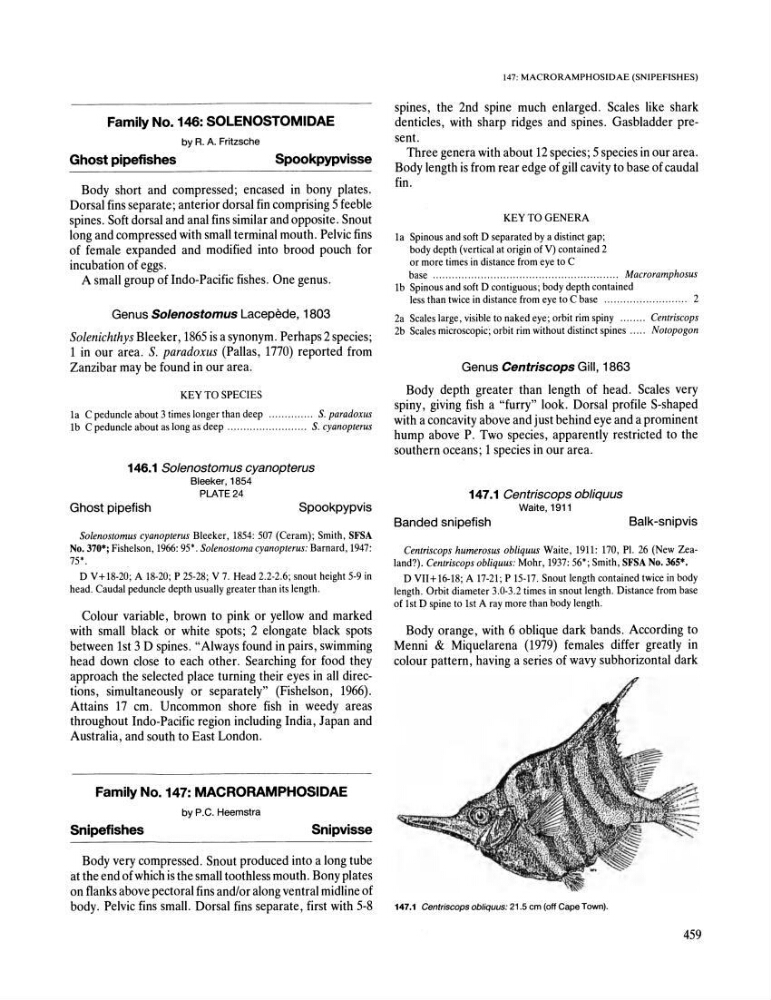
Body depth greater than length of head. Scales very
spiny, giving fish a "furry" look. Dorsal profile S-shaped
with a concavity above and just behind eye and a prominent
hump above P. Two species, apparently restricted to the
southern oceans; 1 species in our area.
147.1 Centriscops ob/iquus
Waite, 1911
Banded snipefish
Balk-snipvis
Centriscops humerosus obliquus Waite, 1911: 170, PI. 26 (New Zealand?). Centriscops obliquus: Mohr, 1937: 56*; Smith, SFSA No. 365*.
D VII + 16-18; A 17-21; P 15-17. Snout length contained twice in body
length. Orbit diameter 3.0-3.2 times in snout length. Distance from base
of 1st D spine to 1st A ray more than body length .
Body orange, with 6 oblique dark bands. According to
Menni & Miquelarena (1979) females differ greatly in
colour pattern, having a series of wavy subhorizontal dark
147.1 Centriscopsobliquus: 21.5 em (off Cape Town).
459
by R. A. Fritzsche
Ghost pipefishes
Spookpypvisse
Body short and compressed; encased in bony plates.
Dorsal fins separate; anterior dorsal fin comprising 5 feeble
spines. Soft dorsal and anal fins similar and opposite. Snout
long and compressed with small terminal mouth. Pelvic fins
of female expanded and modified into brood pouch for
incubation of eggs.
A small group of Indo-Pacific fishes. One genus.
Genus Solenostomus Lacepede, 1803
Solenichthys Bleeker, 1865 is a synonym. Perhaps 2 species;
1 in our area. S. paradoxus (Pallas, 1770) reported from
Zanzibar may be found in our area.
KEY TO SPECIES
1a C peduncle about 3 times longer than deep .............. S. paradoxus
1b C peduncle about as long as deep .... ............ .... ..... S. cyanopterus
146.1 Solenostomus cyanopterus
Bleeker, 1854
PLATE 24
Ghost pipefish
Spookpypvis
Solenostomus cyanopterus Bleeker, 1854: 507 (Ceram) ; Smith, SFSA
No. 370*; Fishelson, 1966: 95*. Solenostoma cyanopterus: Barnard, 1947:
75* .
D V+ 18-20; A 18·20; P 25-28; V 7. Head 2.2-2.6; snout height 5-9 in
head. Caudal peduncle depth usually greater than its length.
Colour variable, brown to pink or yellow and marked
with small black or white spots; 2 elongate black spots
between 1st 3 D spines. "Always found in pairs, swimming
head down close to each other. Searching for food they
approach the selected place turning their eyes in all directions, simultaneously or separately" (Fishelson, 1966).
Attains 17 cm. Uncommon shore fish in weedy areas
throughout Indo-Pacific region including India, Japan and
Australia, and south to East London.
Family No. 147: MACRORAMPHOSIDAE
by P.C. Heemstra
Snipefishes
Snipvisse
Body very compressed. Snout produced into a long tube
at the end of which is the small toothless mouth. Bony plates
on flanks above pectoral fins and/or along ventral midline of
body. Pelvic fins small. Dorsal fins separate, first with 5-8
147: MACRORAMPHOSIDAE (SNIPEFISHES)
spines, the 2nd spine much enlarged. Scales like shark
denticles, with sharp ridges and spines. Gasbladder present.
Three genera with about 12 species; 5 species in our area.
Body length is from rear edge of gill cavity to base of caudal
fin .
KEY TO GENERA
1a Spinous and soft D separated by a distinct gap;
body depth (vertical at origin of V) contained 2
or more times in distance from eye to C
base ....... ............ ..... ... ................. .............. Macroramphosus
lb Spinous and soft D contiguous; body depth contained
less than twice in distance from eye to C base .... .. .... .. ............. . 2
2a Scales large, visible to naked eye; orbit rim spiny ....... . Centriscops
2b Scales microscopic; orbit rim without distinct spines .... . Notopogon
Genus Centriscops Gill, 1863
Body depth greater than length of head. Scales very
spiny, giving fish a "furry" look. Dorsal profile S-shaped
with a concavity above and just behind eye and a prominent
hump above P. Two species, apparently restricted to the
southern oceans; 1 species in our area.
147.1 Centriscops ob/iquus
Waite, 1911
Banded snipefish
Balk-snipvis
Centriscops humerosus obliquus Waite, 1911: 170, PI. 26 (New Zealand?). Centriscops obliquus: Mohr, 1937: 56*; Smith, SFSA No. 365*.
D VII + 16-18; A 17-21; P 15-17. Snout length contained twice in body
length. Orbit diameter 3.0-3.2 times in snout length. Distance from base
of 1st D spine to 1st A ray more than body length .
Body orange, with 6 oblique dark bands. According to
Menni & Miquelarena (1979) females differ greatly in
colour pattern, having a series of wavy subhorizontal dark
147.1 Centriscopsobliquus: 21.5 em (off Cape Town).
459