

145: SYNGNATHIDAE (SEA HORSES & PIPEFISHES)
145.13 Hippichthys cyanospilos
(Bleeker, 1854)
PLATE 23
Bluespeckled pipefish
Blouspikkelde-pypvis
Syngnathus cyanospilos Bleeker, 1854: 114 (Indonesia); Smith, SFSA
No. 351*; 1963: 538*' Syngnathus mossambicus Peters, 1855: 465
(Mozambique); 1855: 277. Hippichthys cyanospilus: Dawson, 1978: 150*.
Rings (12-14)+(32-35); D 20-28; P 13-16; total subdorsal rings 4.25-6.0 ;
D origin on last or penultimate trunk ring.
Venter and side of trunk without dark bars; D typically
with 3-4 prominent brown spots on each ray. Reaches 16
cm. Inhaca and Inhambane, Mozambique; northern Red
Sea to Fiji. (See illustration on p. 450.)
145.14 Hippichthys heptagonus
Bleeker, 1849
Belly pipefish
Boepens-pypvis
Hippichthys heptagonus Bleeker, 1849: 15 (Indonesia); Dawson, 1978:
136*. Syngnathus djarong: Smith, 1951: 53; 1953: 516, No. 352a; 1963:
537*'
Rings (14-15)+(36-42); D 23-30; P 13-16; total subdorsal rings 5.0-6.25.
Brownish, often without distinctive markings; venter of
trunk commonly dusky, shading to near black on median
ridge; some with brownish bars; D rays without distinct row
of brown spots. Reaches 15 cm . Durban , St. Lucia and
'nHtunga lakes, Natal; Kenya to Solomon Ids. (See illustration on p. 450.)
145.15 Hippichthys spicifer
(Ruppell, 1838)
PLATE 23
Bellybarred pipefish
Balkpens-pypvis
Syngnathus spicifer Riippell, 1838: 143, PI. 33, Fig. 4 (Red Sea); Smith,
SFSA No. 352*; 1963: 537* . Hippichthys spidfer: Dawson, 1978: 142*.
Hippichthys (Hippichthys) spidfer: Dawson, 1985: 98*.
Rings (14-16)+(36-41); D 25-30; P 15-18; total subdorsal rings 5.0-6.0;
subadults and adults always with some keeled scutella.
Variably brownish, mottled or with prominent dark bars
crossing lower half of side and venter of trunk; bars absent
or obscured by dark ground colour in some adults; Drays
without rows of distinct brown spots. Reaches 175 mm.
Durban and Xora River mouth; northern Red Sea to
Samoa. (See illustration on p. 450.)
Genus Hippocampus Rafinesque, 1810
Although often represented in collections and aquaria
and sometimes sold as curios, the seahorses are poorly
known systematically. Characters employed for their identification (e.g. ring counts, numbers of fin rays) exhibit
little variation between species, and both morphometric
features and preserved coloration are rather variable within
a species. Seahorses occur in offshore waters but most are
452
found in inshore habitats among algae or sea grasses. Some
species are reported to reach 30 cm TL, but others are
mature at 25 mm TL. In most cases, identification is difficult
and the correct name for many species is presently uncertain. More than 100 species have been described, but valid
species probably number fewer than 30; 6 recorded from
our area . The key and species accounts for seahorses are
modified from Smith (1949, 1963, 1965).
KEY TO SPECIES
1a Body rings with long spines .......... .... ...... .. ......... .. . .. ... H. histrix
1 b Body rings without long spines ....... .. ............... ..... .... .......... .. 2
2a Coronet low or obsolete ............. .... .. .. .. .. .................... .. ...... 3
2b Coronet prominent .. .. ........................................................ 5
3a Snout length ca. 2 in HL; Drays 19-21 .... ... .......... H. trimaculatus
3b Snout length more than 2 in HL, about equals
postorbital length; Drays 16-18 .. ........ .. ................ ... ... ..... ..... 4
4a Coronet usually obsolete in adults; 2 prominent
tubercles below Dbase .......................................... H. capensis
4b Coronet low, distally bifid; 3 prominent tubercles
below Dbase ........................................ .... ...... .. ...... H. kuda
5a D 19-21; P 17-18; coronet with 5-6 distal points
in young, broadly rounded in adults ................ H. cameiopardalis
5b D 16-17; P 15-16; coronet distally concave and
usually pentagonal ................... .... .................. ... .. .... H. whitei
145.16 Hippocampus camelopardalis
Bianconi, 1853
Giraffe seahorse
Kameel-seeperdjie
Hippocampus camelopardalis Bianconi, 1853: 68 (Mozambique); Bianconi, 1855: 223, PI. 1, Fig. 3; Smith, SFSA No. 348*; 1963: 519*.
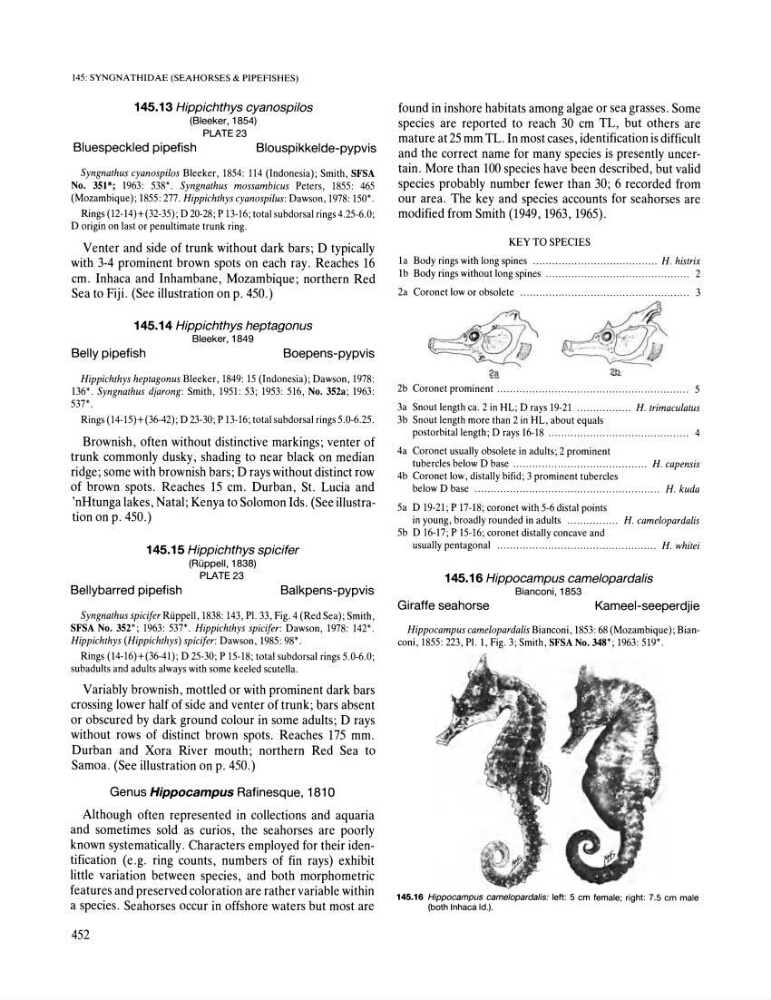
145.16 Hippocampus camelopardalis: left: 5 em female; right: 7.5 em male
(both Inhaea Id.).
145.13 Hippichthys cyanospilos
(Bleeker, 1854)
PLATE 23
Bluespeckled pipefish
Blouspikkelde-pypvis
Syngnathus cyanospilos Bleeker, 1854: 114 (Indonesia); Smith, SFSA
No. 351*; 1963: 538*' Syngnathus mossambicus Peters, 1855: 465
(Mozambique); 1855: 277. Hippichthys cyanospilus: Dawson, 1978: 150*.
Rings (12-14)+(32-35); D 20-28; P 13-16; total subdorsal rings 4.25-6.0 ;
D origin on last or penultimate trunk ring.
Venter and side of trunk without dark bars; D typically
with 3-4 prominent brown spots on each ray. Reaches 16
cm. Inhaca and Inhambane, Mozambique; northern Red
Sea to Fiji. (See illustration on p. 450.)
145.14 Hippichthys heptagonus
Bleeker, 1849
Belly pipefish
Boepens-pypvis
Hippichthys heptagonus Bleeker, 1849: 15 (Indonesia); Dawson, 1978:
136*. Syngnathus djarong: Smith, 1951: 53; 1953: 516, No. 352a; 1963:
537*'
Rings (14-15)+(36-42); D 23-30; P 13-16; total subdorsal rings 5.0-6.25.
Brownish, often without distinctive markings; venter of
trunk commonly dusky, shading to near black on median
ridge; some with brownish bars; D rays without distinct row
of brown spots. Reaches 15 cm . Durban , St. Lucia and
'nHtunga lakes, Natal; Kenya to Solomon Ids. (See illustration on p. 450.)
145.15 Hippichthys spicifer
(Ruppell, 1838)
PLATE 23
Bellybarred pipefish
Balkpens-pypvis
Syngnathus spicifer Riippell, 1838: 143, PI. 33, Fig. 4 (Red Sea); Smith,
SFSA No. 352*; 1963: 537* . Hippichthys spidfer: Dawson, 1978: 142*.
Hippichthys (Hippichthys) spidfer: Dawson, 1985: 98*.
Rings (14-16)+(36-41); D 25-30; P 15-18; total subdorsal rings 5.0-6.0;
subadults and adults always with some keeled scutella.
Variably brownish, mottled or with prominent dark bars
crossing lower half of side and venter of trunk; bars absent
or obscured by dark ground colour in some adults; Drays
without rows of distinct brown spots. Reaches 175 mm.
Durban and Xora River mouth; northern Red Sea to
Samoa. (See illustration on p. 450.)
Genus Hippocampus Rafinesque, 1810
Although often represented in collections and aquaria
and sometimes sold as curios, the seahorses are poorly
known systematically. Characters employed for their identification (e.g. ring counts, numbers of fin rays) exhibit
little variation between species, and both morphometric
features and preserved coloration are rather variable within
a species. Seahorses occur in offshore waters but most are
452
found in inshore habitats among algae or sea grasses. Some
species are reported to reach 30 cm TL, but others are
mature at 25 mm TL. In most cases, identification is difficult
and the correct name for many species is presently uncertain. More than 100 species have been described, but valid
species probably number fewer than 30; 6 recorded from
our area . The key and species accounts for seahorses are
modified from Smith (1949, 1963, 1965).
KEY TO SPECIES
1a Body rings with long spines .......... .... ...... .. ......... .. . .. ... H. histrix
1 b Body rings without long spines ....... .. ............... ..... .... .......... .. 2
2a Coronet low or obsolete ............. .... .. .. .. .. .................... .. ...... 3
2b Coronet prominent .. .. ........................................................ 5
3a Snout length ca. 2 in HL; Drays 19-21 .... ... .......... H. trimaculatus
3b Snout length more than 2 in HL, about equals
postorbital length; Drays 16-18 .. ........ .. ................ ... ... ..... ..... 4
4a Coronet usually obsolete in adults; 2 prominent
tubercles below Dbase .......................................... H. capensis
4b Coronet low, distally bifid; 3 prominent tubercles
below Dbase ........................................ .... ...... .. ...... H. kuda
5a D 19-21; P 17-18; coronet with 5-6 distal points
in young, broadly rounded in adults ................ H. cameiopardalis
5b D 16-17; P 15-16; coronet distally concave and
usually pentagonal ................... .... .................. ... .. .... H. whitei
145.16 Hippocampus camelopardalis
Bianconi, 1853
Giraffe seahorse
Kameel-seeperdjie
Hippocampus camelopardalis Bianconi, 1853: 68 (Mozambique); Bianconi, 1855: 223, PI. 1, Fig. 3; Smith, SFSA No. 348*; 1963: 519*.
145.16 Hippocampus camelopardalis: left: 5 em female; right: 7.5 em male
(both Inhaea Id.).