

Whitley, 1947, is endemic to Australia and the subgenus
Amphelikturus Parr, 1930, is represented in the tropical!
subtropical Atlantic Ocean.
145.1 Acentronura tentacu/ata
Gunther, 1870
Pipehorse
Pypperdjie
Acentronura tentaculata Gunther, 1870: 516 (Gulf of Suez) . Acentronura gracillima (non Temminck & Schlegel): Smith, 1951: 53; 1953: 516,
No. 348a*. Acentronura mossambica Smith, 1963: 522, PI. 76, Figs. F & G
(Inhaca, Mozambique). Acentronura (Acentronura) tentaculata: Dawson,
1985: 17'.
Rings (12)+(39-44); D 16-17; P 14-16; A 4; subdorsal rings (2.5-1.5)
+(1.5-2.5) = 3.25-4.4; dermal flaps present on head and body. Small,
sluggish , seahorse-like pipefishes lacking C in subadults and adults; C
present in pouch in young and early juveniles.
Mainly brown, some dermal flaps blackish. Reaches at
least 63 mm. Inhaca and Inhambane, Mozambique; northern Red Sea to Torres Straits and Queensland, Australia.
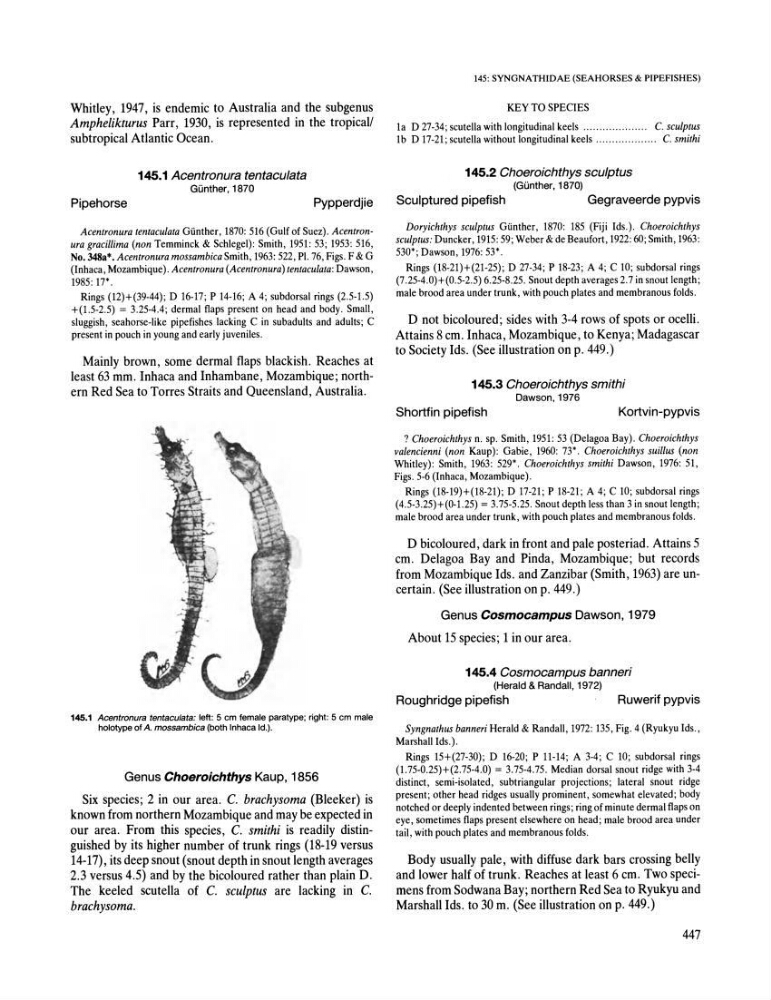
145.1 Aeentronura tentaeulata: left: 5 em female paratype; right: 5 em male
holotype of A. mossambiea (both Inhaea Id.).
Genus Choeroichthys Kaup, 1856
Six species; 2 in our area. C. brachysoma (Bleeker) is
known from northern Mozambique and may be expected in
our area. From this species, C. smithi is readily distinguished by its higher number of trunk rings (18-19 versus
14-17), its deep snout (snout depth in snout length averages
2.3 versus 4.5) and by the bicoloured rather than plain D.
The keeled scutella of C. sculptus are lacking in C.
brachysoma.
145: SYNGNATHIDAE (SEAHORSES & PIPEFISHES)
KEY TO SPECIES
la D 27-34; scutella with longitudinal keels............ .. ...... C. sculptus
Ib D 17-21; scutella without longitudinal keels .... ............... C. smithi
145.2 Choeroichthys SCU/ptus
(Gunther, 1870)
Sculptured pipefish
Gegraveerde pypvis
Doryichthys sculptus Gunther, 1870: 185 (Fiji Ids.). Choeroichthys
sculptus: Duncker, 1915: 59; Weber & de Beaufort, 1922: 60; Smith, 1963:
530'; Dawson, 1976: 53' .
Rings (18-21)+(21-25); D 27-34; P 18-23; A 4; C 10; subdorsal rings
(7 .25-4.0)+(0.5-2.5) 6.25-8.25. Snout depth averages 2.7 in snout length;
male brood area under trunk, with pouch plates and membranous folds.
D not bicoloured; sides with 3-4 rows of spots or ocelli.
Attains 8 cm. Inhaca, Mozambique, to Kenya; Madagascar
to Society Ids. (See illustration on p. 449.)
145.3 Choeroichthys smithi
Dawson, 1976
Shortfin pipefish
Kortvin-pypvis
? Choeroichthys n. sp. Smith, 1951 : 53 (Delagoa Bay). Choeroichthys
valencienni (non Kaup): Gabie, 1960: 73'. Choeroichthys suil/us (non
Whitley): Smith, 1963: 529* . Choeroichthys smithi Dawson, 1976: 51,
Figs. 5-6 (Inhaca, Mozambique).
Rings (18-19)+(18-21); D 17-21; P 18-21; A 4; C 10; subdorsal rings
(4.5-3.25)+(0-1.25) = 3.75-5.25. Snout depth less than 3 in snout length;
male brood area under trunk, with pouch plates and membranous folds.
D bicoloured, dark in front and pale posteriad. Attains 5
cm. Delagoa Bay and Pinda, Mozambique; but records
from Mozambique Ids. and Zanzibar (Smith, 1963) are uncertain. (See illustration on p. 449.)
Genus Cosmocampus Dawson, 1979
About 15 species; 1 in our area.
145.4 Cosmocampus banneri
(Herald & Randall, 1972)
Roughridge pipefish
Ruwerif pypvis
Syngnathus banneri Herald & Randall, 1972: 135, Fig. 4 (Ryukyu Ids.,
Marshall Ids.).
Rings 15+(27-30); D 16-20; P 11-14; A 3-4; C 10; subdorsal rings
(1.75-0.25)+(2.75-4.0) = 3.75-4.75 . Median dorsal snout ridge with 3-4
distinct, semi-isolated, subtriangular projections; lateral snout ridge
present; other head ridges usually prominent, somewhat elevated; body
notched or deeply indented between rings; ring of minute dermal flaps on
eye, sometimes flaps present elsewhere on head; male brood area under
tail, with pouch plates and membranous folds.
Body usually pale, with diffuse dark bars crossing belly
and lower half of trunk. Reaches at least 6 cm. Two specimens from Sodwana Bay; northern Red Sea to Ryukyu and
Marshall Ids. to 30 m. (See illustration on p. 449.)
447
Amphelikturus Parr, 1930, is represented in the tropical!
subtropical Atlantic Ocean.
145.1 Acentronura tentacu/ata
Gunther, 1870
Pipehorse
Pypperdjie
Acentronura tentaculata Gunther, 1870: 516 (Gulf of Suez) . Acentronura gracillima (non Temminck & Schlegel): Smith, 1951: 53; 1953: 516,
No. 348a*. Acentronura mossambica Smith, 1963: 522, PI. 76, Figs. F & G
(Inhaca, Mozambique). Acentronura (Acentronura) tentaculata: Dawson,
1985: 17'.
Rings (12)+(39-44); D 16-17; P 14-16; A 4; subdorsal rings (2.5-1.5)
+(1.5-2.5) = 3.25-4.4; dermal flaps present on head and body. Small,
sluggish , seahorse-like pipefishes lacking C in subadults and adults; C
present in pouch in young and early juveniles.
Mainly brown, some dermal flaps blackish. Reaches at
least 63 mm. Inhaca and Inhambane, Mozambique; northern Red Sea to Torres Straits and Queensland, Australia.
145.1 Aeentronura tentaeulata: left: 5 em female paratype; right: 5 em male
holotype of A. mossambiea (both Inhaea Id.).
Genus Choeroichthys Kaup, 1856
Six species; 2 in our area. C. brachysoma (Bleeker) is
known from northern Mozambique and may be expected in
our area. From this species, C. smithi is readily distinguished by its higher number of trunk rings (18-19 versus
14-17), its deep snout (snout depth in snout length averages
2.3 versus 4.5) and by the bicoloured rather than plain D.
The keeled scutella of C. sculptus are lacking in C.
brachysoma.
145: SYNGNATHIDAE (SEAHORSES & PIPEFISHES)
KEY TO SPECIES
la D 27-34; scutella with longitudinal keels............ .. ...... C. sculptus
Ib D 17-21; scutella without longitudinal keels .... ............... C. smithi
145.2 Choeroichthys SCU/ptus
(Gunther, 1870)
Sculptured pipefish
Gegraveerde pypvis
Doryichthys sculptus Gunther, 1870: 185 (Fiji Ids.). Choeroichthys
sculptus: Duncker, 1915: 59; Weber & de Beaufort, 1922: 60; Smith, 1963:
530'; Dawson, 1976: 53' .
Rings (18-21)+(21-25); D 27-34; P 18-23; A 4; C 10; subdorsal rings
(7 .25-4.0)+(0.5-2.5) 6.25-8.25. Snout depth averages 2.7 in snout length;
male brood area under trunk, with pouch plates and membranous folds.
D not bicoloured; sides with 3-4 rows of spots or ocelli.
Attains 8 cm. Inhaca, Mozambique, to Kenya; Madagascar
to Society Ids. (See illustration on p. 449.)
145.3 Choeroichthys smithi
Dawson, 1976
Shortfin pipefish
Kortvin-pypvis
? Choeroichthys n. sp. Smith, 1951 : 53 (Delagoa Bay). Choeroichthys
valencienni (non Kaup): Gabie, 1960: 73'. Choeroichthys suil/us (non
Whitley): Smith, 1963: 529* . Choeroichthys smithi Dawson, 1976: 51,
Figs. 5-6 (Inhaca, Mozambique).
Rings (18-19)+(18-21); D 17-21; P 18-21; A 4; C 10; subdorsal rings
(4.5-3.25)+(0-1.25) = 3.75-5.25. Snout depth less than 3 in snout length;
male brood area under trunk, with pouch plates and membranous folds.
D bicoloured, dark in front and pale posteriad. Attains 5
cm. Delagoa Bay and Pinda, Mozambique; but records
from Mozambique Ids. and Zanzibar (Smith, 1963) are uncertain. (See illustration on p. 449.)
Genus Cosmocampus Dawson, 1979
About 15 species; 1 in our area.
145.4 Cosmocampus banneri
(Herald & Randall, 1972)
Roughridge pipefish
Ruwerif pypvis
Syngnathus banneri Herald & Randall, 1972: 135, Fig. 4 (Ryukyu Ids.,
Marshall Ids.).
Rings 15+(27-30); D 16-20; P 11-14; A 3-4; C 10; subdorsal rings
(1.75-0.25)+(2.75-4.0) = 3.75-4.75 . Median dorsal snout ridge with 3-4
distinct, semi-isolated, subtriangular projections; lateral snout ridge
present; other head ridges usually prominent, somewhat elevated; body
notched or deeply indented between rings; ring of minute dermal flaps on
eye, sometimes flaps present elsewhere on head; male brood area under
tail, with pouch plates and membranous folds.
Body usually pale, with diffuse dark bars crossing belly
and lower half of trunk. Reaches at least 6 cm. Two specimens from Sodwana Bay; northern Red Sea to Ryukyu and
Marshall Ids. to 30 m. (See illustration on p. 449.)
447