

Australia, Japan, Hawaiian Ids., Lord Howe Id. and Easter
Id.; depth range 14 - 220 m.
132.35 Pristis oligolepis: ventral view of palate: M = maxilla; P = palatine teeth;
TP = tooth patch on medial face of upper jaw symphysis; V = vomerine
teeth (after Randall et ai., 1982).
Family No. 133: MELAMPHAIDAE
by A.W. Ebeling
Bigscale fishes
Grootskub-visse
Body oblong to fusiform. Head large, cavernous; snout
blunt. Dorsal and anal fins with 1-3 weak spines. Pelvic fins
located under or slightly behind pectoral fins, with 1 spine
and 6-8 soft-rays. Caudal fin with 3-4 small spines preceding
principal rays. Scales thin and cycloid, usually deciduous,
and sometimes quite large. Sensory canal organs on head
large, well developed, and covered by a thin outer skin
marked with horizontal embossed lines. Lateral line
rudimentary, reduced to 1 or 2 pored scales behind upper
edge of operculum. Jaw teeth tiny, pointed, in single rows
or bands. Vertebrae 24-31, including terminal urostyle.
Small dark brown to blackish deep-sea species occurring
at mid-depths of all oceans except Arctic Ocean and
Mediterranean Sea. Frequently caught in trawl hauls to
great depths, but of no commercial importance. Five
genera, with a total of 33 species; 14 species likely to be
found in our area. Most recently revised by Ebeling &
Weed (1973). LS (longitudinal scales) are counted from
nape to base of caudal fin; DS (diagonal scales) are counted
in an oblique series from dorsal-fin origin to anus.
Mid-flank of a typical melamphaid, showing (shaded) scales in a diagonal series
(DSR). Note: scales are drawn intact, although on most specimens many are
missing and represented only by scale pockets. (From Ebeling & Weed, 1973.)
133: MELAMPHAIDAE (BIGSCALE FISHES)
KEY TO GENERA
la LS fewer than 15; scales almost always lost,
leaving large, shaggy, ill-defined pockets ................ Scopelogadus
Ib LS 20-40; scales often lost, but pockets well defined .................. 2
2a Bony ridges on top of head crest-like, with serrated
margins; conspicuous medial spine in front of eyes ......... Poromitra
FR
/
B
C
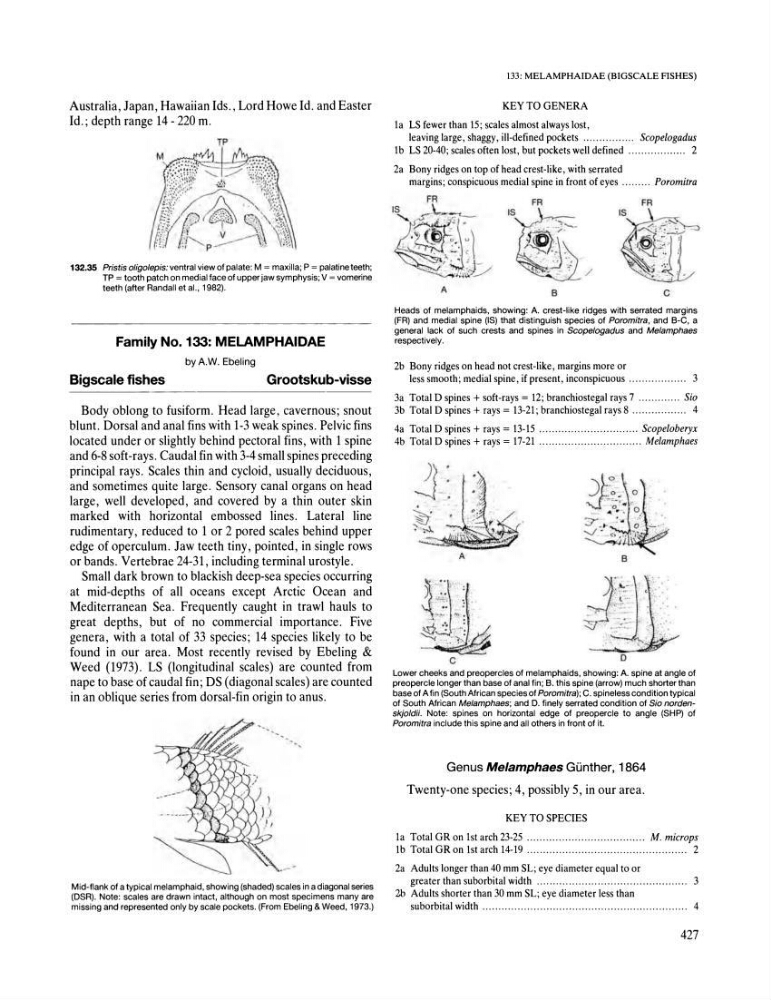
Heads of mel am ph aids, showing: A. crest-like ridges with serrated margins
(FR) and medial spine (IS) that distinguish species of Poromitra, and B-C, a
general lack of such crests and spines in Scopelogadus and Melamphaes
respectively.
2b Bony ridges on head not crest-like, margins more or
less smooth; medial spine, if present, inconspicuous ........... ....... 3
3a Total D spines + soft-rays = 12; branchiostegal rays 7 ............. Sio
3b Total D spines + rays = 13-21; branchiostegal rays 8 ................. 4
4a Total D spines + rays = 13-15 ............................... Scopeloberyx
4b Total D spines + rays = 17-21 ................................ Melamphaes
A
B
C
Lower cheeks and preopercles of melamphaids, showing: A. spine at angle of
preopercle longer than base of anal fin; B. this spine (arrow) much shorter than
base of A fin (South African species of Poromitra); C. spineless condition typical
of South African Melamphaes; and D. finely serrated condition of Sio nordenskjoldii. Note: spines on horizontal edge of preopercle to angle (SHP) of
Poromitra include this spine and all others in front of it.
Genus Me/amphaes Gunther, 1864
Twenty-one species; 4, possibly 5, in our area.
KEY TO SPECIES
la Total GR on 1st arch 23-25 ..................................... M. microps
Ib Total GR on 1st arch 14-19 .................................................. 2
2a Adults longer than 40 mm SL; eye diameter equal to or
greater than suborbital width ............................................... 3
2b Adults shorter than 30 mm SL; eye diameter less than
suborbital width ................................................................ 4
427
Id.; depth range 14 - 220 m.
132.35 Pristis oligolepis: ventral view of palate: M = maxilla; P = palatine teeth;
TP = tooth patch on medial face of upper jaw symphysis; V = vomerine
teeth (after Randall et ai., 1982).
Family No. 133: MELAMPHAIDAE
by A.W. Ebeling
Bigscale fishes
Grootskub-visse
Body oblong to fusiform. Head large, cavernous; snout
blunt. Dorsal and anal fins with 1-3 weak spines. Pelvic fins
located under or slightly behind pectoral fins, with 1 spine
and 6-8 soft-rays. Caudal fin with 3-4 small spines preceding
principal rays. Scales thin and cycloid, usually deciduous,
and sometimes quite large. Sensory canal organs on head
large, well developed, and covered by a thin outer skin
marked with horizontal embossed lines. Lateral line
rudimentary, reduced to 1 or 2 pored scales behind upper
edge of operculum. Jaw teeth tiny, pointed, in single rows
or bands. Vertebrae 24-31, including terminal urostyle.
Small dark brown to blackish deep-sea species occurring
at mid-depths of all oceans except Arctic Ocean and
Mediterranean Sea. Frequently caught in trawl hauls to
great depths, but of no commercial importance. Five
genera, with a total of 33 species; 14 species likely to be
found in our area. Most recently revised by Ebeling &
Weed (1973). LS (longitudinal scales) are counted from
nape to base of caudal fin; DS (diagonal scales) are counted
in an oblique series from dorsal-fin origin to anus.
Mid-flank of a typical melamphaid, showing (shaded) scales in a diagonal series
(DSR). Note: scales are drawn intact, although on most specimens many are
missing and represented only by scale pockets. (From Ebeling & Weed, 1973.)
133: MELAMPHAIDAE (BIGSCALE FISHES)
KEY TO GENERA
la LS fewer than 15; scales almost always lost,
leaving large, shaggy, ill-defined pockets ................ Scopelogadus
Ib LS 20-40; scales often lost, but pockets well defined .................. 2
2a Bony ridges on top of head crest-like, with serrated
margins; conspicuous medial spine in front of eyes ......... Poromitra
FR
/
B
C
Heads of mel am ph aids, showing: A. crest-like ridges with serrated margins
(FR) and medial spine (IS) that distinguish species of Poromitra, and B-C, a
general lack of such crests and spines in Scopelogadus and Melamphaes
respectively.
2b Bony ridges on head not crest-like, margins more or
less smooth; medial spine, if present, inconspicuous ........... ....... 3
3a Total D spines + soft-rays = 12; branchiostegal rays 7 ............. Sio
3b Total D spines + rays = 13-21; branchiostegal rays 8 ................. 4
4a Total D spines + rays = 13-15 ............................... Scopeloberyx
4b Total D spines + rays = 17-21 ................................ Melamphaes
A
B
C
Lower cheeks and preopercles of melamphaids, showing: A. spine at angle of
preopercle longer than base of anal fin; B. this spine (arrow) much shorter than
base of A fin (South African species of Poromitra); C. spineless condition typical
of South African Melamphaes; and D. finely serrated condition of Sio nordenskjoldii. Note: spines on horizontal edge of preopercle to angle (SHP) of
Poromitra include this spine and all others in front of it.
Genus Me/amphaes Gunther, 1864
Twenty-one species; 4, possibly 5, in our area.
KEY TO SPECIES
la Total GR on 1st arch 23-25 ..................................... M. microps
Ib Total GR on 1st arch 14-19 .................................................. 2
2a Adults longer than 40 mm SL; eye diameter equal to or
greater than suborbital width ............................................... 3
2b Adults shorter than 30 mm SL; eye diameter less than
suborbital width ................................................................ 4
427