

124: ATELEOPODIDAE (TADPOLE FISHES)
the eye and the length of the V. If this proves to be correct,
then our species would be called Ateleopus loppei with A.
barnardi a synonym. Three nominal species, 1 in our area.
124.4/jimaia loppei
Roule, 1922
ljimaia loppei Roule, 1922: 641 (off Agadir, Morocco in 350 - 400 m);
1928: 14, Fig; Barnard, 1948: 353*; Smith, SFSA No. 188a; Stauche &
Blache, 1964: 48; Franca & Ferreira, 1967: 15*; Penrith, 1969: 72; Karrer,
~1975: 70.
D 9-10; A 78-85; A+C = 84-92; P 12-14; V 1(+3); GR (0-1)+10; LL
38-40, scales only visible when skin removed; adipose D ridge from above
anus to C base; conical knob behind eye, P about as long as D, does not
reach A origin.
Attains about 2 m. Dark brown to black generally,
slightly lighter ventrally; lining of mouth dark; V ray and
fold of skin at angle of mouth pale, iris greyish brown.
Morocco to Cape Peninsula, down to 460 m; common from
Liideritz northwards.
Family No. 125: MIRAPINNIDAE
by E. Bertelsen
Mirapinnids
Mirapinniede
Body elongate . Fins soft-rayed. Dorsal fin opposite anal
fin with origin behind mid-standard length. Pelvic fins jugular with laterally projecting lobes. Cleft of mouth oblique to
sub-vertical. Upper jaw slightly protrusible. Maxilla broad;
one supramaxilla. Teeth tiny. Skin without scales. Vertebrae 42-55 .
Very few post-metamorphic specimens known, the
largest 4-6 cm. Larvae epipelagic in tropical and subtropical
parts of all oceans; adults may be mesopelagic. Three
genera with a total of 4 species (Bertelsen & Marshall, 1956,
1984).
KEY TO GENERA
la Body moderately elongate; head 3.7 in SL;
skin covered with hair-like filaments; no
appendage on C ................................................... . Mirapinna
(Eastern North Atlantic , a single specimen)
Ib Body very elongate; head 6-10 in SL; skin smooth (except
for microscopic papillae); C prolonged into a ribbon-like
streamer, reaching a length of 2-3 times SL ............................. 2
2a V rays 4-5 ................ .. ...................... ....... ...... Eutaeniophorus
2b V rays 8-10 ...... .. ......................................... Parataeniophorus
Genus Eutaeniophorus Bertelsen & Marshall, 1958
Single species; assumed to occur in our area.
125.1 Eutaeniophorus festivus
(Bertelsen & Marshall, 1956)
Taeniophorus festivus Bertelsen & Marshall, 1956: 6, Figs. 3,4, 8 & 9
(Indian Ocean). Eutaeniophorus festivus: Bertelsen & Marshall, 1958: 9.
D 16-20; A 15-18; P 19-24; V 4-5; GR 2+8. Vertebrae 47- 55. Depth
11.5-12.5 (with filled stomach about 4); head 7.7-10 in SL. Stomach
extremely distensible (food: copepods). Caudal streamer less than 25%
SL in larvae less than 10 mm, broken in most larger specimens, but complete and 2-3 times SL in 3 specimens 12-35 mm.
Colour in life purple. Largest preserved specimens
brownish. Largest recorded specimen 53 mm (holotype).
Observed hovering in vertical position. Caught in pelagic
nets in 0 - 200 m. Recorded from all oceans between ca . 20 0 S
and 35°N. Several records from Mozambique Channel, the
southernmost at 24°57'S, 40 0 18'E.
Genus Parataeniophorus Bertelsen & Marshall, 1956
Two species, 1 in our area, the other assumed to occur
here.
KEY TO SPECIES
la D 15-20; A 14-17 ........ .. ... ..... ................................... . P. brevis
Ib D 28-33; A 23-29 .......... ... ....................................... P. gulosus
125.2 Parataeniophorus brevis
Bertelsen & Marshall, 1956
Parataeniophorus brevis Bertelsen & Marshall, 1956: 10, Fig. 7 (southern Mozambique Channel).
D 15-20; A 14-17; Pea. 16-18; V 8-9; GR 3+9. Vertebrae 42-46. Depth
5-7; head 6-10 in SL. Caudal streamer broken in all specimens, length of
remainder subequal to SL in a fish of 29 mm.
r..:...IfIlof.' ...... ,...on...,..j.~U
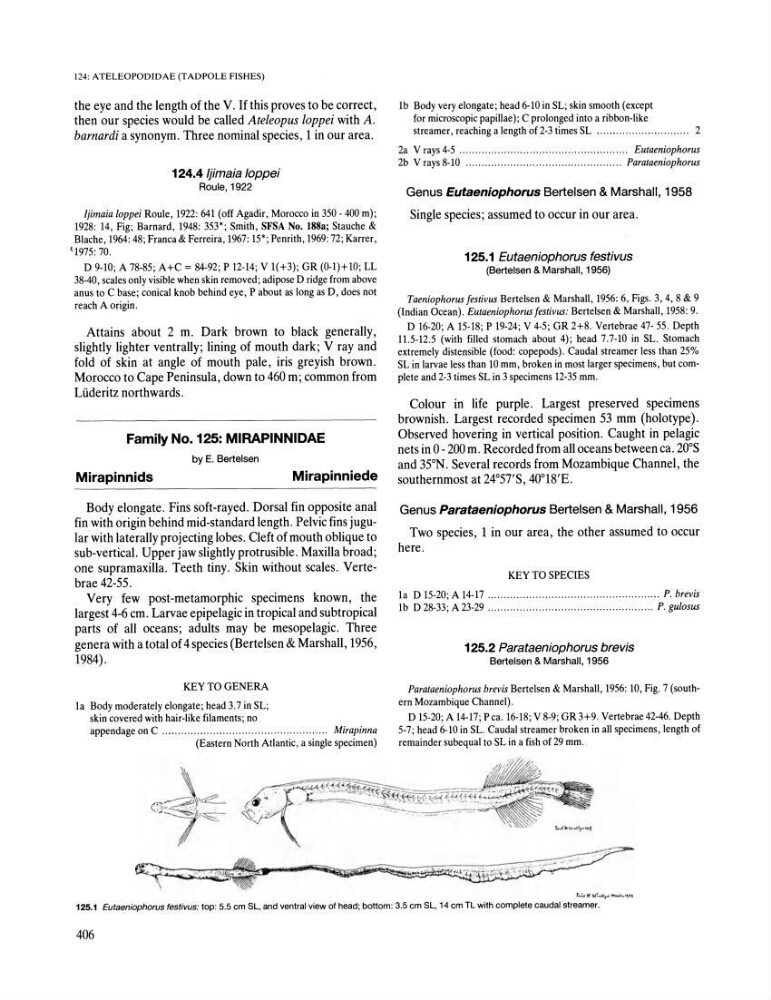
125.1 Eutaeniophorus festivus: top: 5.5 em SL, and ventral view of head; bottom: 3.5 em SL. 14 em TL with complete caudal streamer.
406
the eye and the length of the V. If this proves to be correct,
then our species would be called Ateleopus loppei with A.
barnardi a synonym. Three nominal species, 1 in our area.
124.4/jimaia loppei
Roule, 1922
ljimaia loppei Roule, 1922: 641 (off Agadir, Morocco in 350 - 400 m);
1928: 14, Fig; Barnard, 1948: 353*; Smith, SFSA No. 188a; Stauche &
Blache, 1964: 48; Franca & Ferreira, 1967: 15*; Penrith, 1969: 72; Karrer,
~1975: 70.
D 9-10; A 78-85; A+C = 84-92; P 12-14; V 1(+3); GR (0-1)+10; LL
38-40, scales only visible when skin removed; adipose D ridge from above
anus to C base; conical knob behind eye, P about as long as D, does not
reach A origin.
Attains about 2 m. Dark brown to black generally,
slightly lighter ventrally; lining of mouth dark; V ray and
fold of skin at angle of mouth pale, iris greyish brown.
Morocco to Cape Peninsula, down to 460 m; common from
Liideritz northwards.
Family No. 125: MIRAPINNIDAE
by E. Bertelsen
Mirapinnids
Mirapinniede
Body elongate . Fins soft-rayed. Dorsal fin opposite anal
fin with origin behind mid-standard length. Pelvic fins jugular with laterally projecting lobes. Cleft of mouth oblique to
sub-vertical. Upper jaw slightly protrusible. Maxilla broad;
one supramaxilla. Teeth tiny. Skin without scales. Vertebrae 42-55 .
Very few post-metamorphic specimens known, the
largest 4-6 cm. Larvae epipelagic in tropical and subtropical
parts of all oceans; adults may be mesopelagic. Three
genera with a total of 4 species (Bertelsen & Marshall, 1956,
1984).
KEY TO GENERA
la Body moderately elongate; head 3.7 in SL;
skin covered with hair-like filaments; no
appendage on C ................................................... . Mirapinna
(Eastern North Atlantic , a single specimen)
Ib Body very elongate; head 6-10 in SL; skin smooth (except
for microscopic papillae); C prolonged into a ribbon-like
streamer, reaching a length of 2-3 times SL ............................. 2
2a V rays 4-5 ................ .. ...................... ....... ...... Eutaeniophorus
2b V rays 8-10 ...... .. ......................................... Parataeniophorus
Genus Eutaeniophorus Bertelsen & Marshall, 1958
Single species; assumed to occur in our area.
125.1 Eutaeniophorus festivus
(Bertelsen & Marshall, 1956)
Taeniophorus festivus Bertelsen & Marshall, 1956: 6, Figs. 3,4, 8 & 9
(Indian Ocean). Eutaeniophorus festivus: Bertelsen & Marshall, 1958: 9.
D 16-20; A 15-18; P 19-24; V 4-5; GR 2+8. Vertebrae 47- 55. Depth
11.5-12.5 (with filled stomach about 4); head 7.7-10 in SL. Stomach
extremely distensible (food: copepods). Caudal streamer less than 25%
SL in larvae less than 10 mm, broken in most larger specimens, but complete and 2-3 times SL in 3 specimens 12-35 mm.
Colour in life purple. Largest preserved specimens
brownish. Largest recorded specimen 53 mm (holotype).
Observed hovering in vertical position. Caught in pelagic
nets in 0 - 200 m. Recorded from all oceans between ca . 20 0 S
and 35°N. Several records from Mozambique Channel, the
southernmost at 24°57'S, 40 0 18'E.
Genus Parataeniophorus Bertelsen & Marshall, 1956
Two species, 1 in our area, the other assumed to occur
here.
KEY TO SPECIES
la D 15-20; A 14-17 ........ .. ... ..... ................................... . P. brevis
Ib D 28-33; A 23-29 .......... ... ....................................... P. gulosus
125.2 Parataeniophorus brevis
Bertelsen & Marshall, 1956
Parataeniophorus brevis Bertelsen & Marshall, 1956: 10, Fig. 7 (southern Mozambique Channel).
D 15-20; A 14-17; Pea. 16-18; V 8-9; GR 3+9. Vertebrae 42-46. Depth
5-7; head 6-10 in SL. Caudal streamer broken in all specimens, length of
remainder subequal to SL in a fish of 29 mm.
r..:...IfIlof.' ...... ,...on...,..j.~U
125.1 Eutaeniophorus festivus: top: 5.5 em SL, and ventral view of head; bottom: 3.5 em SL. 14 em TL with complete caudal streamer.
406