

Order ATHERINIFORMES
This order is an ill-defined assemblage of 6 families that
represents the residue after the Cyprinodontiformes and
the Beloniformes are subtracted from the taxon Atherinomorpha. See Rosen and Parenti, 1981, for a discussion of
the classification of these fishes.
Two families occur in our area. They can be recognised
by the following combination of characters: two dorsal fins,
the first with 3 to 8 weak spines; anal fin with one weak spine
and 11 to 28 soft-rays; pectoral fins inserted high on the
body; pelvic fins with a spine and 5 soft-rays; pelvic fin
origin between verticals at pectoral base and first dorsal fin
origin; scales cycloid; lateral line absent; mouth small,
terminal, not extending past vertical at middle of eye;
rostral cartilage not attached to premaxillae; egg large,
demersal, with adhesive filaments and many oil droplets
that coalesce at the vegetative pole.
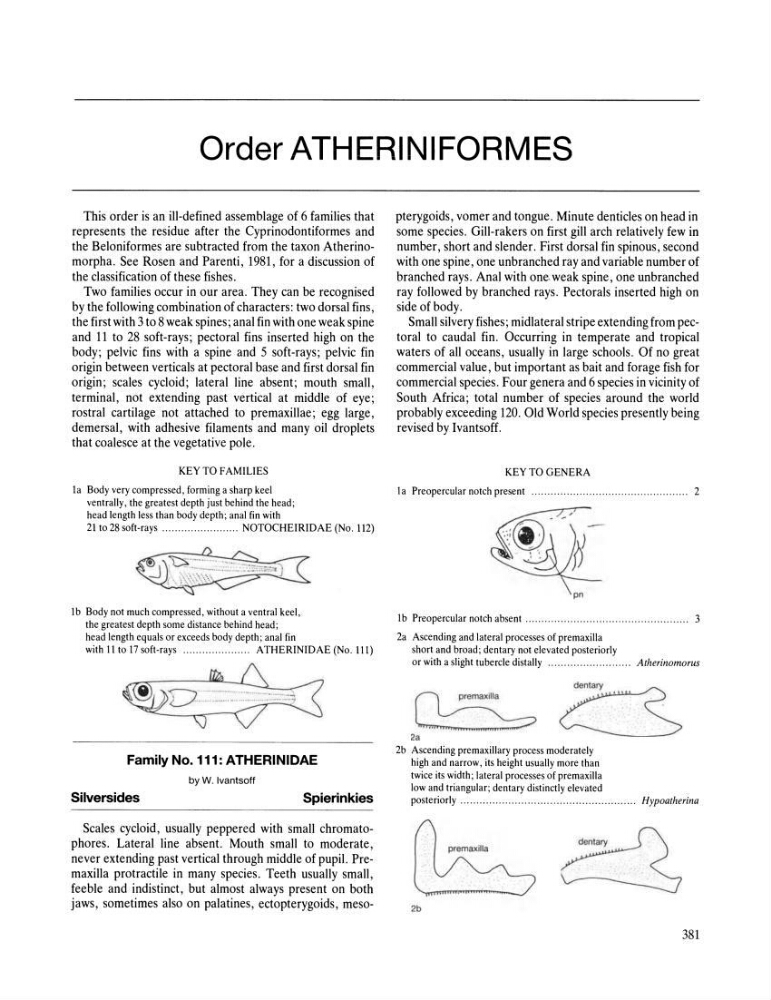
KEY TO FAMILIES
la Body very compressed, forming a sharp keel
ventrally, the greatest depth just behind the head;
head length less than body depth; anal fin with
21 to 28 soft-rays ........................ NOTOCHEIRIDAE (No. 112)
Ib Body not much compressed, without a ventral keel,
the greatest depth some distance behind head;
head length equals or exceeds body depth; anal fin
with 11 to 17 soft-rays ..................... ATHERINIDAE (No. 111)
. . ................................... -'" ... -~
~~
~D~ m > . . . . . . . --'
Family No.111: ATHERINIDAE
by W. Ivantsoff
Silversides
Spierinkies
Scales cycloid, usually peppered with small chromatophores. Lateral line absent. Mouth small to moderate,
never extending past vertical through middle of pupil. Premaxilla protractile in many species. Teeth usually small,
feeble and indistinct, but almost always present on both
jaws, sometimes also on palatines, ectopterygoids, mesopterygoids, vomer and tongue. Minute denticles on head in
some species. Gill-rakers on first gill arch relatively few in
number, short and slender. First dorsal fin spinous, second
with one spine, one unbranched ray and variable number of
branched rays. Anal with one,weak spine, one unbranched
ray followed by branched rays. Pectorals inserted high on
side of body.
Small silvery fishes; midlateral stripe extending from pectoral to caudal fin. Occurring in temperate and tropical
waters of all oceans, usually in large schools. Of no great
commercial value, but important as bait and forage fish for
commercial species. Four genera and 6 species in vicinity of
South Africa; total number of species around the world
probably exceeding 120. Old World species presently being
revised by Ivantsoff.
KEY TO GENERA
1 a Preopercular notch present ...................................................... 2
1 b Preopercular notch absent........................................................ 3
2a Ascending and lateral processes of premaxilla
short and broad; dentary not elevated posteriorly
or with a slight tubercle distally .............................. Atherinomorus
~
2a
2b Ascending premaxillary process moderately
high and narrow, its height usually more than
twice its width; lateral processes of premaxilla
low and triangular; dentary distinctly elevated
posteriorly ............................................................................ Hypoatherina
premaxilla
2b
381
This order is an ill-defined assemblage of 6 families that
represents the residue after the Cyprinodontiformes and
the Beloniformes are subtracted from the taxon Atherinomorpha. See Rosen and Parenti, 1981, for a discussion of
the classification of these fishes.
Two families occur in our area. They can be recognised
by the following combination of characters: two dorsal fins,
the first with 3 to 8 weak spines; anal fin with one weak spine
and 11 to 28 soft-rays; pectoral fins inserted high on the
body; pelvic fins with a spine and 5 soft-rays; pelvic fin
origin between verticals at pectoral base and first dorsal fin
origin; scales cycloid; lateral line absent; mouth small,
terminal, not extending past vertical at middle of eye;
rostral cartilage not attached to premaxillae; egg large,
demersal, with adhesive filaments and many oil droplets
that coalesce at the vegetative pole.
KEY TO FAMILIES
la Body very compressed, forming a sharp keel
ventrally, the greatest depth just behind the head;
head length less than body depth; anal fin with
21 to 28 soft-rays ........................ NOTOCHEIRIDAE (No. 112)
Ib Body not much compressed, without a ventral keel,
the greatest depth some distance behind head;
head length equals or exceeds body depth; anal fin
with 11 to 17 soft-rays ..................... ATHERINIDAE (No. 111)
. . ................................... -'" ... -~
~~
~D~ m > . . . . . . . --'
Family No.111: ATHERINIDAE
by W. Ivantsoff
Silversides
Spierinkies
Scales cycloid, usually peppered with small chromatophores. Lateral line absent. Mouth small to moderate,
never extending past vertical through middle of pupil. Premaxilla protractile in many species. Teeth usually small,
feeble and indistinct, but almost always present on both
jaws, sometimes also on palatines, ectopterygoids, mesopterygoids, vomer and tongue. Minute denticles on head in
some species. Gill-rakers on first gill arch relatively few in
number, short and slender. First dorsal fin spinous, second
with one spine, one unbranched ray and variable number of
branched rays. Anal with one,weak spine, one unbranched
ray followed by branched rays. Pectorals inserted high on
side of body.
Small silvery fishes; midlateral stripe extending from pectoral to caudal fin. Occurring in temperate and tropical
waters of all oceans, usually in large schools. Of no great
commercial value, but important as bait and forage fish for
commercial species. Four genera and 6 species in vicinity of
South Africa; total number of species around the world
probably exceeding 120. Old World species presently being
revised by Ivantsoff.
KEY TO GENERA
1 a Preopercular notch present ...................................................... 2
1 b Preopercular notch absent........................................................ 3
2a Ascending and lateral processes of premaxilla
short and broad; dentary not elevated posteriorly
or with a slight tubercle distally .............................. Atherinomorus
~
2a
2b Ascending premaxillary process moderately
high and narrow, its height usually more than
twice its width; lateral processes of premaxilla
low and triangular; dentary distinctly elevated
posteriorly ............................................................................ Hypoatherina
premaxilla
2b
381