

Organisation. As explained to anglers, anyone is entitled to
use a pet name in conversation, for a child or anything else,
but when it comes to publication or clarification, one legal
SCIENTIFIC NOMENCLATURE AND CLASSIFICATION
name should be available and used. It is hoped that the
common names in this book will be used in all these cases.
Scientific nomenclature and classification
For every described species of fish, there is only one valid
scientific name. The scientific name comprises two Latin
(or Latinised) words, which together make a unique species
name that can be used only for that particular species. The
species Epinephelus guaza, our common yellowbelly
rockcod (Family Serranidae), was described and named by
the famous Swedish biologist Carl von Linne (Linnaeus) in
1758. The International Code of Zoological Nomenclature
stipulates that the starting point for zoological names is the
tenth edition of Linnaeus's catalogue of animals, called
Sys!ema Naturae, which is assigned the publication date of
January 1, 1758. Names published before 1758 are not allowed, unless they have been published in a valid description after 1758. Some species have been given two or more
scientific names, in which event the oldest name is usually
considered the valid name, and the later (more recently
published) name (or names) are regarded as junior
synonyms.
The first term in the species name is the name of the genus
to which that species is now assigned in the present classification used in this book. Thus, the species Epinephelus
guaza (Linnaeus, 1758) is here put in the genus
Epinephelus. It was originally described by Linnaeus in the
genus Labrus, and we indicate that the species is now assigned to a genus other than its original one by placing the
author's name in parentheses. Citation ofthe author's name
and date of publication with the species name is optional,
but they should be given at least once in every publication
that uses the scientific name.
The genus (if not monotypic) comprises two or more
closely related species; in our area, we have 35 species of
Epinephelus. The classification that is based on the inferred
evolutionary (phylogenetic) relationships of Epinephelus
guaza and other fishes comprises a hierarchy of taxa (singular taxon) or categories, with each higher category being
more inclusive than the one below.
Additional categories, such as subgenus or subspecies,
are also sometimes used. Note that the genus name is spelt
with a capital letter , but the first letter of the species name
(even if based on a proper noun) is not capitalised.
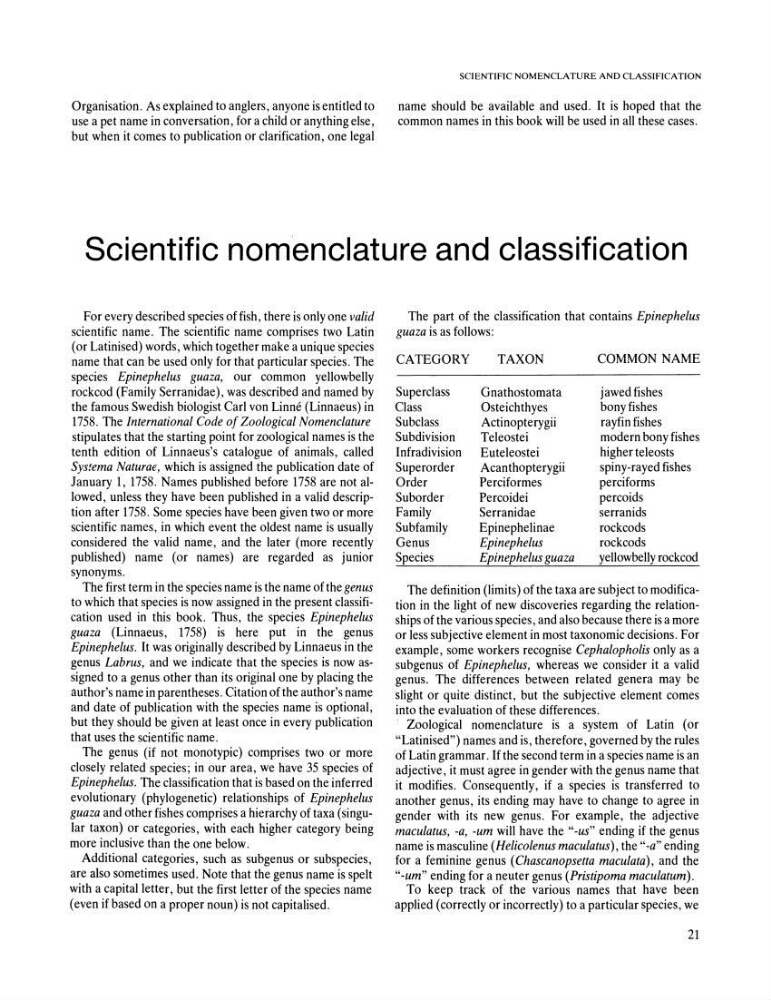
The part of the classification that contains Epinephelus
guaza is as follows:
CATEGORY
TAXON
COMMON NAME
Superclass
Gnathostomata
j awed fishes
Class
Osteichthyes
bony fishes
Subclass
Actinopterygii
rayfin fishes
Subdivision
Teleostei
modern bony fishes
Infradivision
Euteleostei
higher teleosts
Superorder
Acanthopterygii
spiny-rayed fishes
Order
Perciformes
perciforms
Suborder
Percoidei
percoids
Family
Serranidae
serranids
Subfamily
Epinephelinae
rockcods
Genus
Epinephelus
rockcods
Species
Epinephelus guaza
yellowbelly rockcod
The definition (limits) of the taxa are subject to modification in the light of new discoveries regarding the relationships of the various species, and also because there is a more
or less subjective element in most taxonomic decisions. For
example, some workers recognise Cephalopholis only as a
subgenus of Epinephelus, whereas we consider it a valid
genus. The differences between related genera may be
slight or quite distinct, but the subjective element comes
into the evaluation of these differences.
Zoological nomenclature is a system of Latin (or
"Latinised") names and is, therefore, governed by the rules
of Latin grammar. If the second term in a species name is an
adjective, it must agree in gender with the genus name that
it modifies. Consequently, if a species is transferred to
another genus, its ending may have to change to agree in
gender with its new genus. For example, the adjective
maculatus, -a, -um will have the "-us" ending if the genus
name is masculine (Helicolenus maculatus) , the "-a" ending
for a feminine genus (Chascanopsetta maculata), and the
"-um" ending for a neuter genus (Pristipoma maculatum).
To keep track of the various names that have been
applied (correctly or incorrectly) to a particular species, we
21
use a pet name in conversation, for a child or anything else,
but when it comes to publication or clarification, one legal
SCIENTIFIC NOMENCLATURE AND CLASSIFICATION
name should be available and used. It is hoped that the
common names in this book will be used in all these cases.
Scientific nomenclature and classification
For every described species of fish, there is only one valid
scientific name. The scientific name comprises two Latin
(or Latinised) words, which together make a unique species
name that can be used only for that particular species. The
species Epinephelus guaza, our common yellowbelly
rockcod (Family Serranidae), was described and named by
the famous Swedish biologist Carl von Linne (Linnaeus) in
1758. The International Code of Zoological Nomenclature
stipulates that the starting point for zoological names is the
tenth edition of Linnaeus's catalogue of animals, called
Sys!ema Naturae, which is assigned the publication date of
January 1, 1758. Names published before 1758 are not allowed, unless they have been published in a valid description after 1758. Some species have been given two or more
scientific names, in which event the oldest name is usually
considered the valid name, and the later (more recently
published) name (or names) are regarded as junior
synonyms.
The first term in the species name is the name of the genus
to which that species is now assigned in the present classification used in this book. Thus, the species Epinephelus
guaza (Linnaeus, 1758) is here put in the genus
Epinephelus. It was originally described by Linnaeus in the
genus Labrus, and we indicate that the species is now assigned to a genus other than its original one by placing the
author's name in parentheses. Citation ofthe author's name
and date of publication with the species name is optional,
but they should be given at least once in every publication
that uses the scientific name.
The genus (if not monotypic) comprises two or more
closely related species; in our area, we have 35 species of
Epinephelus. The classification that is based on the inferred
evolutionary (phylogenetic) relationships of Epinephelus
guaza and other fishes comprises a hierarchy of taxa (singular taxon) or categories, with each higher category being
more inclusive than the one below.
Additional categories, such as subgenus or subspecies,
are also sometimes used. Note that the genus name is spelt
with a capital letter , but the first letter of the species name
(even if based on a proper noun) is not capitalised.
The part of the classification that contains Epinephelus
guaza is as follows:
CATEGORY
TAXON
COMMON NAME
Superclass
Gnathostomata
j awed fishes
Class
Osteichthyes
bony fishes
Subclass
Actinopterygii
rayfin fishes
Subdivision
Teleostei
modern bony fishes
Infradivision
Euteleostei
higher teleosts
Superorder
Acanthopterygii
spiny-rayed fishes
Order
Perciformes
perciforms
Suborder
Percoidei
percoids
Family
Serranidae
serranids
Subfamily
Epinephelinae
rockcods
Genus
Epinephelus
rockcods
Species
Epinephelus guaza
yellowbelly rockcod
The definition (limits) of the taxa are subject to modification in the light of new discoveries regarding the relationships of the various species, and also because there is a more
or less subjective element in most taxonomic decisions. For
example, some workers recognise Cephalopholis only as a
subgenus of Epinephelus, whereas we consider it a valid
genus. The differences between related genera may be
slight or quite distinct, but the subjective element comes
into the evaluation of these differences.
Zoological nomenclature is a system of Latin (or
"Latinised") names and is, therefore, governed by the rules
of Latin grammar. If the second term in a species name is an
adjective, it must agree in gender with the genus name that
it modifies. Consequently, if a species is transferred to
another genus, its ending may have to change to agree in
gender with its new genus. For example, the adjective
maculatus, -a, -um will have the "-us" ending if the genus
name is masculine (Helicolenus maculatus) , the "-a" ending
for a feminine genus (Chascanopsetta maculata), and the
"-um" ending for a neuter genus (Pristipoma maculatum).
To keep track of the various names that have been
applied (correctly or incorrectly) to a particular species, we
21